Does a Rabbit Need a Water Fountain?
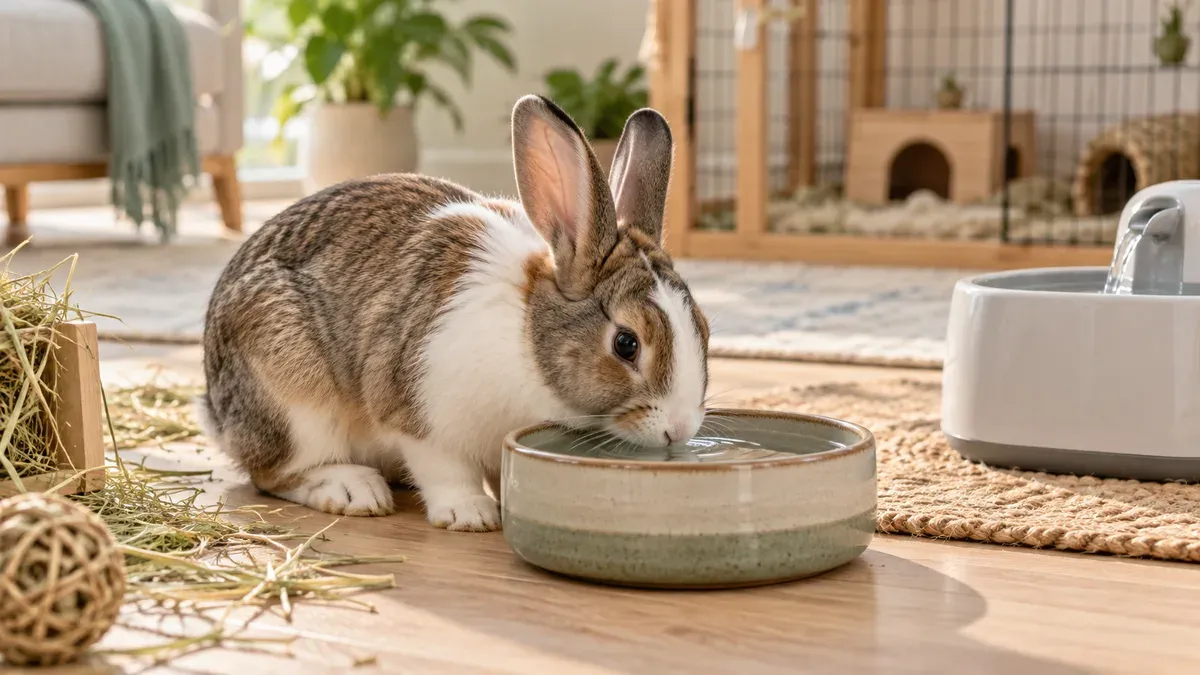
No, a rabbit does not need a water fountain, and in most cases one is best avoided. A wide, heavy bowl rinsed daily covers the need perfectly, for a few pounds, with no component capable of failing.
The main reason is not price, it is the cable. A fountain means a mains supply immediately next to an animal that chews by nature. That is a constraint cat fountains — which is what these devices are actually designed for — have never had to deal with.
Why the bowl remains the right answer
The comparison between the two classic vessels is already settled: the bowl beats the bottle, mainly because a failed bottle is invisible. The detail is in water bottle or bowl for a rabbit.
The fountain arrives as a third device, and it inherits exactly the flaw that rules out the bottle: when it stops, nothing tells you. A pump that dies, a plug knocked out by a paw, a level dropped below the intake — in every case the rabbit has no water and you cannot see it as you walk into the room. An upturned bowl, you can.
The four practical problems with a fountain
1. The cable. This is the deal-breaker. Rabbits chew cables; it is normal behaviour and it cannot be trained out, as covered in how to protect cables from rabbits. Deliberately running a live wire into the pen contradicts everything else we recommend about rabbit-proofing.
If you install one anyway, the cable must be fully enclosed in rigid trunking and the unit placed outside the pen — which removes much of the point.
2. The noise. A pump runs continuously. For a prey species whose hearing is a survival tool, constant noise close to the resting area is not neutral. Some rabbits habituate; others avoid the area — which means avoiding the water.
3. Maintenance. Filters to replace, a pump to dismantle and descale, awkward corners. In a pen where hay, bedding and dust fall constantly, a fountain clogs faster than a bowl and is far harder to clean.
4. Cost. Purchase price, recurring filters, electricity — against a ceramic bowl that costs the price of a sandwich and lasts years.
The one case where the question is worth asking
A rabbit that visibly drinks little. But before buying a device, take the steps in order:
- Check the vessel. If you are using a bottle, switch to a wide bowl: that is the change with the biggest effect, and the transition method is in water bottle or bowl for a rabbit.
- Check the water itself: fresh, changed daily, in a rinsed container.
- Add water points rather than sophistication. Two bowls in two places beat one clever device.
- Check the diet. A rabbit eating plenty of greens mechanically drinks less, and that is not a problem. Intake benchmarks are in how much water does a rabbit drink.
- See a vet if the drop is real and recent.
That last point matters most. A clear change in water intake — down or up — is a health signal, not an equipment question. A rabbit that stops drinking belongs in my rabbit is not drinking, and one drinking far more than before in my rabbit is drinking a lot. Buying a fountain in those situations masks a symptom.
If you install one anyway
- Put the unit outside the pen, with only the drinking basin reachable.
- Fully enclose the cable in rigid trunking.
- Keep a conventional bowl alongside it, permanently: that is your backup if it fails.
- Check the level and that it is running every day, exactly as you would a bowl.
- Keep to the filter replacement schedule.
The backup bowl is not excessive caution: it is what separates a comfort accessory from a single point of failure.
What to buy instead
For the same money, a wide ceramic bowl — heavy, stable, impossible to tip with a paw, rinsable in ten seconds and with no moving parts. That is the equipment that covers the need, and it is among the genuinely essential accessories.
The rest of the budget is better spent on hay, which is the real determinant of digestive and dental health.
Sources
- Rabbit health and welfare, RSPCA — core needs, including constant access to fresh water.
- Nutrition of rabbits, MSD Veterinary Manual — drinking and ration benchmarks.
Where to go next
If your original question was about the vessel, water bottle or bowl for a rabbit gives the full verdict and the transition method. If it was about quantity, how much water does a rabbit drink gives the benchmarks and the signs of dehydration. And if your rabbit is visibly drinking less than before, the page to read is my rabbit is not drinking. The rest of our equipment guidance sits in the rabbit accessories section and the rabbit species profile.
Frequently asked questions
Are cat fountains suitable for rabbits?
Technically yes, and that is what most brands sell, since almost nothing is designed for rabbits. But the issue is not compatibility, it is context: a cat does not chew the power cable, a rabbit does. The risk is simply not comparable between the two species.
Does a fountain keep water cleaner than a bowl?
Not in a rabbit pen. Hay, bedding and dust fall into a fountain's reservoir exactly as they fall into a bowl, except they end up in the pump and filter instead of staying visible at the bottom. A dirty bowl is obvious and rinses in ten seconds; a clogged fountain is noticed later.
My rabbit does not drink much — could a fountain help?
That is the one case where the question is worth asking, but work through it in order. Check the vessel first — a wide bowl beats a bottle comfortably — then the freshness of the water, its position and the number of water points. Above all, a drop in intake in a rabbit that used to drink normally is a reason to see a vet, not an equipment problem.
Do fountain filters need changing?
Yes, regularly, per the manufacturer's schedule, and it is a recurring cost to factor in. A saturated filter no longer cleans anything and can instead become a bacterial reservoir. That is an extra maintenance burden compared with a bowl you rinse daily.