Water bottle or bowl for a rabbit: which should you choose?
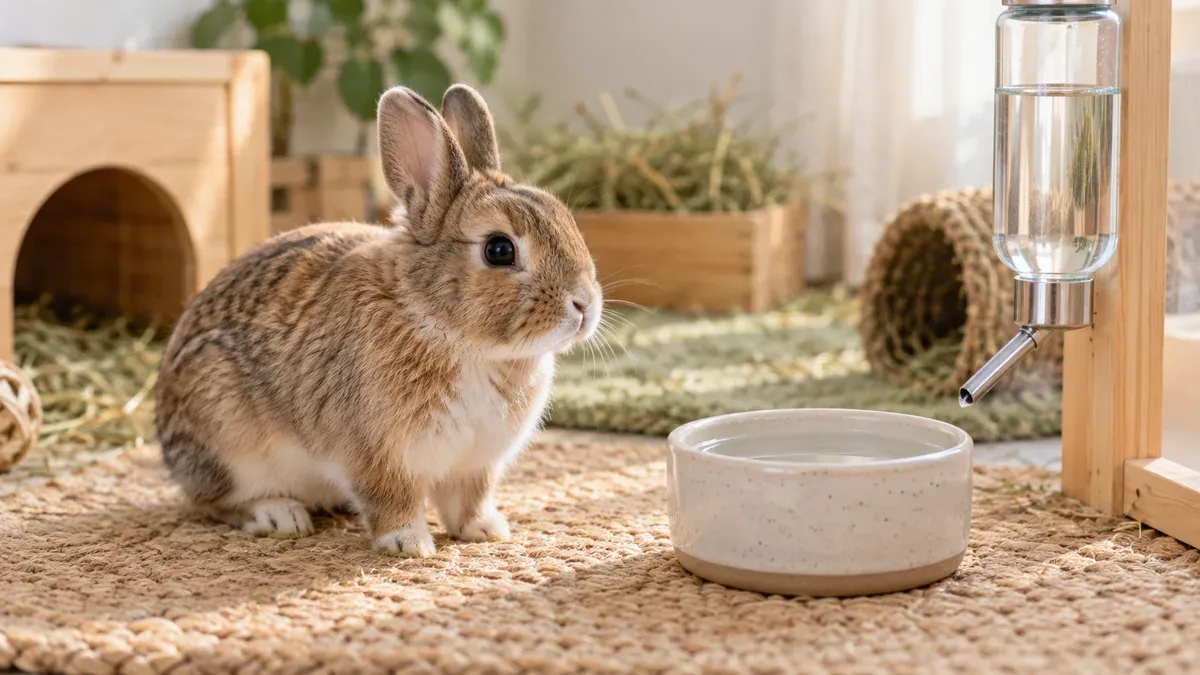
For a rabbit’s water, a bowl is the better default: the rabbit drinks head down, in its natural posture, with no limit on flow. The sipper bottle keeps a genuine role — as a backup, for travel, or when the bowl ends up upturned every single day — provided you check that it actually flows.
So the real question is not “which of the two is good”, but which model to buy, where to put it, how to keep it clean and how to move from one to the other without the rabbit drinking less during the changeover. Expected quantities are covered in how much water does a rabbit drink.
What each container actually changes
| Criterion | Bowl | Sipper bottle |
|---|---|---|
| Drinking posture | Natural, head down | Head raised, neck extended |
| Flow | Unlimited | Limited by the ball, varies by model |
| Water cleanliness | Needs watching: hay, litter, dust | Good, the water stays enclosed |
| Possible failure | Tipping over, immediately visible | Airlock or seized ball, invisible |
| Checking intake | Easy with a measuring jug | Possible but distorted by leaks |
| Cleaning | Quick, the base is reachable | Neck and spout hard to scrub |
The decisive line is the failure one: a tipped bowl is obvious the moment you walk into the room, whereas a failed bottle shows nothing. That is the main reason a rabbit can go a whole day without drinking and nobody notices.
That leaves a third vessel, the circulating fountain. It adds nothing a wide, heavy bowl does not already cover, and it puts a power cable inside the pen of an animal that chews: the detail is in does a rabbit need a water fountain.
Choosing a bowl: four criteria that matter
- The material. Glazed ceramic or stainless steel. Plastic scratches, holds biofilm, takes on smells, and often ends up chewed.
- Weight or fixing. A heavy bowl with a wide base, or a model clipped to the pen panel, survives a paw. If tipping becomes a daily game, the causes and fixes are in why does my rabbit tip over its bowl.
- The shape. Wide and shallow rather than tall and narrow: a rabbit that has to plunge its head in soaks its chin and dewlap, which irritates the skin over time.
- The position. Away from the hay rack and the litter tray, on a spot the rabbit does not scrabble at. A bowl under the hay fills with strands within the hour; next to the tray, it catches kicked-out litter. How to organise the toilet corner is in how to clean a rabbit litter box.
Using a bottle properly, if you keep one
A bottle is not to be banned, it is to be checked. Three failures come up again and again:
- Airlock: a bubble stops the water coming down. The level no longer drops and the rabbit licks without getting anything.
- A ball seized by limescale or plant residue, making suction too hard for an old or weakened rabbit.
- A slow leak that empties the bottle into the bedding and creates the illusion of a rabbit that drank a lot.
The check takes five seconds: push the ball with a fingertip every morning, confirm a drop forms, then note the level. A bottle needs a brush, not just a rinse — the spout and the neck are the first places to fur up.
One practical point: on the move, the bottle regains the advantage, since it does not spill inside the carrier. How to organise a journey is described in how to transport a rabbit by car.
Switching from bottle to bowl without a drop in intake
This is the riskiest moment, because a rabbit used to a sipper may ignore a bowl for several days.
- Add the bowl without removing the bottle. Put it elsewhere in the pen, filled to the brim: a rabbit spots a water surface more easily when it is close to the rim.
- Leave both in place for one to two weeks, long enough for the bowl to become the container used spontaneously.
- Measure instead of guessing. Fill from a measuring jug and note what is missing over two or three consecutive days, as set out in my rabbit is not drinking.
- Remove the bottle only once the bowl visibly drops every day.
Throughout the changeover, keep an eye on the greens: a rabbit eating plenty of fresh vegetables naturally drinks less, which can mask an ignored bowl (what greens to give a rabbit every day).
What puts a rabbit off drinking
Before concluding that a rabbit “does not like the bowl”, check these five points, in order:
- A slippery film of biofilm. It forms within a day or two in summer and can be felt before it can be seen. Daily wash in hot water, rinsed well.
- Washing-up liquid residue. A scented trace is enough to make a rabbit give up. Rinse until the smell is completely gone.
- Lukewarm water, left in direct sun or under a lamp. Summer corrections are in how to keep a rabbit cool in summer.
- A container too high for an older or arthritic rabbit. A low rim changes everything: see senior rabbit health.
- A single water point in a shared pen, which a dominant rabbit can monopolise.
Particular cases
- Two rabbits: two water points in two distinct places, without exception. It is also insurance if one of them tips a bowl.
- Senior rabbit: a low, wide, stable bowl, placed on the usual route rather than out of the way.
- Rabbit outdoors in winter: check by hand several times a day, since a bottle spout freezes before the water in a bowl does (keeping a rabbit outdoors, how to keep a rabbit warm in winter).
- Away for several hours: two full containers beat one large one. A single failure must never be able to cut off all access to water.
What not to do
- Sweetening the water or adding flavoured syrup to encourage drinking: it unbalances the gut flora and makes intake impossible to measure.
- Diluting vitamins or a supplement in the drinking water without veterinary advice: the changed taste often lowers intake.
- Taking the water away at night because “it never gets touched anyway”: rabbits are active at dawn and dusk, and much of their drinking happens when you are not there.
- Trusting the level in a bottle without testing the ball: a stable level can mean a failure just as easily as a rabbit that is not drinking.
- Ignoring a sudden rise in intake: that is something to report to the vet, as my rabbit is drinking a lot explains.
Where to go next
One concrete next step: tonight, fill the container from a measuring jug and note the volume, then measure again at the same time tomorrow. Two days are enough to know whether your rabbit is drinking or your equipment is creating the illusion that it is. If the amount looks low, the full check is in my rabbit is not drinking; if you are kitting out a first pen, the complete list is in what accessories are truly essential for a rabbit. Our other equipment guides are in the rabbit accessories section and on the rabbit species page.
Sources and references
Frequently asked questions
Should I keep both a bowl and a bottle permanently?
It is sound insurance, and the best arrangement during a switch, in summer, and for a rabbit left alone for several hours. Two water points in two different places stop a tipped bowl, an airlocked bottle or a companion blocking access from leaving the rabbit without water all day. Both need daily cleaning, otherwise the second one is just another dirty container.
What size bowl should I get for a rabbit?
A wide, shallow bowl the rabbit can drink from without dipping its ears or soaking its chin, and heavy enough not to go over with one paw. Volume matters less than stability and width: a small bowl refilled twice a day beats a large reservoir filled once a week and never washed.
How do I stop the water freezing in an outdoor hutch?
No container holds out against frost for long. A bottle freezes sooner than a bowl, because the ball and spout seize up before the body of the container ices over. In cold spells the only reliable method is checking by hand several times a day, refreshing the water each time, and keeping a spare container sheltered from the wind.
Is tap water fine, or should I use bottled water?
Drinkable tap water is fine in the vast majority of cases. What causes problems is almost never the water itself but the container: biofilm at the bottom of the bowl, traces of scented washing-up liquid, a clogged bottle spout. Cleaning daily in hot water and rinsing thoroughly changes intake far more than changing the water source.