Does a rabbit need a hay rack? The straight answer
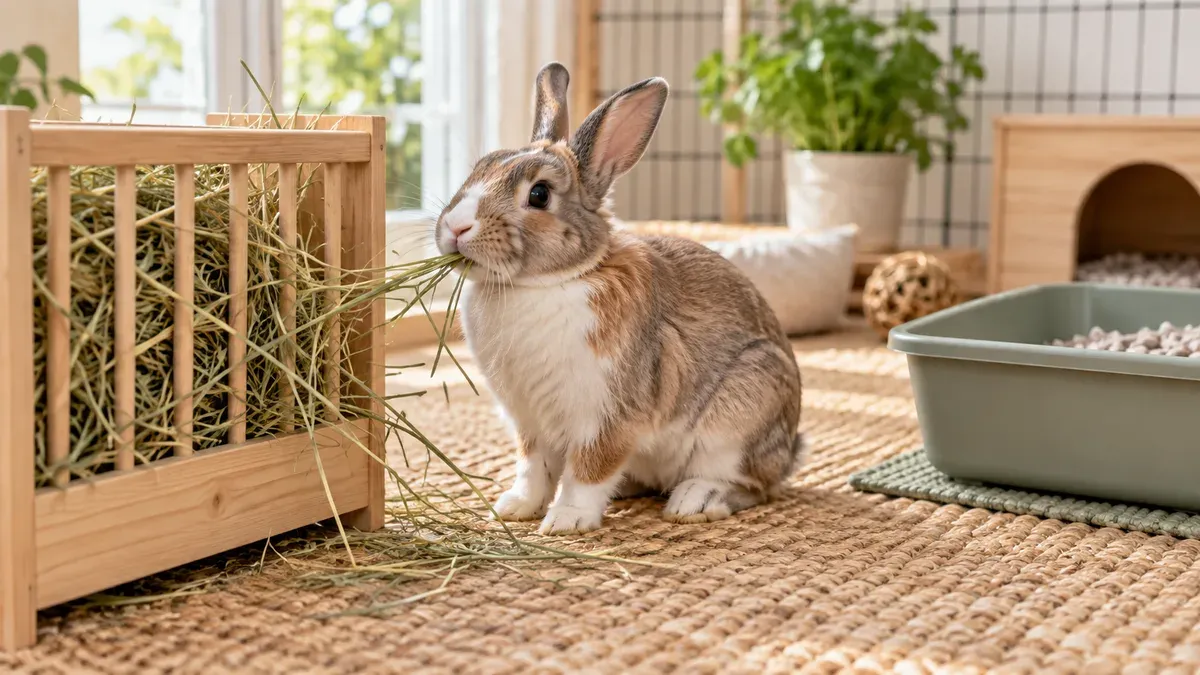
No, a hay rack is not essential. What is essential is hay available at all times, in quantity, within immediate reach of the litter tray. A rack is simply one way of presenting it: it makes housekeeping easier, it does not make hay more appealing or more nourishing.
It earns its place in two specific situations: when hay left on the floor is soiled within hours, and when waste becomes genuinely expensive. It becomes counterproductive the moment it moves hay away from the rabbit or forces it to eat with its head raised.
The hay is compulsory, the holder is not
Hay is the foundation of the diet and must stay available day and night. The RSPCA’s practical benchmark is to offer at least a rabbit-sized bundle each day, while keeping hay available at all times; the feeding principles are set out in how much hay does a rabbit need.
Two practical consequences for choosing a holder:
- It must hold at least a day’s hay. Something you refill three times a day is not a solution, it is a chore.
- It must sit beside the tray. Rabbits readily eat while using their tray; that is also the single most effective lever in litter training, as how to litter train a rabbit explains.
What a hay rack actually gives you
- Clean hay. Left on the floor of the pen, hay is soiled with urine and droppings within hours; a rabbit refuses soiled hay, and the ration goes in the bin.
- Less waste. Rabbits sort constantly: they pull strands out, push coarse stems aside, sleep on the pile. A rack limits the spread without preventing the sorting.
- Floor space. In a small pen every square decimetre counts: the space benchmarks are in what size enclosure for a rabbit.
- Hay that stays dry, which matters in a damp room or next to a rabbit that tips its water bowl over.
Those are four housekeeping benefits. None of them is a health benefit: a rabbit fed from a pile refreshed daily eats just as well, sometimes better.
What a hay rack does not replace
- The natural posture. A floor-level pile lets a rabbit sort through strands. A holder should not force the rabbit to stretch upwards or adopt an uncomfortable posture.
- Occupation. Rummaging through a pile of hay is one of the activities that fill a rabbit’s day, alongside those described in how to keep a bored rabbit busy.
- Daily refreshing. A rack filled once a week gives compacted, dusty hay that the rabbit ignores. Hay quality and condition matter more than the holder, as timothy or meadow hay: which to choose shows.
Comparing ways to present hay
| Presentation | Waste | Hay cleanliness | Amount eaten | Who it suits |
|---|---|---|---|---|
| Large pile in the litter tray | Looks high, is low in practice | Moderate, refresh daily | The best | Almost every rabbit |
| Pile on the floor in a set corner | High | Poor in a small pen | Good | Large spaces, floors cleaned often |
| Vertical rack against the tray | Low | Good | Good | Small pens, hay soiled quickly |
| Rack fixed high on the wall | Low | Good | Reduced | No common case |
| Hay ball or hanging globe | Low | Good | Very reduced | Occasional enrichment only |
| Cardboard box filled with hay | Moderate | Good | Very good | Rabbits that dig and sort a lot |
The cardboard box, routinely overlooked, does two jobs at once: the ration and the activity. It is replaced when dirty, at no cost.
When a hay rack is a bad idea
- For an older or stiff rabbit. Stretching up for hay becomes uncomfortable, and intake falls without any obvious cause; monitoring at that age is described in senior rabbit health.
- When it is mounted too high. Hay pulled from above head height drops dust and debris into the eyes, and tires the rabbit before it has eaten its ration.
- When it is far from the tray. A rabbit will not cross its pen for a snack; hay is eaten opportunistically, where it rests or toilets.
- When the bars are wide and spaced. A rabbit that pushes its head or a foot between two bars can get stuck; with that kind of design, an open container is the safer choice.
- When it becomes an excuse for infrequent refills. A large dispenser filled on Monday gives compacted, dusty hay by Thursday.
What makes a hay rack work
- Hay reachable at head height, with the rabbit sitting, without stretching upwards.
- Capacity of at least one day’s ration, to avoid constant refills.
- A wide opening, with no spaced bars a head or a foot can slip through.
- Position against the litter tray, or immediately next to it: this is the single factor with the biggest effect on intake. Choosing the tray itself is covered in the best litter tray for rabbits.
- Washable, dismantlable material, since hay leaves dust and sometimes urine behind.
- Daily refilling, with the compacted bottom layer cleared out once a week.
Very fine hay, or hay from the bottom of the bag, releases plenty of dust whatever the holder; if your rabbit sneezes or shakes its head every time it visits the rack, the question shifts to the environment and is handled in my rabbit keeps shaking its head.
If your rabbit eats less hay since the rack went in
Test before interpreting: temporarily take the rack out and put a large pile of hay back in the tray, changing nothing else — same hay, same bedding, same routine.
- Intake recovers: the holder was the problem. Move it closer to the tray, lower it, or drop it.
- Intake does not quickly return to its usual level: do not assume the holder is the cause; seek veterinary advice. The possible reasons, dental problems included, are sorted in why has my rabbit stopped eating hay and dental malocclusion in rabbits.
An unusual drop in hay intake can indicate dental pain or another health problem and warrants prompt veterinary advice.
Where to go next
A concrete next step: tonight, measure the distance between the hay and the litter tray. If it is greater than the length of your rabbit lying down, bring the two together before buying anything — it is the free adjustment that changes hay intake the most. For the rest of the kit, what accessories are truly essential for a rabbit separates the useful from the superfluous, and looking after the tray corner is covered in how to clean a rabbit litter box. Our other guides are gathered in the rabbit accessories section and on the rabbit species page.
Source
Frequently asked questions
Can I skip a hay rack altogether?
Yes. A pile of hay refreshed daily in or beside the litter tray does the same job, and matches how rabbits actually eat: head at floor level, sorting through the strands. A rack is a housekeeping convenience, not equipment a rabbit's health depends on.
Is a hanging hay ball a good choice?
It is the least effective way to present everyday hay. It holds very little, usually makes the rabbit stretch upwards, and empties slowly, which suggests the ration has been eaten when it has mostly been compacted. Keep it for occasional enrichment, never as the main hay supply.
Should hay go in the litter tray or beside it?
Both work, as long as the hay is within immediate reach of the tray. Rabbits happily eat while using their tray: bringing the two together almost always increases how much hay goes in. What matters is replacing soiled hay daily, not choosing one side over the other.
My rabbit has eaten less hay since I fitted a rack. What now?
Offer the hay in a pile in the tray without changing the hay or bedding. If intake does not quickly return to its usual level, seek veterinary advice without delay: dental pain or another medical problem needs to be ruled out.