My rabbit keeps shaking its head: what to check
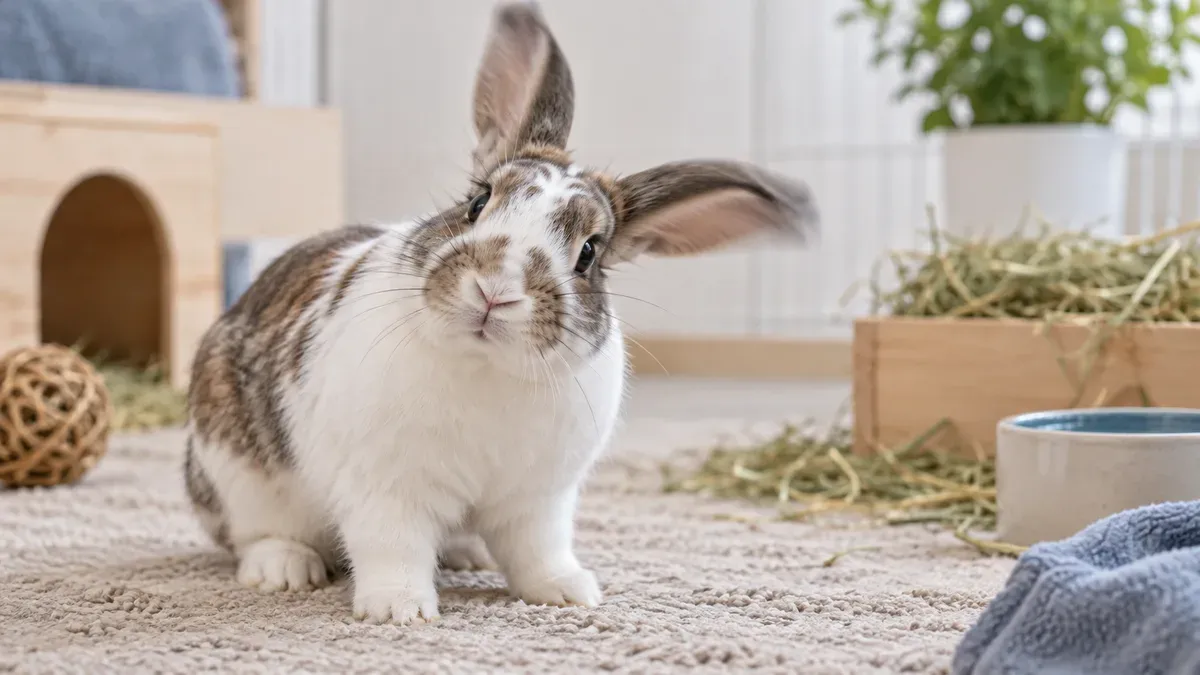
Veterinary note — This article helps you describe what you are seeing before an appointment. It does not replace a clinical examination: only a rabbit-savvy vet can see the depth of the ear canal, with an otoscope, and tell apart causes that look identical from the outside.
An isolated shake may accompany waking or grooming. Ask for advice if it repeats unusually, always comes from the same side, or arrives with something else — ear scratching, crusts, discharge, sneezing, a head tilt.
Before interpreting anything, gather three concrete facts: one ear or both, what you can see inside the ear flap without putting anything in, and what comes with the shaking. Those three details point far more reliably than a general impression, and they are exactly what the vet will ask for on the phone.
When head shaking means nothing
Shaking the head is part of an ordinary rabbit’s repertoire. It is unremarkable when it is:
- brief and isolated: one or two shakes, then the rabbit goes back to what it was doing;
- linked to waking or stretching, often followed by a full-body shake;
- the tail end of grooming, after the front paws have smoothed the ears;
- triggered by dust: very dry hay, fine bedding, a blanket shaken out nearby;
- followed by a joyful leap and no other unusual sign.
The movement warrants veterinary advice if it repeats unusually, interrupts rest, always targets the same side, or comes with insistent scratching at one ear. No number of shakes or time period can diagnose an ear problem on its own.
Sorting by what comes with it
Shaking on its own does not point anywhere: what comes with it does the sorting. This table is not a diagnosis — it tells you what to look at and how urgently to call.
| What else you can see | Possible causes for a vet to distinguish | What to do |
|---|---|---|
| Thick beige or brown crusts, in layers inside the canal | Ear mites | Prompt appointment, never lift the crusts |
| One ear targeted, base of the ear warm, sore to touch | One-sided canal problem, foreign body, abscess | Prompt appointment, put nothing in |
| Discharge in the canal, unusual smell | Outer ear infection | Appointment, a sample is often needed |
| Head tilt settling in, loss of balance, falling over | Inner-ear disease, E. cuniculi — the triage is in my rabbit has a head tilt | Call the same day, do not wait |
| Sneezing, nasal discharge, matted fur on the front paws | Upper respiratory involvement | Appointment: the whole ear-nose-throat area is assessed together |
| Weeping eye on the same side, red eyelid | Eye discharge, sometimes dental in origin — the sorting is in my rabbit has watery eyes | Appointment, put nothing in the eye |
| Body scratching, dandruff along the back, broken hair | Skin parasite rather than an ear problem | Vet appointment |
| Nothing else, and only around hay or the litter tray | Dust from bedding or hay that is too fine | Remove the dust source and ask for advice if shaking persists or worsens |
Each lead has its own page, with the full picture and the real treatment: ear mites in rabbits, rabbit abscesses, E. cuniculi in rabbits, conjunctivitis in rabbits. When the rabbit scratches its whole body rather than just its head, the sorting is done area by area in my rabbit keeps scratching; when sneezing dominates, the question becomes a respiratory one and is covered in my rabbit sneezes.
The three-minute check before you call
All you need is good light and a rabbit sitting on a non-slip floor. No instrument, no product.
- Look inside both ear flaps, putting nothing in. A healthy flap is pink and smooth, with no visible deposit.
- Compare the two sides. Asymmetry is the most useful clue: one ear held slightly lower, warmer, or guarded when your hand comes near.
- Brush your fingertips over the base of each ear, without pressing. Warmth, swelling, or a rabbit that flinches is worth reporting.
- Count the shakes over one hour. “He shakes his head” and “he shook his head twelve times in an hour” do not produce the same advice on the phone.
- Photograph each ear in daylight. A sharp photo saves handling the rabbit again during the consultation.
Finally, note two facts that have nothing to do with ears: how much hay has gone since yesterday, and what the litter tray looks like. A rabbit that shakes its head and eats normally is not in the same situation as one that shakes its head and has left its hay untouched — pain suppresses appetite before it becomes visible, as explained in how to tell if a rabbit is in pain.
The lop-eared rabbit
In a rabbit with dropped ears, the flap covers the entrance to the canal. Two practical consequences:
- Visual checks are less reliable. What you can see at the entrance says almost nothing about the depth of the canal, which only an otoscope reaches.
- Signs go unnoticed more easily. In a lop, head shaking is sometimes the first available signal, well before any visible crust.
In practice: in a lop, repeated shaking gets examined sooner, not later. Lift the flap gently to look, only if the rabbit accepts it without being restrained, and stop if it struggles — the full examination belongs in the consulting room.
What you must never do
- Put in a cotton bud, a tissue or a finger: debris is pushed deeper and inflamed skin bleeds.
- Pour in oil, vinegar, a home remedy or hydrogen peroxide: none of it treats a parasite, and the vet will no longer be able to see anything.
- Use ear drops meant for a dog or a cat, or a leftover prescription from a previous episode. Fipronil, found in some dog or cat parasite products, is contraindicated in rabbits; and a product suited to an outer-ear infection can make things worse if the eardrum is involved. Choosing the product is part of the examination.
- Lift the crusts, in the ears especially: the skin underneath is inflamed and very painful.
- Treat blind. Treating mites that are not there delays the real diagnosis by weeks.
- Wait and see when a head tilt appears. That sign is not for observing at home; it is for examining — what to do in the first hours is set out in my rabbit has a head tilt.
When to call, and how urgently
- Call the same day: a head tilt settling in, loss of balance or falling over, an ear that is very painful to touch, bleeding in the canal, a rabbit that is hunched or will no longer be approached.
- Arrange an appointment promptly: unusual, repeated shaking, crusts or visible deposit in the ear flap, discharge, insistent scratching at one ear, associated sneezing.
- Emergency, with no hourly threshold to wait for: shaking alongside a rabbit that has stopped eating, or droppings that are fewer or absent. In rabbits, do not wait until the next morning to seek care — the full response is set out in rabbit emergency warning signs, and the three levels of urgency in when to see an exotic vet.
One practical point: several causes of ear disease pass between rabbits by direct contact. If you have two, say so when you call; what to do about the second rabbit and any temporary separation should be decided with the vet.
Cutting out what triggers ordinary shaking
When the check shows nothing and the rabbit is eating normally, the environment deserves a round of inspection before any other hypothesis:
- Very fine hay, or hay from the bottom of the bag, releases a lot of dust; the type and condition of the hay matter, as set out in timothy or meadow hay: which to choose.
- Dusty or scented bedding irritates the airways and the eyes: see the best bedding for rabbits.
- A tray cleaned too rarely concentrates ammonia at floor level, exactly where a rabbit breathes: useful frequencies are in how to clean a rabbit litter box.
- Scented products in the room — sprays, candles, air fresheners — whose effect on rabbits is covered in are air fresheners dangerous for rabbits.
These fixes are worth making, but they never replace an examination when an ear is visibly affected.
Where to go next
The next step is one dated observation: tonight, write down which side the rabbit shakes, how many times in an hour, and what you can see in each ear flap. Do it again tomorrow. If the shaking intensifies, if a head tilt appears, or if hay intake drops, book an appointment without waiting for your triage to conclude. Our other guides are gathered in the rabbit health section and on the rabbit species page.
Sources and veterinary references
The sources below frame the general description of ear, parasitic and bacterial disease in rabbits. They replace neither a clinical examination nor a prescribed treatment.
- Merck Veterinary Manual — Parasitic diseases of rabbits
- Merck Veterinary Manual — Bacterial and mycotic diseases of rabbits
Frequently asked questions
Does head shaking always mean an ear infection?
No. A brief, isolated shake may accompany waking or grooming. Unusual repetition, one-sided shaking, crusts, discharge, redness or pain warrant veterinary advice.
Can I clean my rabbit's ear with a cotton bud?
Never. A cotton bud pushes debris deeper into the canal, damages skin that is already inflamed, and stops the vet from seeing the true state of the ear. A rabbit's ear canal is not cleaned blind at home: look, photograph, and put nothing in.
My rabbit shakes its head and now holds it tilted. Is that the same thing?
No, and the difference matters. Head shaking is a brief, active movement; a head tilt is a posture that persists, often with loss of balance. A tilt that appears warrants a call the same day: several very different causes look alike at that point, including inner-ear disease and E. cuniculi infection.
My lop shakes its head more often. Is that just the breed?
No, it is not a breed trait to accept. Dropped ears close off the canal and make visual checks less reliable, but they do not make head shaking normal. In a lop, repeated shaking is a reason to have the ears checked sooner by a rabbit-savvy vet, who can see the depth of the canal with an otoscope.