My rabbit has a head tilt: what to do in the first hours
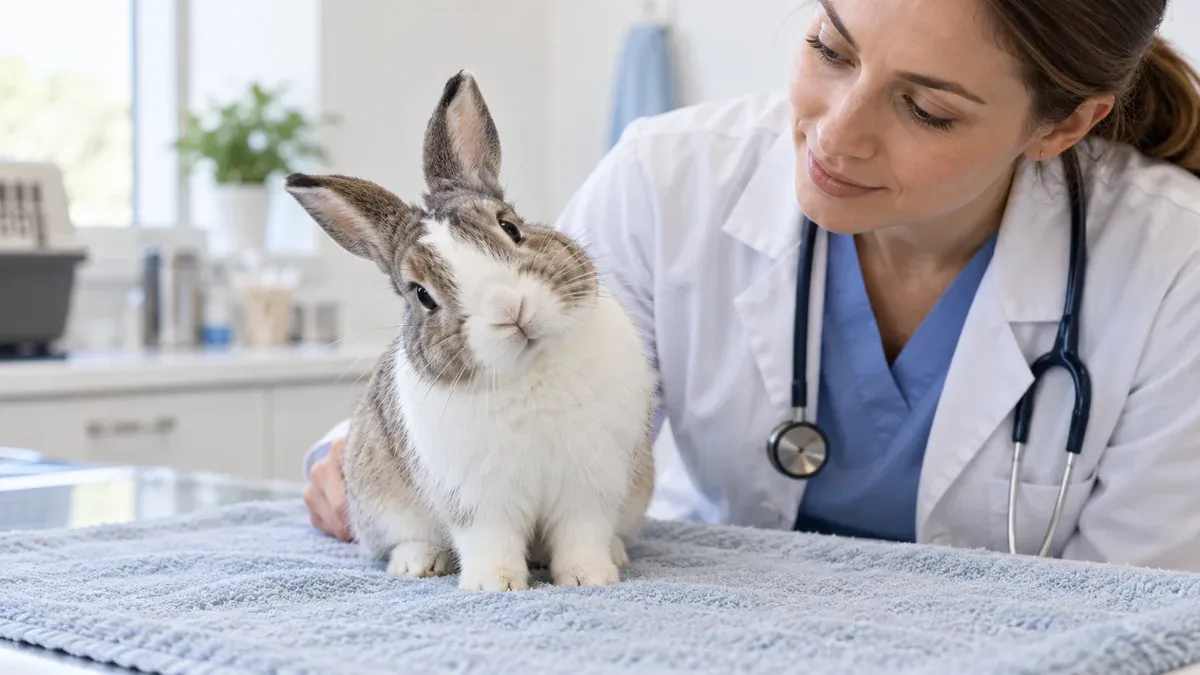
Veterinary warning — A head tilt, loss of balance or rolling calls for an exotic vet appointment without delay. This article helps you describe the situation and protect your rabbit before that appointment. It replaces neither the clinical examination nor the prescribed treatment, which depends on the exact cause.
A rabbit that starts holding his head to one side needs to be seen by an exotic vet the same day. This is not a passing muscular stiffness: a tilted head almost always reflects a problem in the inner ear or the central nervous system, and the possible causes get worse without treatment.
While you wait for the appointment, two things matter and only one is in your hands: stopping your rabbit from injuring himself as he loses balance, and recording precisely what you see. Everything else — naming the cause, choosing the treatment — belongs to the examination.
What to do within the hour
- Put him at floor level, in a small space lined with rolled towels or firm cushions. A rabbit losing balance topples over: the aim is that he falls from nowhere and hits no hard edge.
- Remove every height — platform, step, ramp, an accessible sofa. Even a low height can injure a rabbit who can no longer right himself.
- Bring hay, water and bowls within reach, placed on the floor right beside him rather than across the pen. A rabbit who can no longer cross his own space stops eating before he feels hungry.
- Do not pick him up, hold him upright or make him walk. Restraint increases panic, and a rabbit struggling against a grip can injure his back.
- Call the clinic and describe four things: which side the head leans to, since when, whether the eyes flick from side to side on their own, and whether he has eaten and passed droppings since yesterday.
Film fifteen seconds of him moving at floor level as well: video shows the vet what a stressed rabbit in a consulting room may not reproduce.
Head tilt and head shaking are not the same sign
The confusion is common, and it changes how urgently you act.
- Head shaking is an active, brief, often repeated movement. It points towards the outer ear or a local irritation, and the full triage is in my rabbit is shaking its head.
- A head tilt is a posture that settles in and that the rabbit does not correct. It often comes with loss of balance, circling, or falling repeatedly to the same side.
One detail is worth noting and reporting: eyes that flick from side to side on their own (nystagmus) frequently accompany inner ear involvement. It is not for you to interpret, but it is a useful observation on the phone.
Repeated head shaking before the tilt is useful information to report to the vet.
The causes the vet has to tell apart
The same sign covers conditions whose treatments have nothing in common. This table is not a diagnostic tool: it shows what points where, and where to read on.
| What comes with the tilt | Cause to rule out |
|---|---|
| Sudden onset, rolling, sometimes hind-end weakness | Central nervous system involvement, including E. cuniculi |
| Repeated shaking on one side, discharge, painful ear base | Middle or inner ear infection |
| Thick crusts in the ear flap, persistent scratching | Ear mites with possible complications |
| A fall, a failed jump, a bite during a fight, handling that went wrong | Head or neck trauma |
| Swelling at the ear base or under the jaw | Deep abscess or dental disease |
| Older rabbit, rapid onset, other neurological signs | Another neurological condition requiring investigation |
Two reasoning mistakes come up again and again. The first is assuming E. cuniculi because it is the best-known cause: a bacterial ear infection looks identical from across the room. The second is putting the tilt down to old age in a senior rabbit, when an ear problem is treatable at any age.
What the vet looks for, and why diagnosis takes time
The examination starts with the ears, using an otoscope — something no home inspection replaces, because the visible ear flap can look perfectly clean while the problem sits deep. Depending on what is found, the vet may suggest imaging of the tympanic bulla, a full neurological examination, a check for associated dental disease, or blood work.
No single test settles it. That is especially true of E. cuniculi serology, whose limits are explained on the dedicated page for that parasite: a positive result proves exposure, not active disease. The vet therefore reasons from a set of arguments, and treatment often begins before there is any certainty.
The practical consequence: do not stop a treatment because the diagnosis feels uncertain, and do not extend it on your own initiative. The drugs used here, their doses and their duration are prescription decisions.
Nursing at home while treatment runs
This is the part you handle, and it weighs heavily on the outcome.
- The living space goes single-level, padded, with no shelf and no raised bowl. Non-slip flooring is essential: an unbalanced rabbit on tiles recovers nothing, as the best floor surface for rabbits explains.
- Food stays reachable without effort: hay in a small pile against his body, damp greens placed in front of him, water in a wide bowl rather than a bottle, which forces him to lift his head.
- Weigh him daily, at the same time each day. A drop can reveal that the rabbit is no longer feeding himself properly — the method is in how to weigh a rabbit at home.
- Watch the eye on the tilted side, because it rubs against the floor and dries out. A red, closed or weeping eye is reported without waiting for the next appointment (my rabbit has watery eyes).
- Check the rear end every day: a rabbit that topples over gets soiled and stops grooming normally. The useful steps, and the dangerous ones, are set out in can you bathe a rabbit.
- Give medication exactly as prescribed, without crushing a tablet meant to stay whole or shifting the timing: the technique is in how to give a rabbit medication.
If your rabbit lives in a pair, do not separate them without veterinary advice: the companion grooms, warms and stimulates a weakened rabbit, and several days apart can break the bond.
What makes things worse
- Putting anything in the ear — oil, hydrogen peroxide, drops bought for a dog or cat, leftovers from an old prescription. With a damaged eardrum, some products worsen inner ear damage, and the vet can no longer see anything through the otoscope.
- Treating blind with an antiparasitic “because it must be E. cuniculi”. A bacterial ear infection treated with the wrong product gains several weeks of head start.
- Straightening the head, restraining or carrying the rabbit so he “holds himself properly”.
- Leaving any height accessible during the unsteady phase.
- Waiting until tomorrow when the tilt comes with a rabbit that has stopped eating: that is the tipping point described in rabbit emergency warning signs.
- Deciding alone that nothing can be done. Many rabbits who look severely affected in the first days go on to live normally; that decision is made with the vet, not from the look of a posture.
What recovery looks like
Treatment here is counted in weeks, not days, and improvement is rarely a straight line. Three markers help you read it correctly:
- Appetite usually improves before posture. A rabbit eating properly again is doing better even if his head is still tilted.
- Balance returns before alignment. He stops rolling first, then walks straight, and the residual tilt fades last — sometimes never completely.
- A relapse under stress is possible. One more reason to avoid abrupt changes during recovery.
A stable tilt that remains after recovery is not in itself suffering: what matters is that the rabbit eats, moves, grooms and holds his weight.
Reducing the risk of it happening again
Three levers genuinely help, without any guarantee:
- Get every repeated head shake examined early, especially in a lop, whose ear flap closes off the canal.
- Reduce avoidable stress — constant noise, a conflicted pairing, repeated upheaval — so it does not complicate recovery.
- Keep the litter tray clean, since the parasite’s spores are shed in urine: the useful frequency is in how to clean a rabbit litter box.
Where to go next
The next step is immediate: note which side the head leans to, how many hours it has been going on, and what your rabbit has eaten since yesterday, then call an exotic vet with those three facts. If you are unsure how urgent another sign seen at the same time is, the full triage is in when to see an exotic vet; if your rabbit has stopped eating, the course of action is in my rabbit is not eating. Our other guides are gathered in the rabbit health section and on the rabbit species page.
Veterinary sources
Links checked on September 12, 2026: these pages cover parasitic, ear-related and neurological conditions in rabbits. They replace neither a clinical examination nor a prescribed treatment.
- Merck Veterinary Manual — Parasitic diseases of rabbits
- MSD Veterinary Manual — Eye and ear disorders of rabbits
- House Rabbit Society — E. cuniculi
Frequently asked questions
Can a rabbit's head tilt resolve on its own?
Don't count on it. A head tilt reflects a problem in the inner ear or the central nervous system, and the possible causes do not settle by themselves: an untreated bacterial ear infection gets worse, and so does an untreated parasitic one. What owners sometimes read as spontaneous improvement is usually the rabbit compensating, not the cause going away.
My rabbit tilts its head but eats and moves normally — is that less serious?
It is reassuring about his general state, not about the cause. A rabbit that keeps eating keeps his gut moving, which removes the immediate life-threatening urgency, but the tilt is still an ear or neurological sign that needs examining the same day. Keep recording how much hay disappears and what the droppings look like: those two markers are what will turn this into an emergency if appetite drops.
Should I straighten the head or stop my rabbit from rolling?
No. You never straighten a rabbit's head and you never hold him still by force: restraint increases panic, and a struggling rabbit can injure his own spine. The useful action is to set up a low, padded, obstacle-free space where he can lose balance without hurting himself, then let the vet assess the damage.
My rabbit has had a head tilt for a long time — can he live like that?
Many rabbits live well with a residual tilt once the cause has been treated, provided the setup matches: everything at floor level, bowls he can reach without stretching, daily checks on the eye on the tilted side and on his rear end. A rabbit that eats, moves and grooms with a stable tilt is not a rabbit in permanent distress, but he does need regular veterinary follow-up.