My rabbit has watery eyes: causes and what to do
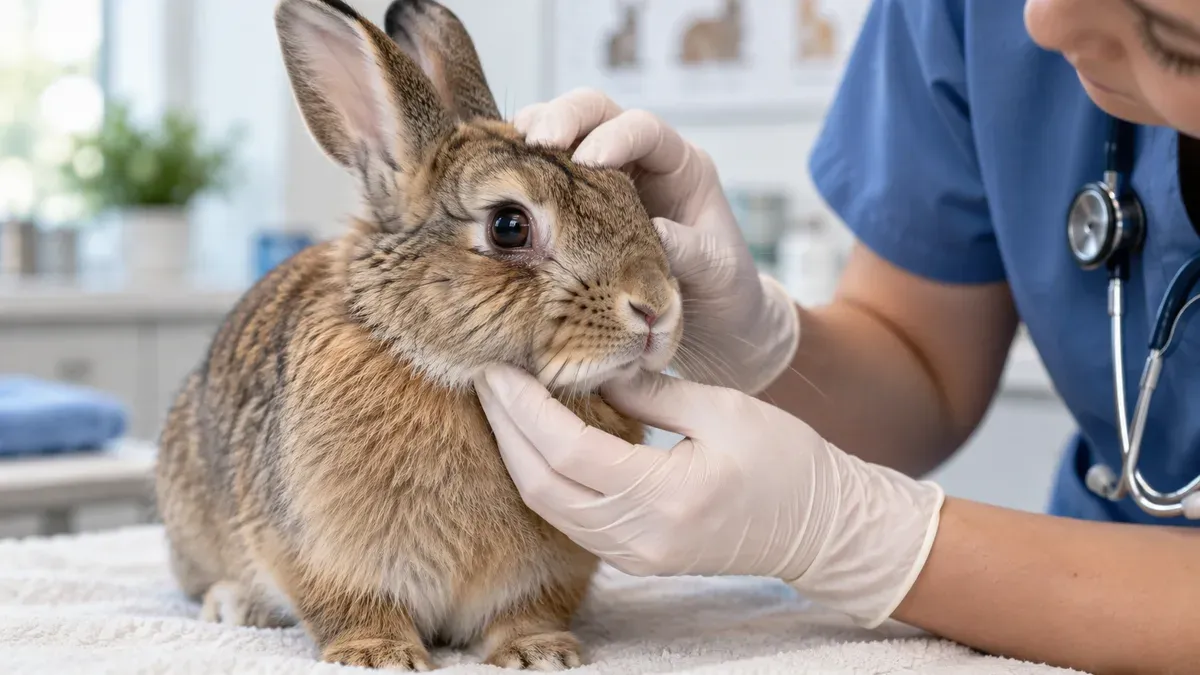
Veterinary note — This article helps you describe what you are seeing before an appointment. It does not replace an examination: only a rabbit-savvy vet can stain the cornea, flush a tear duct and examine the back of the mouth to investigate a possible dental cause.
A rabbit’s weepy eye can arise from the eye itself, the tear duct, the teeth, the nose or the environment. Contact a vet promptly when discharge appears, and call the same day if the eye is closed, bulging or cloudy, if there is a lump under the eye, or if the rabbit is eating less.
Before naming anything, gather three facts: what the discharge looks like, one eye or both, and what comes with it. Those three details do the sorting — not how dramatic the weeping looks.
What the discharge itself tells you
Discharge alone is not a diagnosis, but it directs the eye. This table says what to look at and how urgently to call, not what your rabbit has.
| What you can see | Possibilities to tell apart | What to do |
|---|---|---|
| Clear tears, white and uninflamed eye | Poor tear drainage, an obstructed tear duct, often dental in origin | Book an appointment; the mouth needs examining |
| Thick, whitish or yellowish discharge, lids stuck together | Established inflammation, secondary infection | Prompt appointment, no eye drops without advice |
| Discharge alongside sneezing and a wet nose | Upper respiratory disease tracking to the eye through the tear duct | Appointment; nose and eyes are treated together |
| One eye only, sudden onset, intense rubbing | Foreign body, a strand of hay under the lid | Prompt appointment, do not try to remove it |
| Lump or swelling under the eye or along the jaw | Tooth root disease, abscess | Do not wait for the next available slot |
| Cloudy, bluish cornea or a mark on the surface of the eye | Corneal damage | Call the same day |
| Both eyes, damp fur across the bridge of the nose, dusty hay or bedding | Possible environmental irritant | Remove the irritant and seek prompt veterinary advice |
Each possibility has its own page, with the full picture and the real treatment: conjunctivitis in rabbits when the eye is frankly red and inflamed, dental malocclusion in rabbits when the dental trail holds up, abscesses in rabbits when there is a lump, and snuffles in rabbits when the nose is running too.
One eye or both: why it matters
After the look of the discharge, this is the most useful thing to note, and the easiest.
- One eye points to a local cause on that side: a foreign body, an obstructed tear duct, a tooth root on that side, a surface injury. Check whether the same side shows anything else — an ear the rabbit shakes, a fuller cheek, a wetter nostril.
- Both eyes point to a general or environmental cause: dust, ammonia, scented products, upper respiratory disease. This is the case where walking round the room usually tells you more than watching the rabbit again.
Write the asymmetry down before you call. “The left eye has been running since Tuesday, the right one is dry” is usable information; “his eyes are watering” is not.
The weepy eye that is not red: the most underrated trail
Clear, constant weeping on an eye that is neither red nor swollen looks like a cosmetic detail. It is in fact the situation that most deserves a look inside the mouth.
Tears normally drain through a duct that leaves the inner corner of the eye and runs down towards the nose, alongside the roots of the upper teeth. When those roots lengthen or deviate — which is what happens with malocclusion — the duct is compressed: tears stop draining and spill onto the cheek. The eye itself is fine; the problem is upstream.
Two practical consequences:
- Cleaning, even daily, fixes nothing. It protects the skin; it does not reopen the drainage route.
- The useful examination is not an eye examination. It looks at the back of the mouth, often with head imaging, as set out in dental malocclusion in rabbits.
This mechanism also explains why discharge that runs for months “without being serious” sometimes ends in a late dental consultation, with a tooth root already badly damaged.
The three-minute check before you call
All it takes is good light and a rabbit on a non-slip floor. No instruments, and nothing put into the eye.
- Compare the two eyes head-on, at the rabbit’s level. An eye that is slightly more closed, more prominent, or ringed with damp fur shows up by comparison, not on its own.
- Look at the surface of the eye in raking light. A healthy cornea is crisp and glossy; a dull, cloudy or bluish look is worth reporting straight away.
- Follow the track of the discharge. Damp fur at the inner corner only, or the whole cheek down to the chin? The length of the track describes the volume better than an estimate.
- Feel under the eye and along the jaw with your fingertips, without pressing, comparing both sides. A rounded, firm area, or one that makes the rabbit flinch, goes on the list for the vet.
- Photograph each eye in daylight, head-on and in profile. A sharp photo saves handling the rabbit again at the appointment.
Finally, note two non-eye markers: how much hay has gone since yesterday, and the state of the litter tray. A rabbit in pain eats less before it shows anything else, as explained in how to tell if a rabbit is in pain.
Protecting the skin under the eye until the appointment
Discharge that lasts damages the skin it runs across: the fur macerates and breaks, and the skin beneath turns red. That soreness is avoidable at home, with no risk.
- Clean around the eye with saline, using a clean pad per eye so nothing is carried from one side to the other, wiping from the inner corner outwards.
- Then dry by dabbing with a dry pad. This is the step most often skipped, and it is the one that limits maceration.
- Repeat morning and evening for as long as the discharge lasts, without rubbing and without insisting if the rabbit struggles.
- Watch the skin: a red, bald or crusted patch under the eye needs reporting, as it sometimes needs treating in its own right.
These steps bring relief. They replace neither the diagnosis nor the treatment of the cause: until that cause is treated, the eye will run again.
What not to do
- Putting in human eye drops, drops meant for a dog or cat, or leftovers from a previous prescription: some products make corneal damage worse, and masking the signs delays the diagnosis.
- Trying to remove a foreign body with tweezers, a cotton bud or a finger: the risk of damaging the cornea is real.
- Using herbal infusions, milk, home mixtures or a non-veterinary “soothing” product.
- Settling for weeks of cleaning a permanently weepy eye: that is the route to teeth found far too late.
- Waiting until tomorrow when the eye is closed, bulging or cloudy, or when the rabbit stops eating.
When to see a vet, and how urgently
- Call the same day: a closed, very swollen or bulging eye, a cloudy or marked cornea, bleeding, a lump under the eye or along the jaw, a rabbit sitting hunched and unresponsive.
- Book promptly: any new discharge, especially thick discharge or stuck-together lids, constant weeping on one side, insistent rubbing, sneezing alongside.
- Emergency, with no waiting period to observe: discharge alongside a rabbit that has stopped eating, or droppings that are fewer or absent. In rabbits, a stalled gut is not something to monitor — the full picture is in rabbit emergency warning signs, and the three levels of urgency in when to see an exotic vet for your rabbit.
Worth mentioning if you have two rabbits: some respiratory causes of eye discharge pass between rabbits by direct contact. Say so when you call, and decide what to do for the second rabbit with the vet.
Reducing what makes a healthy eye water
When the check shows nothing, both eyes are affected and the rabbit is eating normally, four ambient irritants deserve an inspection: very fine hay, or hay from the bottom of the bag, which releases a lot of dust (timothy, meadow or orchard hay: which to choose); dusty or scented bedding, which irritates the eyes before the airways (the best bedding for rabbits); a litter tray cleaned too rarely, which concentrates ammonia at the rabbit’s head height (how to clean a rabbit litter box); and scented products in the room, sprays, candles and plug-ins (are air fresheners dangerous for rabbits).
These fixes are worth making, but they never replace an examination when only one eye runs or when the discharge is thick.
Where to go next
A concrete next step: tonight, write down which eye is running, what the discharge looks like, how far the track reaches down the cheek and how much hay has gone, then do it again tomorrow. Share those observations when you call the vet, without delaying the appointment. If the rabbit is also shaking its head, the complementary sorting is in my rabbit keeps shaking its head; if sneezing dominates, in my rabbit sneezes. The rest of our guidance is in the rabbit health section and on the rabbit species page.
Sources and veterinary references
The sources below frame the general description of eye and dental disorders in rabbits. They replace neither a clinical examination nor prescribed treatment.
- MSD Veterinary Manual — Eye and ear disorders of rabbits
- PDSA — Dacryocystitis in rabbits
- VCA Hospitals — Dental disease in rabbits
- VCA Hospitals — Infectious diseases in rabbits
Frequently asked questions
The eye runs but it is not red. Is that less serious?
It is not more reassuring, it is different. Clear tears on a white, calm eye point to poor tear drainage rather than surface inflammation: the tear duct, which runs alongside the roots of the upper teeth, is not draining. The cause is often dental, and cleaning will not fix it.
How long can I wait before booking an appointment?
Contact a vet promptly whenever eye discharge appears: an eye problem can worsen quickly and its cause cannot be established at home. Some signs are not for watching and waiting: a closed or bulging eye, a cloudy cornea, a swelling under the eye, refusal to eat or fewer droppings all mean calling the same day.
Can I clean the eye with saline?
Yes, around the eye and on the wet fur, using a clean pad per eye and wiping from the inner corner outwards. It soothes and protects the skin, but it treats nothing: saline is neither eye drops nor a treatment. No human eye drops and no leftover prescription should go into the eye without veterinary advice.
Both eyes are running. Does that mean an infection?
No. Both eyes at once point first to a general or environmental cause — hay or bedding dust, ammonia from a litter tray cleaned too rarely, a scented product in the room — or to an upper respiratory problem. One eye alone points instead to a local cause on that side.