My rabbit has a bloated belly: is it an emergency?
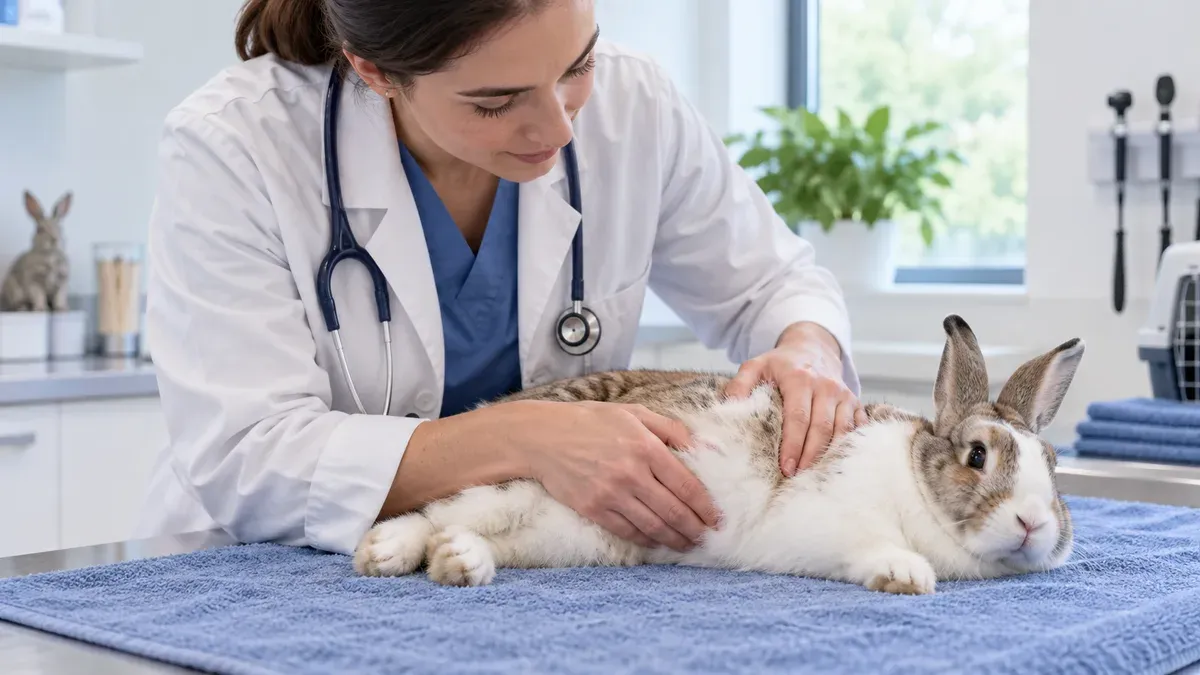
Veterinary note — This article helps you describe what you are seeing and decide how fast to act. It does not replace an examination: only a rabbit-savvy vet can palpate the abdomen, take images and tell a build-up of gas from an obstruction — two situations that are not managed the same way.
A tense, hard and painful belly in a rabbit, especially alongside no droppings or a refusal to eat, is an emergency: call a clinic immediately, without waiting for morning. A simply round tummy in a rabbit that eats, moves and passes droppings is not the same situation.
So the whole question comes down to two steps: is this real bloat, and what comes with it? Both observations take a few minutes and need no equipment.
The three signs that make the call immediate
Any one of these is enough to ring a clinic straight away, day or night:
- A tense, swollen abdomen that hurts on contact, often with loud tooth grinding and a hunched posture.
- A marked reduction or absence of droppings, especially if the rabbit is eating less or refusing food.
- A collapsed rabbit that no longer gets up, breathes fast, or has cold extremities.
All three appear among the life-threatening signs described in rabbit emergency warning signs. In this species, a stalled gut is not something you monitor — it is something you treat. If you are unsure how urgent an isolated sign is, the full sorting is in when to see an exotic vet for your rabbit.
Bloated or just round: observe without diagnosing
A rounded appearance alone cannot diagnose bloat. Three things can mislead the eye: the dewlap (the fold of skin under the chin, more marked in females), the abdominal fat of an overweight rabbit, and the full stomach of a rabbit that has just eaten.
Observe the rabbit on the floor, on a non-slip surface, without pressing its abdomen. Compare its usual outline, appetite, activity and droppings. A visibly distended or tense abdomen, pain on light contact, or an associated behaviour change warrants an immediate veterinary call. A vet should examine a persistently enlarged abdomen even if the rabbit appears well, so that the cause can be identified.
A side-on photo taken at the rabbit’s level helps you compare from one day to the next. Without a reference point, any belly looks abnormal once you start looking for it.
Six possibilities to tell apart
This table is not a diagnostic tool: it tells you what to look at besides the belly and how fast to react.
| What you see alongside the belly | Possibility for the vet to rule out | What to do |
|---|---|---|
| Comes on within hours, very tense belly, obvious pain, rabbit motionless | Acute build-up of gas | Call immediately |
| Refusing hay, fewer then no droppings, hunched back | Slowing then stalled gut | Call immediately |
| Big but soft belly, active rabbit, normal droppings | Excess weight, developed dewlap | Review the diet, no urgency |
| Swelling low in the abdomen, odd posture to urinate, cloudy or stained urine | Urinary problem | Prompt appointment |
| Entire female with possible access to a male, nest building, pulled fur | Pregnancy or false pregnancy | Book an appointment |
| Round belly right after a meal, normal rabbit an hour later | Full stomach | Nothing, keep watching |
For more on a stalled gut and its treatment, read rabbit GI stasis. Describe urinary changes or nesting behaviour directly to the vet, because the belly’s appearance cannot establish their cause.
What to do within the hour
The goal is not to treat at home, but to arrive at the clinic with the right information and without having made things worse.
- Write down two exact times: the last meal actually eaten, and the last droppings found in the tray. That is the first question on the phone.
- Call before you leave. The clinic prepares for your arrival and confirms whether any action helps in this particular case — what helps in one situation can harm in another.
- Keep the rabbit quiet and at a comfortable temperature, with no heat source directly against it; the clinic can advise whether warming is needed.
- Leave hay and water available, never forcing intake.
- Photograph the litter tray before cleaning it: the number and size of droppings are hard to describe from memory.
- Get the carrier ready, open on the floor and lined with clean hay — the stress-free method is in how to get a rabbit used to its carrier.
The moves that make a tense belly worse
- Massaging the abdomen. The advice circulates widely on forums. It is contraindicated without veterinary instruction: with an obstruction, it can do real damage.
- Syringe-feeding. Nutritional support has its place, but after the examination and following the instructions given: it can be inappropriate when an obstruction is suspected.
- Making the rabbit run “to get things moving”. Gentle, voluntary movement helps in an early slowdown; pushing a painful rabbit never does.
- Giving a human medicine, an anti-gas product, oil or herbal tea. No amount is improvised, and masking pain delays diagnosis.
- Starving the rabbit to “rest the gut”. In a herbivore with a continuously moving digestive system, no intake keeps the problem going rather than solving it.
- Waiting until morning because the rabbit “seems calm”. Rabbits are prey animals and hide pain to the very end, as how to tell if a rabbit is in pain explains.
Lowering the chance of it happening again
Once the episode is over and treatment finished, three levers matter more than all the rest.
- Hay available at all times, in quantity and quality, remains the first factor in a regular gut: portion markers are in how much hay does a rabbit need, and the reasons a rabbit turns away from hay in why has my rabbit stopped eating hay.
- Any dietary change made gradually, including a change of pellet brand, following the method in how to transition a rabbit’s diet.
- Watching fur intake during a moult, which adds to the digestive load: see rabbit swallowing fur and rabbit moulting: normal or not.
To that, add a habit that costs ten seconds: look at the litter tray every morning. A drop in the number of droppings almost always comes before a swollen belly, and it is the earliest signal you have.
Where to go next
One concrete next step: tonight, photograph the litter tray before cleaning it and note the time of the last meal. Do it again tomorrow. Two photos are enough to show a decline the eye misses — and it is exactly what a vet will ask for if the belly becomes tense. If the rabbit also stops eating, the full approach is in rabbit not eating: what to do. Our other markers are in the rabbit health section and on the rabbit species page.
Sources and veterinary references
The sources below frame the general description of digestive disorders in rabbits. They replace neither a clinical examination nor prescribed treatment.
- Merck Veterinary Manual — Digestive disorders of rabbits
- VCA Hospitals — Gastrointestinal stasis in rabbits
- RSPCA — Rabbit health and welfare
Frequently asked questions
My rabbit looks round but is eating and passing droppings — should I still call?
A rabbit that eats normally, produces its usual number of droppings and moves around as it always does is not in a digestive emergency. A permanently round tummy in an active rabbit points more towards excess weight, a well-developed dewlap or simply a full stomach. Note the date you first noticed it and keep watching the litter tray: it is the change over a few hours, not the volume alone, that tips the situation.
Can I give a human anti-gas product to a bloated rabbit?
Not on your own initiative. Simethicone is sometimes mentioned for rabbits, but only a vet can decide whether it is indicated. Gas build-up and an obstruction can look alike without requiring the same care, so trying a product at home mainly risks delaying the examination. No medicine should be improvised for a tense abdomen.
My rabbit's tummy is gurgling loudly — is that a good sign?
It is neither reassuring nor alarming on its own. A healthy rabbit abdomen makes quiet, regular sounds. Very loud gurgling, or complete silence, is worth reporting to the vet — especially alongside a hunched posture, tooth grinding or fewer droppings. The sound is something you describe on the phone, not something you diagnose at home.
Could an unspayed female with a swollen belly be pregnant?
It is a possibility to rule out whenever an entire female has had any contact with a male, however brief. A false pregnancy can also change the shape of the abdomen and the rabbit's behaviour without any actual pregnancy. Either way, telling them apart is done in the consulting room, by palpation and imaging — not by looking at the animal's outline.