My rabbit keeps scratching: how to work out why
Veterinary note — This article helps you sort what you are seeing before an appointment. It does not replace a clinical examination and cannot establish a diagnosis. Any skin lesion, any scratching that persists, and any rabbit eating less should be seen by a rabbit-savvy vet.
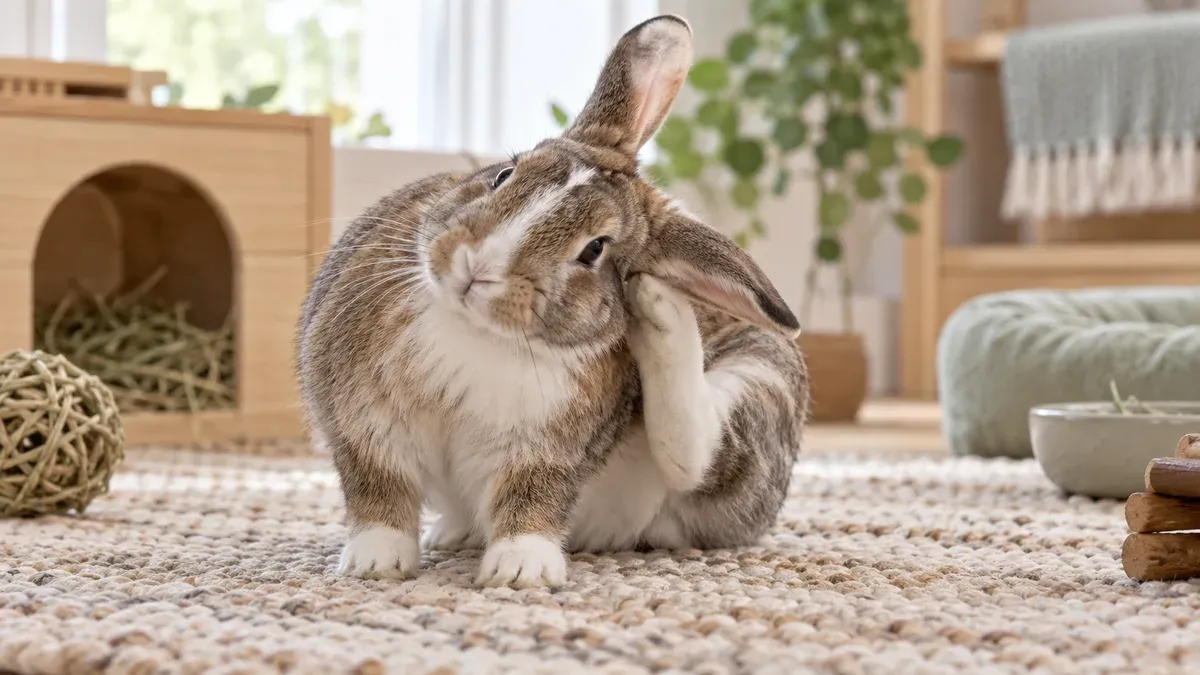
A rabbit that scratches now and then is doing nothing unusual: scratching is part of grooming, just like licking and smoothing the ears. What should stop you is what you can see under the scratched area — red skin, crusts, dandruff, broken hair — and the fact that the rabbit keeps coming back to the same spot.
Before interpreting anything, gather three concrete facts: the exact area the rabbit targets, what the skin looks like there, and how long it has been going on. Those three details are far more useful than a general impression, and they are exactly what the vet will ask for on the phone.
Occasional scratching is normal — frequent scratching is not
A healthy rabbit scratches briefly, moves on to something else, and does not come straight back to it. It smooths its ears with the front paws, licks its flanks, gives itself a shake.
Scratching becomes a symptom when at least one of these is true:
- it is repetitive and localised: the rabbit always returns to the same spot;
- it interrupts rest: the rabbit wakes up to scratch, or is restless during the night;
- it leaves a mark: red skin, a crust, broken hair, a bald patch;
- it comes with repeated head shaking — a sign with its own triage, set out in my rabbit keeps shaking its head;
- it is visibly violent: the rabbit nibbles at itself, twists round sharply, scratches until the skin breaks.
That last point deserves a quick response. Broken skin becomes infected easily, and intense itching hurts. Pain in rabbits reads differently from pain in a dog or a cat, as how to tell if a rabbit is in pain sets out.
Sorting by area: the table that points you somewhere
The scratched area is the best clue available at home. This table does not replace a diagnosis: it tells you what to look at and how urgently to call.
| Area targeted | What you see on the skin | Most common lead | What to do |
|---|---|---|---|
| Inside the ears | Thick beige crusts in layers, canal clogged | Ear mites | Prompt appointment, never lift the crusts |
| Neck, back, base of the neck | Heavy dandruff, sometimes moving, hair coming out in patches | Skin mites (typically Cheyletiella) | Vet appointment, prescribed treatment |
| Muzzle, ear margins, feet | Round crusty patches, clearly outlined bare skin | Ringworm, transmissible to humans | Appointment plus immediate hygiene precautions |
| Back and base of the tail | Small black specks in the coat, restlessness | Fleas | Appointment, treat the rabbit and the home |
| Chin, dewlap, chest | Damp, yellowish fur, macerated skin | Chronic drooling, usually dental in origin | Dental appointment; the skin will not heal on its own |
| Around the eyes | Fur stuck together, damp, red eyelid | Eye discharge | Appointment, put nothing in the eye without advice |
| Underside of the hind feet | Red thickened skin, hair missing under the hock | Sore hocks | Appointment and a change of flooring |
| Everywhere, no visible lesion | Normal skin, coat loaded with dead hair | Moulting, environmental irritation | Brushing; review bedding and dust |
Each lead has its own page, with the full picture and the actual treatment: rabbit ear mites, ringworm in rabbits, fleas in rabbits, rabbit sore hocks. When hair comes out without the rabbit scratching, the question changes and is handled in rabbit moulting: normal or not.
The five-minute check to do before you call
You need no equipment, only good light and a rabbit on a non-slip surface.
- Look inside the ears without inserting anything: a clean canal is pink and smooth. Thick crusts are visible to the naked eye.
- Part the coat against the lie of the hair over the neck, the back and the base of the tail. Look for dandruff, black specks, redness.
- Feel along the back and flanks with your fingertips: a crust, a lump or a warm area is felt before it is seen.
- Do not turn over a rabbit that resists. Inspect only the areas you can see without restraint; the vet can examine the belly and underside of the feet safely.
- Photograph every abnormal area in daylight. A sharp photo beats a description and saves handling the rabbit again at the clinic.
Finally, note two non-skin facts: how much hay has been eaten since yesterday, and what the droppings look like. A rabbit that scratches and eats normally is not in the same situation as a rabbit that scratches and has left its hay untouched.
When the cause is not a parasite
Not all itching comes from parasites, and the environment explains a share of diffuse scratching with no clear lesion:
- Dusty or scented bedding. Fine dust irritates skin and airways. The substrate matters more than people assume: see the best bedding for rabbits.
- A litter tray cleaned too infrequently. Ammonia build-up irritates the skin of the belly and feet as well as the eyes. The useful frequency is set out in how to clean a rabbit litter box.
- Scented products in the room. Sprays, candles, plug-ins: their effect on a rabbit is covered in are air fresheners dangerous for rabbits.
- Very dusty hay, or hay stored damp, which irritates on contact and is obvious to the hand.
- A moult in progress. Accumulated dead hair itches; brushing genuinely helps, and reduces how much fur is swallowed, as my rabbit is swallowing fur explains.
- Heat. An overheated rabbit is restless, licks and scratches more; the temperature markers are in what temperature can rabbits tolerate.
These causes are fixed without a prescription, but they are not guesses: they only hold when the skin is normal under the scratched area. Faced with a crust, a patch or heavy dandruff, the environmental explanation no longer covers it.
What you should never do
- Apply a dog or cat flea product. Some widely sold actives, fipronil among them, are dangerous in rabbits. The active, the form and the protocol are decided at the consultation, based on weight and on the parasite actually identified.
- Lift the crusts, in the ears especially: the skin underneath is inflamed and bleeds.
- Bath or shampoo the rabbit. Bathing is a major and potentially dangerous stress, and it removes no skin parasite: the detail of the risks is in can you bathe a rabbit.
- Apply oil, vinegar or a home remedy into the ear canal or onto a lesion.
- Treat blindly. Treating fleas that are not there delays the real diagnosis by weeks.
- Wait for it to pass once the skin is affected: a lasting skin lesion becomes infected, and some leads, ringworm in particular, spread to humans and to other pets in the household.
When to see a vet, and how urgently
- Prompt appointment, no waiting: head tilt alongside the scratching, a bleeding wound, an ear that is very painful to touch, a rabbit that will no longer let you near it, crusty patches that are spreading.
- Appointment within the next few days: scratching repeated for more than a few days, heavy dandruff, hair coming out in patches, damp fur at the chin or around an eye.
- Call immediately if the scratching comes with reduced appetite or fewer or no droppings: do not wait for an hourly threshold to be reached. The full response is set out in rabbit emergency warning signs, and the three levels of urgency in when to see an exotic vet for your rabbit.
One practical point: several of these conditions spread between rabbits. If you have two, say so when you call — the protocol and what to do about the second animal are decided with the vet, as keeping two rabbits together without fighting also notes.
Where to go next
The next step is one dated observation: tonight, write down the area, what the skin looks like and the time. Do it again tomorrow. If the area spreads or the skin deteriorates within 24 hours, book an appointment without waiting for your own sorting to conclude. To prepare for the treatment that follows, how to give a rabbit medication covers the classic mistakes. Our other guides are gathered in the rabbit health section and in the rabbit species profile.
Sources and veterinary references
The sources below frame the general description of skin and parasitic conditions in rabbits. They replace neither a clinical examination nor prescribed treatment.
- Merck Veterinary Manual — Skin disorders of rabbits
- Merck Veterinary Manual — Parasitic diseases of rabbits
- VCA Hospitals — Rabbit diseases
- RSPCA — Rabbit health and welfare
Frequently asked questions
Does a scratching rabbit always have parasites?
No. Skin parasites can cause genuine itching, but scratching can also come from skin irritated by dusty bedding, from fur left damp under a chin that drools, or from a coat loaded with dead hair during a moult. What points you in the right direction is the state of the skin under the scratched area, not the scratching itself.
Can I use a spot-on flea treatment bought for my cat?
Never. Several products that are routine in dogs and cats, fipronil above all, are dangerous in rabbits. The choice of product, its form and the protocol are decisions for a rabbit-savvy vet, who takes into account weight, age and the parasite actually identified.
Should I pick off the crusts my rabbit is scratching at?
No. Ear crusts in particular sit on inflamed, very painful skin: lifting them makes the ear bleed and worsens the lesion. They come away on their own once the prescribed treatment starts. Photograph the area and show the photo instead of touching it.
My rabbit is scratching one ear and tilting its head. Is that urgent?
A head tilt combined with ear scratching warrants a prompt appointment rather than a wait-and-see approach. Several very different causes look alike at that stage, including middle-ear involvement, and only an examination can tell them apart. Put nothing into the ear canal before that examination.