How to keep two rabbits together without fighting
Veterinary note — A fight between rabbits causes wounds that are often invisible under the fur, particularly on the belly, flanks, legs and genitals. Some close over on the surface and become abscesses days later. After any real conflict, both animals should be examined by a rabbit-savvy vet, visible wound or not.
Two rabbits live together without fighting when three conditions hold over time: both are neutered, the space is set up for two (doubled resources, hides with two exits, no corner without a way out), and tension is spotted before it becomes a conflict. The first meeting is only the starting point; the introduction method itself is covered step by step in how to introduce two rabbits.
A pair that looked settled can still fight weeks or months after introduction. A trip to the vet, pain, a house move or a simple rearrangement is enough to restart a territorial conflict.
Set up for two, not for one rabbit twice over
A space designed for a single rabbit becomes a conflict zone as soon as there are two. Four principles matter more than everything else:
| Setup | What it prevents | The common mistake |
|---|---|---|
| Two litter trays, two water points, two bowls, two hay areas | The single resource one rabbit can block | Grouping everything into one “tidy” corner |
| Hides with two exits each | The rabbit cornered at the back, left with nothing but defence | The closed tunnel or the one-door hutch |
| Open space, no dead ends and no narrow bottlenecks | The chase that finishes in a trap | The gap between a unit and the wall |
| More floor space and more run time | Permanent crowding, which wears tolerance down | Keeping the pen you bought for one rabbit |
Space benchmarks are the same as for a single rabbit, but they do not get divided: two rabbits need more than one rabbit does, not the same thing shared. The sizing figures are in what size enclosure for a rabbit, and the layout itself in how to set up an indoor pen for a rabbit.
One detail matters more than it looks: where the hay rack and the trays go. Eating and toileting are the two moments rabbits cross paths most. Two points placed well apart remove a good share of the daily friction.
Six triggers of a fight in a settled pair
- A return from the vet. Easily the most common: a rabbit coming back from hospitalisation, an anaesthetic or a consultation brings back an unfamiliar smell and altered behaviour. Its partner may treat it as an intruder within the hour.
- Pain or illness. A rabbit in pain defends itself faster, tolerates contact less and sometimes stops returning grooming. A sudden fight in a stable pair is a reason to check both animals — the signs are subtle and set out in how to tell if a rabbit is in pain.
- Hormones. A rabbit that is not neutered, or neutered very recently, is still operating territorially. The decision and the timing are covered in should you spay a female rabbit and should you neuter a male rabbit.
- A rearranged pen or a house move. A reconfigured space becomes territory to claim again — the subject is covered in moving house with a rabbit.
- A single shared resource. One tray, one bowl, one comfortable hide: all it takes is for one rabbit to decide to control access.
- The scent of another rabbit. A third animal in the house, a visit to a friend who keeps rabbits, a blanket brought back from a rescue: imported scent is sometimes enough to set off a reaction.
Spotting tension before the fight
This is the skill that prevents injuries. Most fights are preceded by several days of quiet signals:
| What you see | What it signals | What to do |
|---|---|---|
| One rabbit starts urine-marking again | Territory back in play | Clean, double the resources, look for the triggering event |
| They no longer sleep touching, though they used to | The bond loosening | Watch closely, change nothing else in the space |
| Grooming becomes one-way and the other refuses | Rank imbalance not being accepted | Close observation for a few days |
| One rabbit always eats apart from the other | Access to food controlled by its partner | Separate the hay and water points immediately |
| Chases that no longer stop, repeated laps of the pen | Escalation underway | Redirect attention, cut it short, review the layout |
| Boxing on the hind legs, tufts of fur on the floor | Open conflict | Separate without using hands, check both animals |
A rabbit that starts hiding permanently, grinding its teeth slowly or sitting hunched is not “sulking”: the full posture guide is in how to read rabbit body language.
Breaking up a fight without getting bitten
Two fighting rabbits often form a rolling ball, bite anything that moves and do not hear you. The rule is simple: never bare hands.
- Slide something flat and rigid between them: thick card, a dustpan, a tray, a light board.
- Or throw a thick towel over one of them, then lift the whole bundle without trying to untangle anything.
- A loud noise or a puff of air can break the sequence, but do not count on it: they still have to be physically separated.
- Isolate them immediately in two separate spaces, and only then deal with them and with yourself.
Keep that kit within reach in the room while the cohabitation is young. Going to look for it mid-fight costs seconds that are paid for in bites.
After a fight: the five-point protocol
- Complete separation, in two spaces where they cannot touch. No reuniting the same day, however calm they look.
- Check both rabbits, every time: belly, flanks, legs, genitals, base of the ears. Rabbit bites close over on the surface, which is exactly how an abscess forms several days later.
- Call the vet for any wound, bleeding, limp, warm patch or doubt. A bite inspected too late costs more than a consultation that turns out to be unnecessary.
- Watch both appetites. Conflict stress can reduce hay intake. Any unusual reduction warrants a prompt call; complete food refusal is an emergency (my rabbit is not eating).
- Look for the cause. An unexplained fight in a stable pair is a medical hypothesis first and a housing hypothesis second.
Getting them back together then works exactly as it would with two strangers: neighbouring spaces separated by a barrier, then neutral territory, then progressively longer sessions. That progression is described in how to introduce two rabbits.
The trip to the vet: prepare rather than repair
This is the situation that breaks the most pairs, and the only one you can plan for in advance.
- Ask the practice whether the partner can come along, including for a short hospital stay. Many rabbit-savvy practices allow or encourage it: the bond is preserved and the patient is less stressed.
- If separation is unavoidable, do not put the two back together straight out of the carrier. Set them up side by side, separated by a barrier, until scent and behaviour are back to normal.
- Reunite under supervision, in a cleaned space, and stay present for the first few hours.
- Adapt the convalescence to a pair: a rabbit that has had surgery needs quiet, and an insistent partner can reopen a wound or prevent rest. The full recovery timeline is in caring for a rabbit after spaying and caring for a rabbit after neutering.
What does not work
- Letting them “sort it out between themselves”. In rabbits, an established fight does not end in a compromise, it ends in injuries.
- Telling them off or banging on the pen. A rabbit associates nothing with punishment, except you with danger.
- Adding a third rabbit to calm a tense pair. The difficulty increases; it does not dilute.
- Shrinking the space “so they get used to each other”. Forced crowding accelerates conflict, it does not cure it.
- Relying on a visual check after a fight: under the fur, a bite does not show.
When cohabitation cannot work
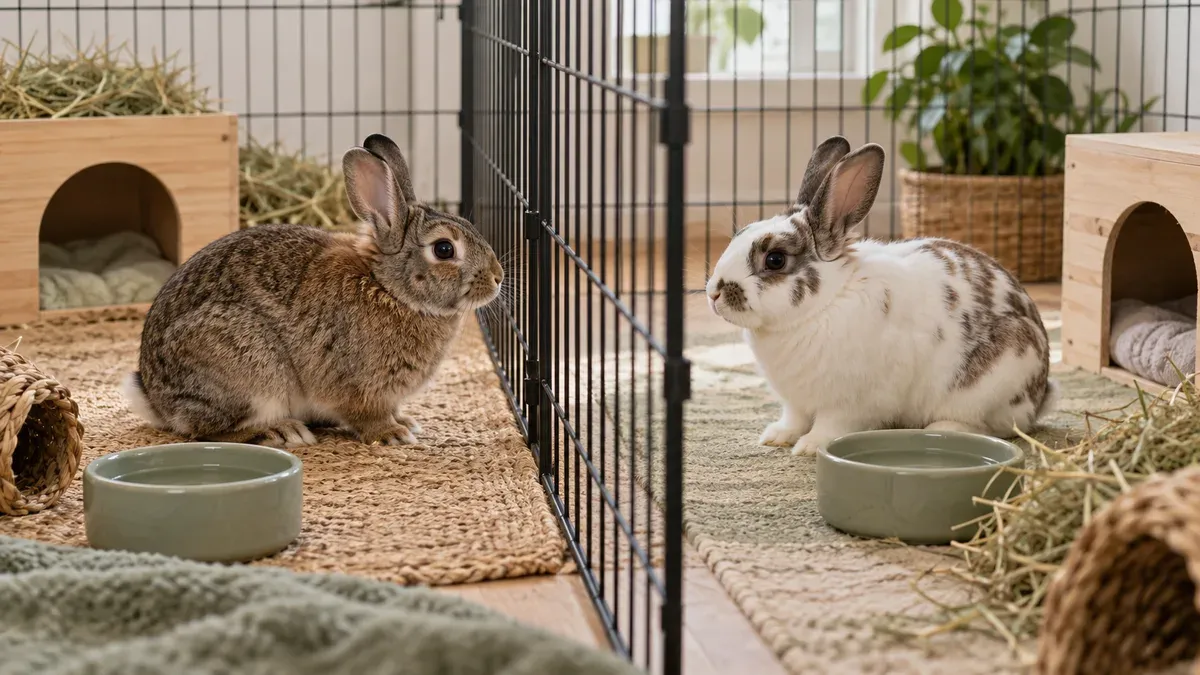
Some pairs never re-bond, particularly after a severe fight or between two strong-willed adults. The answer is not forced cohabitation: two neighbouring pens separated by a barrier, with permanent sight and scent contact and alternating run times, deliver most of the social benefit without the injury risk. Plenty of households live like this long term without any loss of welfare.
If you are still deciding whether a second rabbit is right at all, that underlying question is covered in can a rabbit live alone.
Where to go next
Logical next step: walk round your shared space today with a single question in mind — “where could a rabbit end up cornered with no way out?” — then remove every dead end and double up every resource that exists only once. That is the change that prevents the most conflict for the least effort. After that, browse our rabbit behaviour guides and the rabbit species page.
Sources and references
The sources below frame the welfare and health aspects covered here: this article helps you organise a cohabitation, and does not replace the opinion of a rabbit-savvy vet as soon as an injury or a change in behaviour appears.
- RSPCA — Rabbit health and welfare
- Rabbit Welfare Association & Fund — Neutering, castration and spaying
- VCA Hospitals — Rabbits: problems and diseases
Frequently asked questions
Should I separate two rabbits that are chasing each other?
Not automatically. A short chase that stops on its own, followed by both rabbits settling and eating side by side, is part of sorting out rank. What needs intervention is the chase that never stops, that circles the pen without a break, or that ends with a tuft of fur on the floor. The practical rule: count in seconds, not minutes, and interrupt by redirecting attention rather than by grabbing a rabbit.
My rabbits were fine together and started fighting after I rearranged the pen. Why?
Because a reorganised space becomes territory to claim again. A new layout, an added hide, a moved hay rack or a fresh mat is enough to restart marking in a settled pair. Go back to the previous layout if you can, or clean everything and let them rediscover the space together under supervision, with every resource doubled up.
Can three or more rabbits live together?
Yes, but the difficulty does not rise in a straight line: each newcomer has to find a place with every other rabbit, and a stable group can come apart when a single individual is added. A trio needs noticeably more space, more duplicated resources and zero tolerance for dead-end corners. If the existing pair is fragile, this is not the moment to add a third rabbit.
Can a broken bond be rebuilt for good?
Often yes, provided you restart the progression from the beginning rather than putting both rabbits back together and hoping. Some pairs never re-bond after a severe fight: in that case, living side by side separated by a barrier, with permanent sight and scent contact, is far better than a forced cohabitation. That is not a failure, it is an arrangement.