Are rabbits good pets for children?
Veterinary warning — A rabbit that hides, refuses food or sits hunched is not “sulking about the children”: those signs belong to health and need the opinion of a rabbit-savvy vet. Reading behaviour never replaces an examination.
A rabbit is an excellent family pet, but a poor first pet handed to a young child. The difference comes down to one thing: the animal must stay the responsibility of an adult, with the child as its companion rather than its owner. This is not about how kind or how careful the child is.
It is about the species. A rabbit is a prey animal that hates being lifted, that lives mainly at dawn and dusk, that hides pain, and that lives for 8 to 12 years. None of those traits fits the cuddly, easy-going image still attached to rabbits.
Four realities that contradict the cliché
- It does not want to be picked up. This is friction point number one with a child, because picking up is exactly what a child wants to do. A rabbit that struggles as it is lifted can injure its own back with a single kick; the whole subject is covered in my rabbit doesn’t like being picked up.
- It is active when the child is not. Rabbits come alive early in the morning and late in the day, and doze through the middle — often exactly when the child gets home wanting to play (why does my rabbit sleep so much).
- It lives a long time. A rabbit adopted for an eight-year-old will still be there when that child turns eighteen and leaves to study elsewhere. “Who looks after it in ten years” is a pre-adoption question.
- It is expensive to keep well. Vaccinations, neutering, emergencies at an exotics practice: that is an adult budget, set out in how much does a rabbit cost per month.
What a child can realistically do, by age
| Child’s age | What is realistic | What stays with the adult |
|---|---|---|
| Under 5 | Watching, filling the hay rack with an adult, sitting on the floor nearby | Everything else, plus constant supervision |
| 5 to 7 | Giving hay, changing water, preparing the day’s greens, brushing under supervision | Care, cleaning, free-roam time, health checks |
| 8 to 11 | Daily meals, tray maintenance with help, floor-level play, keeping a weight log | Veterinary decisions, nail trims, medication |
| 12 and over | Almost all of the daily routine, including full cleaning and weight tracking | Final responsibility, budget, vet appointments |
These are orders of magnitude, not a hard rule: a calm six-year-old sometimes does better than a boisterous ten-year-old. The variable that matters is not age on paper but the ability to stay still and accept being refused by the animal.
The rules that make it work
They fit in a few lines, and they prevent most problems:
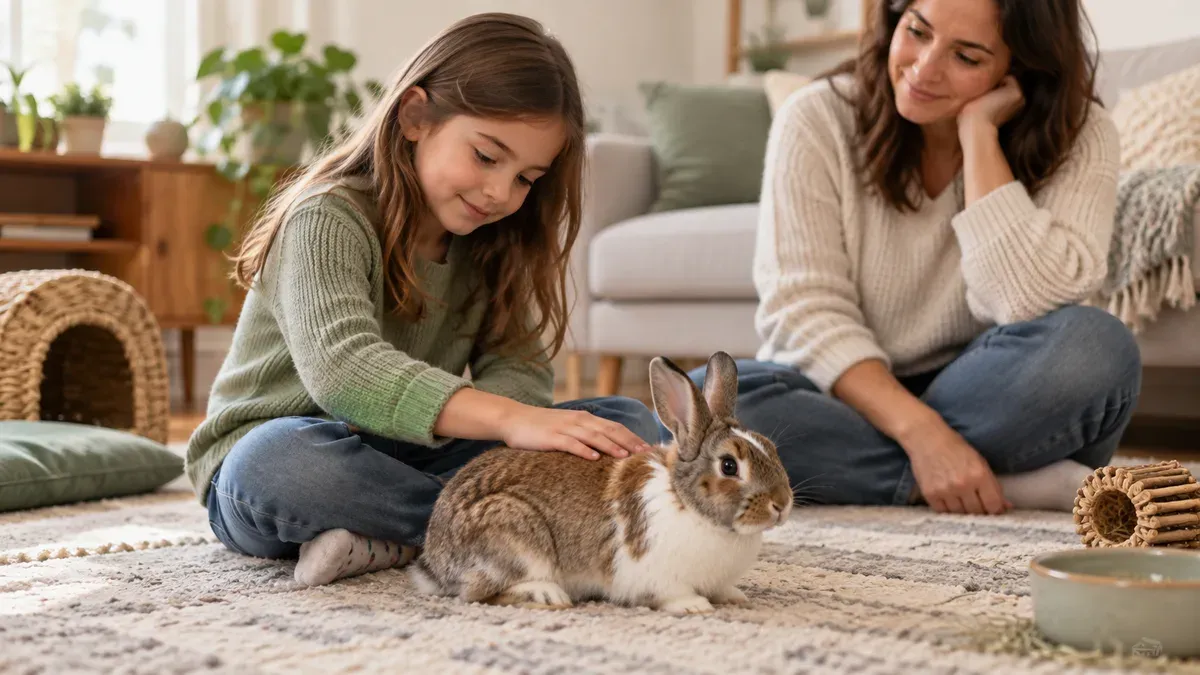
- Interaction happens on the floor, never in arms. The child sits, stays quiet, and lets the rabbit come. It is the same gradual logic as in how to tame a fearful rabbit.
- Never chase a rabbit that walks away. A rabbit that leaves is not “being shy”, it is saying no. Chasing it undoes trust in seconds.
- The rabbit gets a refuge that nobody follows it into: its hiding place is off limits, children included.
- Quiet voices, no running, no shrieking in the room where it lives. Sudden noise is the single biggest stressor in a household with children.
- Treats are not handed out freely. A child feeding all day unbalances the ration and causes digestive trouble (are rabbit treats useful).
- An adult does a daily check: has it eaten its hay, are the droppings in the tray normal, is it moving normally. That check is not delegated (how to tell if a rabbit is in pain).
- The room is made safe before the rabbit arrives, cables included: a free-roaming rabbit around children assumes an already tidy environment (how to rabbit-proof a room).
Bites and scratches: how they actually happen
Incidents with a child nearly always follow the same script: a hand arrives from above (like a predator), a child reaches into the rabbit’s territory, or the animal gets cornered between a wall and someone stepping forward.
A rabbit warns before it bites: it grunts, thumps, turns away, flattens its ears. A child does not decode those signals instinctively — it is something to learn together, and the decoding guide exists for that (how to read rabbit body language, why does my rabbit thump).
Scratches are in practice more common than bites, and they mostly happen as the animal is lifted and then struggles. That is one more argument for the floor-level rule. Causes of biting and what to do about them are covered in why does my rabbit bite.
Signs the rabbit is not coping
Worth watching in the weeks after it joins a household with children:
- it stays hidden all day when it used to come out;
- it grunts or thumps as soon as anyone approaches its space;
- it stops coming over to people, including the adult;
- it digs or chews far more than before;
- it eats less or produces fewer droppings — that last one leaves behaviour behind and becomes a reason to see a vet promptly.
In the first four cases the answer is nearly always the same: cut back the demands on it, restore a genuinely quiet zone, and rebuild the relationship at floor level without forced contact.
The class pet, the surprise gift, the “teach responsibility” rabbit
Three set-ups cause trouble often enough to name:
- The rabbit given as a surprise, often in spring, to a child who never asked for one: the adult who will carry ten years of care decided nothing.
- The rabbit bought “to teach responsibility”: a fragile animal is not a teaching aid, and the lesson gets paid for in animal health when the child loses interest.
- The starter pet for a very young child, sold as less demanding than a dog: less demanding on walks, certainly — not on care or vigilance.
In all three cases, the real question is not “does the child want one?” but “which adult in the house takes over on the days nobody feels like it?”.
In summary
- Rabbits make good family pets, provided the adult is the owner.
- The main friction point is handling: interact on the floor, never in arms.
- Their rhythm — active morning and evening — does not match a young child’s day.
- Incidents almost always come from an ignored signal or a cornered rabbit.
- A rabbit that hides constantly, eats less or passes fewer droppings needs examining.
Logical next step: before adopting, decide which adult owns the care, the budget and the vet appointments, then teach the child three discomfort signals to recognise. To prepare the relationship, browse our rabbit behaviour guides and the rabbit species page.
Sources and reference points
The sources below are used as institutional and veterinary reference points for the welfare and health aspects touched on here: this article helps you organise life together, it does not replace a rabbit-savvy vet as soon as a physical sign appears.
Frequently asked questions
At what age can a child look after a rabbit on their own?
No age makes a child solely responsible for a rabbit, and that is about the nature of the care rather than maturity. Noticing a drop in appetite, judging an abnormal posture, deciding to ring a vet on a Sunday: those are adult decisions. A teenager can handle almost all the daily routine, but the legal, financial and health responsibility stays with the parent.
Can a rabbit live in a child's bedroom?
It is not advisable, for two practical reasons. Rabbits are most active early in the morning and in the evening: they dig, shove bowls around and chew at hours that disrupt sleep. And an animal kept in a bedroom is an animal seen less often, when the earliest signs of illness in this species are spotted by walking past several times a day. A shared living room is the better choice.
What should I do if my rabbit bites my child?
Wash the wound with soap and water and have a doctor look at it if it is deep, bleeds heavily or reddens over the following days: that part is human medicine, not veterinary. On the rabbit's side, look for the trigger — a hand coming from above, a hand reaching into its territory, an animal chased or cornered. A rabbit bite is nearly always a defensive answer to an avoidable situation.
Is a rabbit suitable for a child with allergies?
There is no hypoallergenic rabbit, and the allergy may be to the fur or to the hay, which is permanently present in the home. If a child has a history of allergy or asthma, the question belongs before the adoption and is settled with a doctor, not after the animal arrives — this is a common reason rabbits get given up.