How to keep a rabbit warm in winter: thresholds, shelter and mistakes
Veterinary warning — Rabbits handle cold better than heat, but damp cold, draughts and severe cold remain dangerous, especially for a kit, an elderly or an unwell rabbit. A rabbit that eats less, withdraws or weakens in cold weather should be seen by a vet: a drop in appetite can quickly progress to GI stasis.
To keep a rabbit warm in winter, the key is not to add heat but to give it a dry, well-insulated, draught-free shelter with deep bedding to burrow into. The RSPCA recommends 10–20°C for domestic rabbits and advises considering a sheltered space when temperatures approach 0°C; it is damp cold and draughts that put it at risk, far more than the thermometer alone. Kits, elderly or unwell rabbits, however, need extra vigilance.
Rabbits and cold: the thresholds to know
The RSPCA recommends an ambient temperature of 10–20°C (50–68°F) for domestic rabbits. They can cope with lower temperatures if acclimatised and properly housed, but when the thermometer approaches 0°C (32°F), consider moving their home into a protected space. This is not a universal clinical boundary: damp, wind, health and acclimatisation matter too.
| Situation | Action |
|---|---|
| 10–20°C (50–68°F) | RSPCA-recommended ambient range |
| Below 10°C (50°F) | Increase insulation, bedding and checks |
| Approaching 0°C (32°F) | Consider sheltered, frost-free housing |
For wider context, see what temperature can rabbits tolerate.
The rabbits to protect first
Some rabbits need extra precautions whenever conditions leave the recommended range and often do best in sheltered winter housing:
- kits under 3 months, whose thermoregulation is not yet mature;
- elderly rabbits (over 7–8 years), with reduced thermoregulation;
- sick or convalescent rabbits, since any illness worsens cold sensitivity;
- short-coated or fine-boned breeds, which are less well insulated.
For these, doubt should always tip towards bringing them into shelter.
Keeping an indoor rabbit warm
In a heated flat or house, cold is rarely a problem — summer heat is more of one. A few habits are enough:
- keep the enclosure away from draughts and poorly insulated single-glazed windows;
- raise or insulate the enclosure off a cold floor (tile, concrete) with a mat or flooring;
- avoid placing the enclosure against a radiator: the air becomes dry and hot, which isn’t ideal either;
- offer a lined hide (hay, straw, fleece) where the rabbit can take refuge.
To set up the space properly, lean on our guide rabbit in an apartment.
Keeping an outdoor rabbit warm
A rabbit living outdoors can get through winter without suffering, provided its shelter is genuinely suitable:
- Insulate the shelter: thick timber or added insulation, solid walls, no gaps letting the wind through.
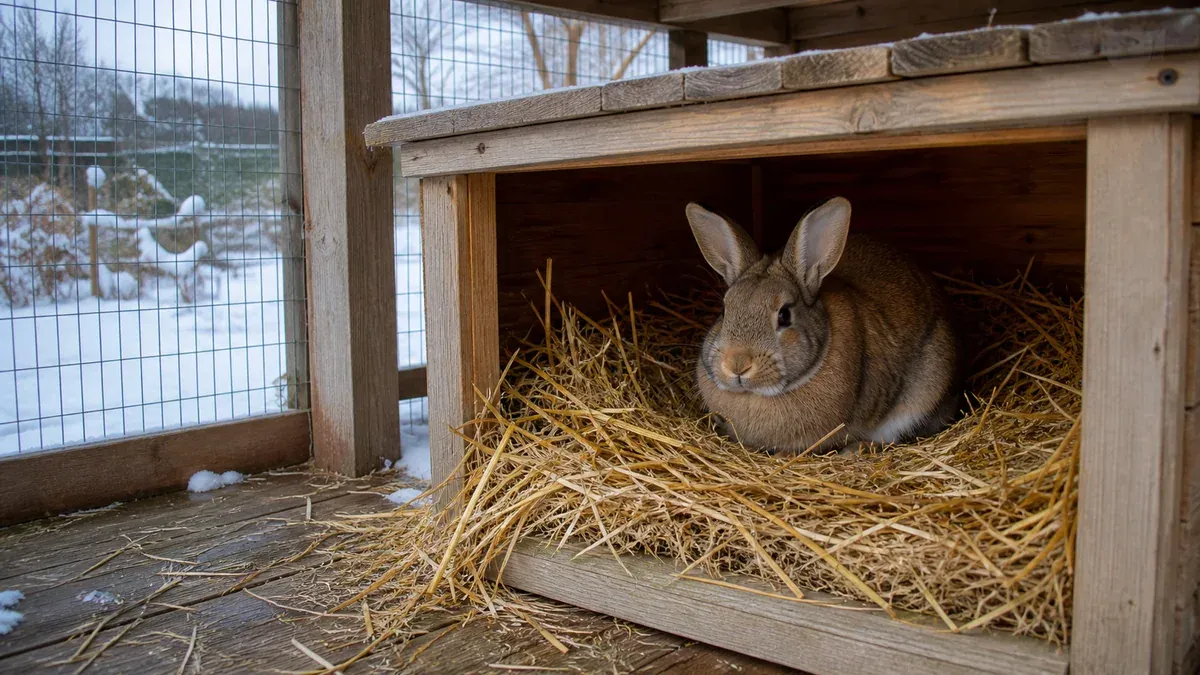
- Plenty of bedding: deep straw (not feeding hay) in the sleeping area, which the rabbit burrows into for warmth; refresh it as soon as it gets damp.
- Protect from moisture: raise the hutch off the ground, face the opening away from prevailing winds, drape a cover but always leave ventilation (otherwise condensation and ammonia build up).
- Keep a frost-free resting spot: if temperatures approach 0°C, consider moving the whole home into a sheltered space.
- Watch the water: a heavy bowl freezes more slowly than a bottle; break the ice or refresh the water several times a day.
- Company and rations: two bonded rabbits keep each other warm, and cold raises energy needs — offer unlimited hay in generous amounts.
In severe or prolonged frost, the safest option is to move the shelter, or the rabbit, into a frost-free space (an insulated garage, a utility room), away from cars and carbon-monoxide sources. For the general principles of outdoor living, see keeping a rabbit outdoors.
The mistakes to avoid
| To avoid | Why it’s a problem |
|---|---|
| Heat lamp or heat pad left unattended | Risk of burns, overheating and fire |
| Sealing the shelter airtight “to keep heat in” | Condensation, damp and ammonia: worse than dry cold |
| Leaving damp bedding in place | Damp cold becomes dangerous; refresh it often |
| Moving the rabbit endlessly between warm and cold | Repeated thermal shocks, poorly tolerated |
| Forgetting that water freezes | A rabbit that stops drinking eats less and risks stasis |
Recognising a rabbit that is too cold
Summer cooling is prevention; so is winter care. Stay alert to the signs of a rabbit that is cold or weakening: it hunches into a ball, stays prostrate, refuses to move, has cold extremities (ears, feet), or eats and drinks less. A drop in appetite in cold weather is never trivial: it can herald GI stasis, an emergency. When in doubt, warm the rabbit gradually in a temperate room and call a vet.
Going further
Browse all our rabbit housing guides and the rabbit species page to adapt its environment to every season.
Veterinary source
Frequently asked questions
At what temperature does a rabbit feel cold?
The RSPCA recommends 10–20°C for domestic rabbits. They can cope with colder conditions in dry, draught-free shelter, but near 0°C consider moving their home into a sheltered, frost-free space.
Can a rabbit live outdoors all year round?
A healthy adult, gradually acclimatised to the cold, can overwinter outdoors with a well-insulated, dry, draught-free shelter packed with deep straw. Damp cold is the real danger. Vulnerable rabbits should be brought into a frost-free space.
Does a rabbit need a heater or a hot water bottle in winter?
The best option is a well-insulated shelter and deep bedding the rabbit can burrow into. Avoid heat lamps and heat pads left unattended: risk of burns, fire and overheating. In severe cold, move the rabbit to a frost-free space rather than adding a risky heat source.
My rabbit's water freezes outdoors — what should I do?
Check the water several times a day, as a bottle freezes quickly and leaves the rabbit without a drink. Prefer a heavy bowl, which freezes more slowly than a bottle, and break the ice or refresh the water regularly. A rabbit that drinks less eats less, which can upset its gut.