How to Choose a Rabbit Carrier
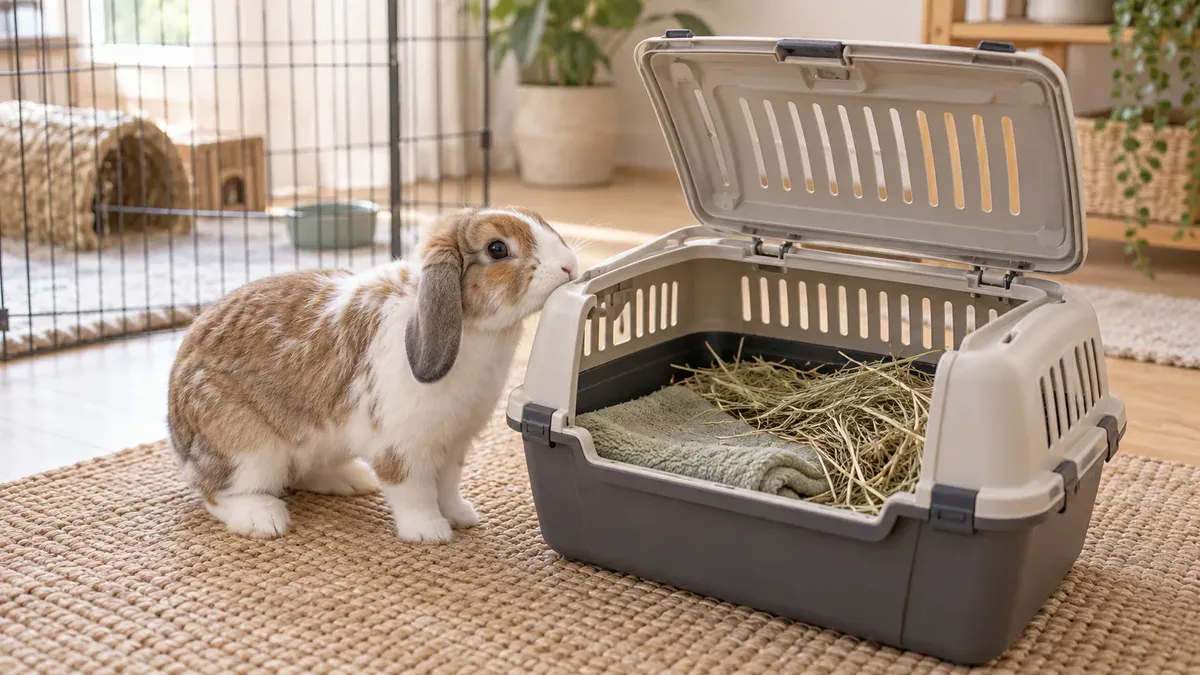
Get a hard-sided carrier with a front door AND a top opening, large enough for the rabbit to lie fully stretched out and turn around. Flat non-slip floor, reinforced clips or screw fastenings, and a weight you can carry at arm’s length for ten minutes.
The decisive criterion is the top opening, and it is the one most guides leave out. You do not get a rabbit out by pulling it through a front door: it grips, braces, and extraction turns into a struggle. From above, you lift it calmly while supporting the hindquarters. A carrier with no opening lid turns every vet visit into an ordeal, for you and for the practitioner.
The criteria that genuinely matter
Size, measured on the animal lying flat
The useful benchmark is not “big enough for the rabbit”. It is the length of the rabbit lying on its side with its legs extended, plus a margin. A rabbit that cannot stretch out stays tense for the whole journey.
Watch out for the adult-size trap: a two-month-old kit will become an adult of 1.5 to 6 kg depending on breed. Buying for today’s size means buying twice. What adult size changes in practice is covered in small or large rabbit, and a Flemish Giant needs a dog-sized model.
The two openings
- The front door is for voluntary entry, during training.
- The top opening is for getting the rabbit out, and above all for handling: a vet can examine a rabbit while leaving it in the box, which cuts stress considerably.
Check that the lid opens wide, not through a 10 cm porthole.
The floor
Flat, solid and non-slip. Never a grid: it injures the hocks, especially in breeds with less protective fur such as the Rex. A rabbit sliding on every bend arrives in a state of maximum stress.
Line it with a towel or fine absorbent bedding, and add hay.
The fastening
This is the most common point of failure. Thin plastic side clips give way over time, and the carrier opens at the worst possible moment. Prefer wide, reinforced clips, or a screw fastening on two-shell models. Test the closure empty a dozen times before relying on it.
Cleaning
A carrier is also used on days when the rabbit is ill. Yours needs to be fully rinsable and disinfectable, which means smooth materials and reachable corners. That alone rules out wicker and fabric.
What to rule out
| Model | Why to avoid it |
|---|---|
| Soft fabric bag | No protection under braking, collapses onto the animal, gets chewed |
| Wicker basket | Gets chewed, cannot be disinfected, unreliable closure |
| Open barred cage | No visual shelter: the rabbit watches everything rush past, maximum stress |
| Wheeled model | Ground vibration and noise are alarming for a prey species |
| Undersized “dwarf” carrier | The animal cannot lie down |
What does not matter
Panoramic portholes, colours, the clip-on bowls supplied (they tip), the padded mats included (rarely washable), and “2-in-1” models claiming to double as a spare cage. A carrier is a travel tool, not housing: the criteria for actual accommodation are in how to choose a rabbit pen.
The carrier is emergency equipment
This is what many people discover too late. On the day a rabbit stops eating, you need to leave for the vet within the hour — not order a carrier. So it should be bought before the animal arrives, alongside the pen and the tray: it is one of the genuinely essential accessories.
The situations that demand that immediate departure are listed in rabbit emergency warning signs.
Checklist before buying
- The adult rabbit will be able to lie fully stretched out and turn around.
- There is a wide top opening.
- The floor is solid, flat and non-slip.
- The clips are wide, or the fastening is by screw.
- The whole thing can be rinsed and disinfected.
- You can carry it loaded, at arm’s length, for the length of a walk.
- It fits in your car, braced against a seat back.
Once bought, do not put it away
A carrier brought out three times a year is an object that announces the vet, and rabbits learn that fast. Leave it open in the living space, with hay inside: it becomes an ordinary hiding place, and on departure day you are not chasing your animal around the room. The step-by-step method is in how to get a rabbit used to its carrier.
Where to go next
What comes next depends on your use. For the road, how to transport a rabbit by car covers bracing in the cabin, temperature and journey length. For trips of several days, travelling with a rabbit compares taking the animal with leaving it behind. And for the training itself, start with how to get a rabbit used to its carrier. The rest of our equipment guidance sits in the rabbit accessories section and the rabbit species profile.
Frequently asked questions
Can two rabbits travel in the same carrier?
Yes, if the two already live together and get on: having the other there noticeably reduces the stress of the journey. The carrier then needs to let both lie flat side by side without overlapping. Never put two rabbits together that are not yet bonded, though — a journey is a stressful context, exactly the kind that triggers a fight.
Will a cat carrier do for a rabbit?
Often yes, provided you check the dimensions rather than the label. Plenty of carriers sold for cats are perfectly suitable, and some sold for rabbits are too small. The only criterion that counts is that the animal can lie fully stretched out and turn around. Do be wary of models with widely spaced bars.
Should you put hay and water in the carrier?
Hay, always: nibbling occupies the rabbit and keeps the gut moving during the journey. Water, no, unless the trip runs to several hours — a bowl tips over and a clipped-on bottle loses its prime. On long journeys, offer water at stops instead, along with water-rich greens.
Where should the carrier be kept between trips?
Within reach, and ideally accessible to the rabbit. A carrier left open in the living space stops being the object that announces the vet and becomes an ordinary hiding place. That is the basis of carrier training, and it completely changes the stress level on the day you actually have to leave.