How to make a balcony safe for a rabbit
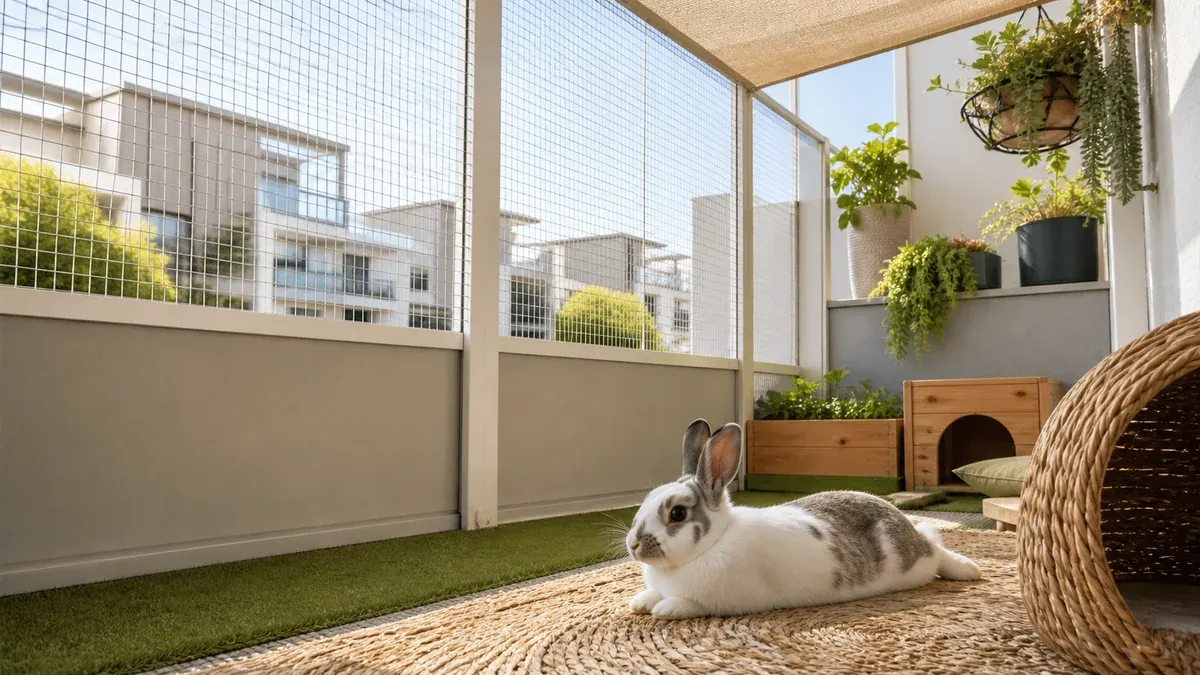
A balcony can give a rabbit a pleasant breath of fresh air, but it concentrates four major dangers you must neutralise before any outing: falling, escaping through the railings, exposure to sun and weather, and toxic plants or products. Making a balcony safe isn’t about decorating: it’s about physically closing every gap, guaranteeing shade and water, and never leaving the rabbit unsupervised. A balcony stays a supervised outing space, never a permanent home.
Falling: the number-one danger
This is the most serious and most underestimated risk. A rabbit:
- climbs a pot, a chair or a planter and gets up high in seconds;
- slips between spaced railings — a standard balustrade often lets a rabbit through, or at least its head, which risks it getting stuck or tipping over;
- leaps without judging the drop, especially when frightened (a sudden noise, a bird) or joyful (a binky).
A fall of several floors is almost always fatal. The only real protection is a closed physical barrier around the whole perimeter and over the full height: fine mesh or sturdy netting, well tensioned and fixed, with no gap at the bottom or on the sides. Check that no piece of furniture acts as a step up to the top of the railing.
Blocking the gaps between railings
A balustrade with vertical or horizontal bars won’t stop a rabbit. Two habits:
- Line the railing with small-gauge mesh (fine chicken wire, or a ventilation panel) fixed over its full height;
- Close the bottom with a solid panel 30–40 cm high (a board, plexiglass, rigid screening): it blocks floor-level gaps and cuts the wind and draughts at the same time.
Pay special attention to the corners and the join with the floor and wall: that’s where a rabbit tries to get through. A determined rabbit tests every gap; leave nothing wider than its head.
Sun, heat and weather
Rabbits cope badly with heat and an exposed balcony quickly turns into a furnace, without the shade or cool of indoors. The rules:
- only take the rabbit out during cool hours (early morning, late in the day);
- always provide a stable shaded area and accessible fresh water;
- bring the rabbit in as soon as the temperature climbs, without waiting for signs of distress.
A rabbit that pants, flattens out and turns apathetic in full sun is having heatstroke, a life-threatening emergency: see our guide on heatstroke in rabbits. Conversely, in cold, wet or windy weather, the balcony isn’t suitable. For temperature thresholds, see what temperature can rabbits tolerate.
Plants and products: what to remove
A balcony is often a mini-garden, and therefore a field of risks:
- many balcony plants are toxic to rabbits (oleander, geranium, ivy, bulbs, etc.) and a rabbit has no reliable instinct to avoid them: remove them or place them fully out of reach. See the list in which houseplants are toxic to rabbits;
- store away fertiliser, treated compost, slug pellets, cleaning products: all dangerous if swallowed;
- keep away treated or varnished balcony furniture that could be gnawed.
If you’re unsure about a plant, treat it as off-limits until you’ve checked.
Predators, noise and stress
A balcony exposes the rabbit to stressors absent indoors:
- birds of prey and cats can approach, especially on a low floor or near a tree; never leave the rabbit alone and unsupervised;
- street noise, fireworks, barking can trigger a panic leap — hence the need for a closed barrier;
- always provide a hiding place (tunnel, open box) where the rabbit can take refuge.
Since rabbits are prey animals, an environment that’s too open and noisy keeps them permanently on alert. Active supervision stays the rule.
Checklist before the first balcony outing
- Barrier closed around the whole perimeter and over the full height, with no gaps.
- No step-up furniture that reaches the top of the railing.
- Shaded area + fresh water available.
- Toxic plants and products removed or out of reach.
- A hiding place accessible.
- Active supervision planned: no rabbit alone on the balcony.
Going further
To go further on outdoor life and its limits, read keeping a rabbit outdoors: good or bad idea, all our rabbit housing guides and the rabbit species page for its core needs.
Frequently asked questions
Can a rabbit fall off a balcony?
Yes, and it's the number-one danger. A rabbit climbs better than you'd think, slips between spaced railings and can do a binky or a panic leap that carries it over the edge. A fall of several floors is almost always fatal. A balcony is never safe for a rabbit without a closed physical barrier over its full height and around the whole perimeter.
Can a rabbit live permanently on a balcony?
No. A balcony suits supervised outings in mild weather at best, never as a permanent home. Exposure to sun, cold, wind, noise and predators (birds, cats) is too much, and the space lacks a real climate-controlled refuge. The rabbit lives indoors; the balcony stays a supervised extra.
What kind of barrier should I fit on a balcony for a rabbit?
Fine mesh or sturdy netting fixed over the full height of the railing, with no gap at the bottom or the sides. Standard balustrade bars often let a rabbit — or its head — through. If needed, add a solid panel at the bottom (30–40 cm) to block gaps and cut the wind.
Is sun on a balcony dangerous for a rabbit?
Yes. Rabbits cope badly with heat and an exposed balcony can quickly become a trap, with no shade or cool. Only take the rabbit out during cool hours, always provide a shaded spot and water, and bring it in as soon as it warms up. A rabbit panting and flat in the sun is an emergency: see our heatstroke guide.