How to choose a rabbit breeder: the checks that actually matter
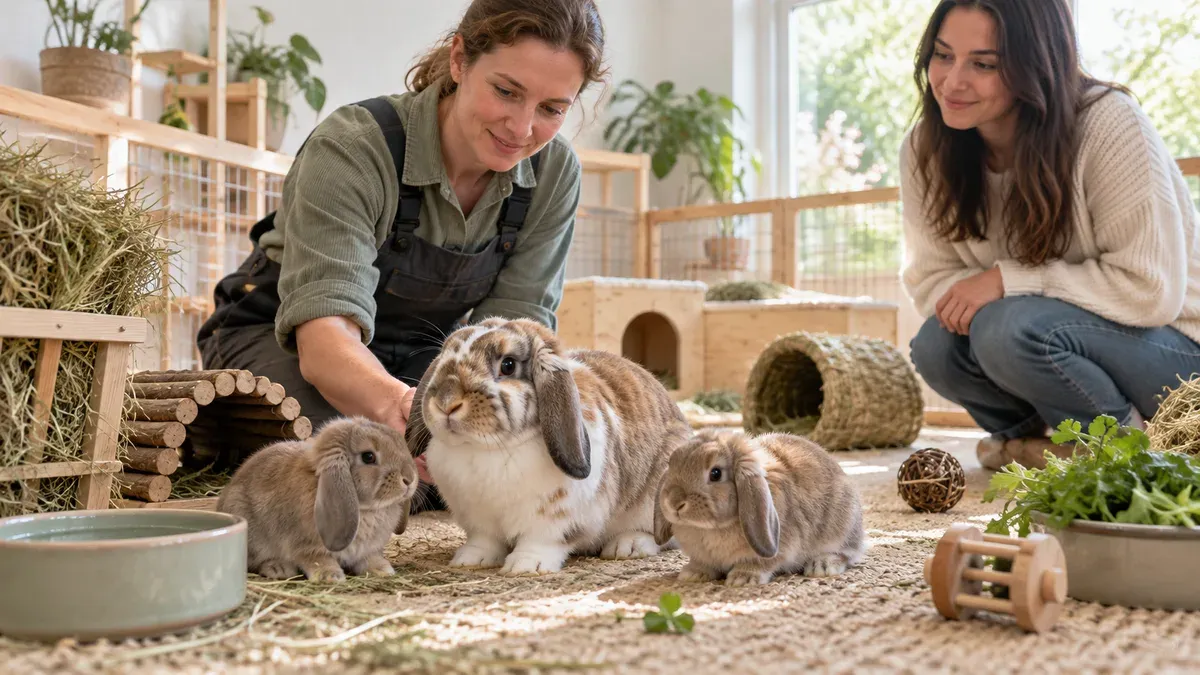
A rabbit breeder is chosen on three conditions, before any conversation about breed: they let you see where the rabbits live and meet the mother, they let no kit leave before full weaning, with a verifiable date of birth and they ask you as many questions as you ask them. If one of the three is missing, the litter can be beautiful: walk away.
This article assumes you have already decided how you are getting your rabbit. If you have not, the rescue / breeder / pet shop / private seller comparison is in should you adopt or buy a rabbit: for most future owners, adopting from a rescue remains the better starting point. A breeder makes sense when you want a particular size or coat type and accept that neutering and follow-up care are yours to arrange.
Where to look, and where not to
- Breed clubs and national rabbit associations: they list identifiable, contactable breeders, usually specialising in one or two breeds.
- Rabbit-savvy vets in your area: they see the kits from nearby breeders and know which ones arrive in good condition.
- Shows and breed events: useful for meeting several breeders in one day and seeing adults of the breed you are considering — not for leaving with an animal on impulse.
- Word of mouth from local rescues, including those that rehome: they know who breeds responsibly and who feeds the abandonment figures.
Three contexts are worth ruling out immediately: general classified ads where the same seller offers several species or several breeds at once, listings offering delivery or a handover at a neutral location, and accounts advertising kits “available now” all year round.
Screening on the phone, before you travel
Five questions are enough, and they take five minutes. The aim is not to catch the breeder out, but to avoid a two-hour drive for nothing.
| The question | What a good answer contains | What should worry you |
|---|---|---|
| What is the exact date of birth, and what collection date do you have in mind? | A precise date, and collection after full weaning | ”He’s ready whenever you like”, or a vague age |
| How many breeds do you keep, and how many litters a year? | One or two breeds, a limited number of litters | Several species, litters back to back |
| What exactly are the kits eating at the moment? | Unlimited hay, named pellets, quantities | A vague answer, or one built around a muesli mix |
| Can I see the mother and where the kits live? | Yes, by appointment | A flat refusal, or an offer to hand over elsewhere |
| Who checked the sex, and what happens if there is a problem? | A sexing they stand behind, to be confirmed by a vet, and a take-back option | ”We’ll see later”, no follow-up of any kind |
The third question repays itself fastest: the exact current diet governs the diet transition of the following weeks, and a vague answer often signals a set-up where hay is not fed ad lib.
On the visit: what you should be shown
Look at the whole set-up, not just the kit that is placed in your arms.
- Visible hay in every enclosure, in quantity, not the last wisps in an empty rack.
- Space and a decent floor: the rabbits should be able to stand up and move about, on a solid rather than wire floor.
- A mother in good condition: clean coat, no thinness, no discharge from eyes or nose.
- Curious kits that come over to sniff rather than pressing themselves into the far corner as a group.
- A calm environment, without overcrowding or an ammonia smell that stings your eyes.
- Kits separated by sex as soon as their age warrants it, which implies somebody has genuinely sexed them.
Two things should end the visit, even after a long drive: a kit with nasal or eye discharge, a soiled rear end or a hunched posture; and a seller who cannot say what the animal eats or when it was weaned. Rescuing a sickly kit funds the next litter, and commits you to immediate veterinary costs you had not planned for.
What a good breeder asks you
This is the most telling criterion, and the most often forgotten. A breeder who asks nothing is selling an animal; a breeder who asks is placing a rabbit. Expect to talk about:
- your set-up: pen size, which room, other animals in the home;
- your experience and the time you have each day;
- where you stand on spaying or neutering when the time comes;
- children in the household and who does the daily care;
- your vet, or at least the fact that you have found a practice that sees rabbits.
A breeder who turns a sale down because the situation does not suit them tells you more about their standards than any sales pitch.
What to take home with you
On collection day, insist on it in writing — a seller’s memory is short, and this information is needed from the very first consultation:
- the date of birth and the weaning date;
- the stated sex and who checked it, to be reconfirmed by your vet;
- the exact current diet, pellet brand and hay type included, with enough to last a few days;
- the health history: vaccinations given and when, any treatments, known issues in the line;
- the breeder’s contact details and their willingness to answer questions after the sale;
- a receipt or sale document carrying the seller’s identity. In England, selling animals as pets in the course of a business is a licensable activity; rules differ across the UK and the rest of Western Europe, but asking for written paperwork and an identifiable seller is good practice everywhere.
Then book a vet check within the first few days: it confirms the sex, checks teeth and general condition, and sets the vaccination schedule. The thresholds for booking are in when to see an exotic vet for your rabbit, and feeding a young rabbit is covered in what to feed a 2-month-old baby rabbit.
The three traps specific to breeders
- The “toy dwarf” that “stays small forever”. A sales label cannot predict adult size. Ask for the breed, the adult weight of both parents and how that information was established; reject an unsupported size promise.
- Back-to-back litters. A doe producing without a break, and stock advertised all year round, describes a backyard breeder rather than a breeding programme. The consequence for you is concrete: more fragile kits and no aftercare.
- Casual sexing. This is the most expensive mistake in the whole trade: two mis-sexed kits housed together can produce an unplanned litter once sexually mature, and timing varies with size. Have the sex reconfirmed by a vet, as buying a rabbit from a pet shop also stresses, and settle the pairing question before adding a second rabbit (male or female rabbit).
If you have already reserved and doubts creep in
- Ask for dated photos of the mother and litter, or a live video visit. A refusal is itself an answer.
- Do not let the collection date move forward. A kit “ready early” is a kit weaned early, with the digestive risk that comes with it.
- Make the first vet appointment a condition, and book it before you collect the rabbit.
- Walk away if the animal is visibly unwell, and report the situation to a local rescue rather than paying.
The purchase price should not weigh in this decision: it is a small share of what the first months actually cost, as set out in how much does a rabbit cost per month.
Where to go next
One concrete step: before travelling anywhere, make the five-question phone call and write the answers down. If three of them come back vague, the decision is already made. Once you have chosen, prepare for arrival with what to feed a 2-month-old baby rabbit and the diet transition guide, and compare the routes one last time in should you adopt or buy a rabbit. Our other guides are gathered in the rabbit adoption section and in the rabbit species profile.
Sources and references
- Rabbit Welfare Association & Fund — Neutering, castration and spaying
- UK legislation — Licensing conditions for selling animals as pets in England
Frequently asked questions
Does a pedigree guarantee a healthy rabbit?
No. A pedigree records ancestry, not health or temperament. It is useful if you are after a specific body type, but it replaces neither seeing the conditions the rabbits live in, nor a check-up with a rabbit-savvy vet, nor questions about the parents. A kit without papers from a transparent breeder beats a pedigree kit handed over in a car park.
Should I walk away from a breeder who will not let me into the rabbitry?
Not automatically, but they should then offer a serious alternative: viewing the rabbits from the doorway, meeting the mother and litter in a reception area, or a live video visit. Some set-ups genuinely restrict entry for biosecurity reasons. What should end the conversation is a refusal to show you anything at all, combined with an offer to hand the rabbit over at a car park or on your doorstep.
Is it normal to reserve a baby rabbit before it is born?
Yes, it is common with breeders who produce few litters, and there is nothing odd about it. Two precautions: get the deposit and its refund terms in writing, and keep the collection date after full weaning, with no bringing it forward "because he's ready". A breeder offering to hand a kit over earlier than planned is giving you a warning sign, not a favour.