The main domestic rabbit breeds, and what a breed actually predicts
Veterinary note — This page describes conformation tendencies, not a diagnosis. Any dental, ear, eye or skin abnormality, in any breed, needs to be seen by a vet experienced with rabbits.
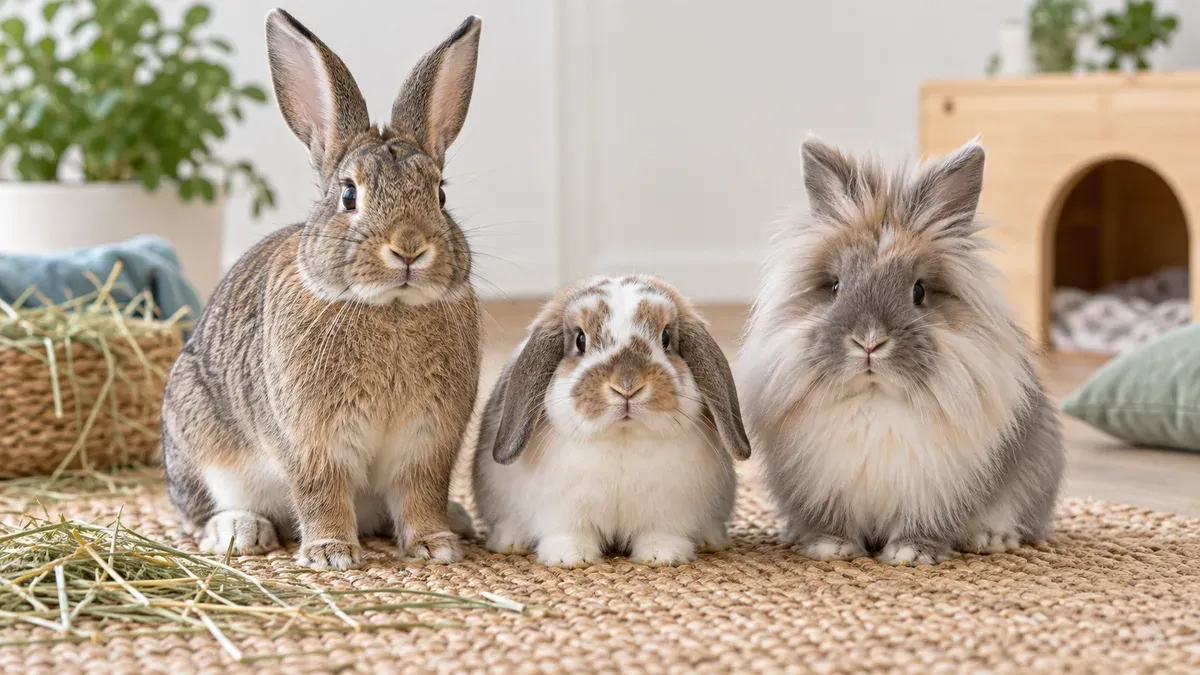
Domestic rabbit breeds are best sorted by three variables that genuinely change daily life: adult size, coat type, and the shape of the head and ears. Almost everything else — colour, breed name, country of origin — has little practical consequence.
One clarification saves a lot of disappointment: a breed does not predict a personality. It predicts litter tray size, brushing frequency and certain health predispositions. Temperament comes from elsewhere, which is the subject of how to choose your first rabbit.
The three variables that actually matter
Before settling on a breed name, place the rabbit on these three axes. They determine equipment, budget and workload.
| Variable | What it changes in practice | What to check before adopting |
|---|---|---|
| Adult size | Enclosure and litter tray size, hay volume, pellet portion, vet costs, strength when handled | Expected adult weight, not today’s weight |
| Coat type | Brushing frequency, moult management, matting risk, digestive risk from swallowed fur | Actual coat length on the flanks and rear, not the back |
| Head and ears | Dental risk, ear risk, how easy home checks are | Muzzle shape, and whether the ears drop |
A 1.2 kg rabbit and a 6 kg rabbit eat the same hay in the same relative proportion, but they do not live in the same space and do not cost the same. Space figures are in what size enclosure for a rabbit, and portion figures in how much pellets to feed a rabbit.
Breeds by adult size
The groups below cover the breeds most often seen in the UK and Western Europe. Weight ranges are indicative and vary between national standards.
Small breeds (roughly 1 to 2 kg as adults)
Netherland Dwarf, Polish, Lionhead, Dwarf Lop, Mini Lop. These are the most commonly sold rabbits, and the ones most often misunderstood: “dwarf” describes a size, not reduced care needs or a smaller space requirement. That point is covered in dwarf rabbits: adult size and real needs.
Two practical consequences: a small rabbit is easier to handle but is injured more easily in a fall, and the dwarf breeds with shortened faces account for a large share of dental problems.
Medium breeds (roughly 2 to 4 kg as adults)
Rex, English Spot, Dutch, Havana, Silver Fox. This is the most comfortable category for a first household: sturdy enough to handle without anxiety, small enough for a standard home, and usually free of extreme conformations.
The Rex stands out for a short, dense coat with no guard hairs — pleasant to touch, but with less padding under the feet, which makes flooring worth attention. See the best floor surface for rabbits and sore hocks in rabbits.
Large breeds (4 kg and over as adults)
Flemish Giant, French Lop, Continental Giant, British Giant. These rabbits need a substantially larger pen, an oversized litter tray, proportionally more hay, and higher vet costs. They are often described as calm, but their weight makes every handling more delicate — for them as much as for you.
Rarely anticipated: average life expectancy in the very large breeds is generally shorter than in small and medium rabbits, and their weight adds load to joints and feet.
Breeds by coat type
This is the variable with the biggest effect on weekly workload.
- Standard short coat (most breeds): routine brushing, stepped up during moults.
- Dense short coat without guard hairs (Rex): few mats, but less protected foot pads.
- Medium coat (Lionhead, many crossbreeds): highly variable between individuals, with the mane and rear needing watching.
- Long coat (Angora, and double-maned Lionheads to a lesser degree): grooming is compulsory, not optional, with a real risk of tight mats and swallowed fur.
Rabbits cannot vomit: fur swallowed during grooming either passes through or accumulates. A long coat is therefore not a cosmetic detail but a digestive risk factor, covered in rabbit swallowing fur and rabbit moulting: normal or not.
The three conformations that need closer monitoring
| Conformation | Breeds involved | What to watch |
|---|---|---|
| Shortened face | Short-muzzled dwarfs, Lionheads | Malocclusion, watery eyes, difficulty gripping hay |
| Lop ears | Dwarf Lop, French Lop, Mini Lop | Wax build-up, ear infections, and a higher dental frequency |
| Long coat | Angora, double-maned Lionhead | Tight mats, soiled fur at the rear, ingested fur |
These predispositions are documented in the standard veterinary references on rabbit dental and ear disease (see sources below). They do not rule out any breed — they tell you where to look first, how often, and what should prompt a consultation. Home checks are described in rabbit dental malocclusion and ear mites in rabbits.
What a breed does not tell you
Three persistent beliefs are worth clearing up before choosing:
- “This breed is cuddly.” Breed temperament descriptions are breeding tendencies, not individual guarantees. Neutering, weaning age and handling method count for far more — see how to tame a fearful rabbit.
- “A dwarf rabbit needs less space.” Movement and exercise needs do not shrink with size: the minimum is the same, set out in how many hours of exercise does a rabbit need.
- “My rabbit is a [breed].” Without a pedigree it is a type, not a breed — and that is fine. Manage the rabbit by its actual size and actual coat.
Where to go next
A concrete next step: instead of starting from a breed name, write down the two numbers that constrain you — available floor space, and the hours of daily exercise your week genuinely allows. Those two numbers rule out incompatible sizes on their own, and what remains is a decision about coat, which is really a decision about grooming time.
The two breeds most often sold in pet shops are covered in dwarf lop rabbit: temperament, size and care and lionhead rabbit: coat, temperament and real needs. Our other guides are gathered in the rabbit breeds section and on the rabbit species page.
Veterinary sources
- RSPCA — Rabbit health and welfare
- VCA Hospitals — Dental disease in rabbits
- MSD Veterinary Manual — Eye and ear disorders of rabbits
Frequently asked questions
How many rabbit breeds are there?
Several dozen are recognised, and the exact number differs between countries because each national association maintains its own standard. The figure has little practical value: most rabbits in rescues, pet shops and homes are crossbreeds with no identifiable breed, and their needs are set by adult size and coat type rather than by a label.
How can I tell what breed my rabbit is?
In most cases you cannot, and it rarely matters. A breed is only proven by a pedigree from a registered breeder. Without paperwork you can describe a type — short-coated dwarf, lop, long-coated — and that is enough to choose the right litter tray, enclosure size, brush and care routine.
Are pedigree rabbits more fragile than crossbreeds?
Not inherently, but some traits selected by breed standards carry well-documented predispositions: a shortened face with dental disease, lop ears with ear problems, a long coat with the digestive risk of ingested fur. A crossbreed with the same conformation carries the same risks.
Can a breed guarantee a friendly rabbit?
No. Breed temperament descriptions reflect tendencies noted by breeders, not traits that reliably pass to an individual. Health, previous experience, socialisation, reproductive status, environment and handling can all influence behaviour. Two rabbits of the same breed can have opposite personalities.