Which Rabbit Breed Sheds the Least?
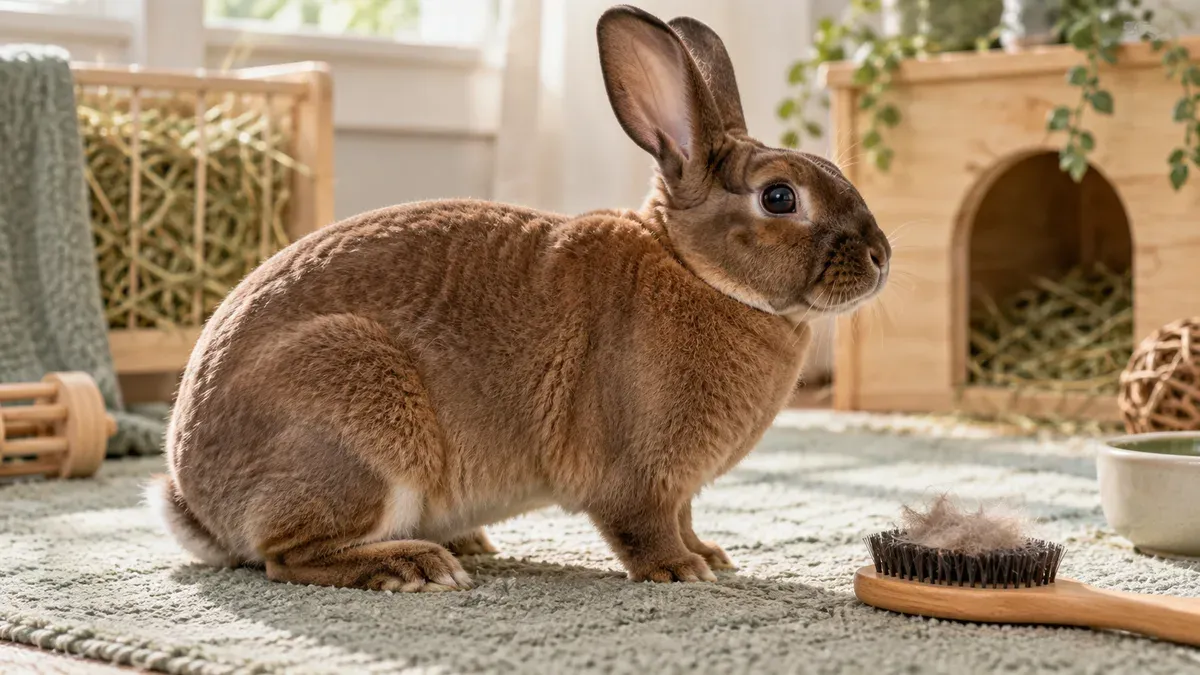
No rabbit breed sheds little. They all moult, and many moult heavily in spring and autumn. If your selection criterion is “an animal that does not leave fur everywhere”, the rabbit is not the right species — and switching breed will not change much.
That said, the workload genuinely varies. The Rex is the easiest to maintain: its short, dense coat, lacking guard hairs, mats little and needs minimal intervention. At the other end, the Angora and the Lionhead demand daily attention. In between, most standard short-coated breeds sit at moderate upkeep.
The ranking, and what it is worth
| Coat type | Breeds | Grooming load |
|---|---|---|
| Short, dense, no guard hair | Rex | Lowest: regular checks, light brushing during moults |
| Standard short coat | Most breeds | Moderate: routine brushing, stepped up during moults |
| Medium coat | Single-maned Lionhead, crosses | Varies by individual |
| Long coat | Angora, double-maned Lionhead | Highest, non-negotiable |
The full framework for reading a breed — size, coat type, head and ear shape — is set out in the main domestic rabbit breeds. This page deals with one variable only: the coat.
On the Rex, two sources agree: the PDSA states it does not need conventional grooming and that a wipe with a damp cloth suffices where necessary, and the British Rabbit Council considers regular visual inspection enough for most Rex rabbits, with light brushing during moults.
What matters more than breed
This is what breed comparisons systematically leave out. Within a single breed, these four factors create wider gaps than the difference between a Rex and a standard short-coated rabbit:
Season. Rabbits renew their coat year-round, with peaks in spring and autumn triggered by day length. The same animal can go from barely shedding to a spectacular moult in a fortnight.
Indoor living. Constant artificial light and stable temperatures blur the seasonal signal. Many house rabbits therefore shed more continuously and less intensely — which feels like a permanent moult.
Age and weight. A senior or overweight rabbit grooms itself less effectively. Dead fur stays put, then comes away all at once, typically over the back and rear end, the areas the animal can no longer reach.
Number of animals. Two rabbits grooming each other each swallow the other’s fur. A pair does not merely double the volume: it shifts the risk.
What these four have in common: they are largely independent of breed, and all of them are managed by observation rather than by the choice you make at adoption.
The real issue is not housework
In rabbits, shedding is not primarily a question of keeping the sofa clean. Rabbits cannot vomit: fur swallowed during grooming has to pass through, or it accumulates. During a moult, the quantity ingested rises sharply.
That is why brushing matters, and it matters for every breed: fur removed by the brush is fur the animal will not swallow. What that means in practice — when to brush, which gut-motility levers to pull, what to watch — is set out in my rabbit is swallowing fur.
And if you are not sure whether what you are seeing is a normal moult, the distinction from a skin problem is made on the appearance of the skin, not the quantity of fur: see rabbit moulting: normal or not.
If your criterion is allergy
This is often the real question behind “which breed sheds least”. The answer is unambiguous: no rabbit is hypoallergenic, and choosing a Rex will not resolve an allergy.
Two reasons. First, the animal allergen is not only fur. Second, and this is specific to rabbits, hay is itself a common allergen — and it is permanently present in the home, in quantity, because it is the basis of the diet. An allergic household cannot engineer its way around that by changing breed.
If someone in the household has a history of allergies or asthma, the question is settled with a doctor before adoption. It is a frequent reason rabbits are given up, as noted in are rabbits good pets for children.
What to choose, in practice
- You want minimum coat maintenance: a Rex, or a standard short-coated breed. Note though that Rex fur protects the hocks less well, which means checking the hocks and getting the flooring right.
- You accept daily grooming: an Angora is viable, provided you commit to daily detangling or regular clipping.
- You are allergic: breed is not the lever; the decision belongs with a doctor.
- You mainly want to limit swallowed fur: brushing during moults matters more than any breed choice.
And the reminder that holds across the whole breed cluster: a breed predicts practical constraints and predispositions, not a character or a guarantee of convenience.
Sources
- Rex rabbit, PDSA — grooming needs of the Rex.
- Grooming, British Rabbit Council — coat care by coat type.
- Rabbit health and welfare, RSPCA — routine care and coat monitoring.
Where to go next
If your breed choice is still open, go back to the full framework in the main domestic rabbit breeds, which crosses coat with size and body shape. If you already have a rabbit mid-moult, the practical handling is in my rabbit is swallowing fur. And if the look of its coat worries you, rabbit moulting: normal or not covers the signs that warrant a vet. The rest of our profiles sit in the rabbit breeds section and the rabbit species profile.
Frequently asked questions
Is there such a thing as a hypoallergenic rabbit?
No. No rabbit breed is hypoallergenic, and picking a breed will not solve an allergy. The allergen is not only the fur either: hay, permanently present in the home and essential to the diet, is itself a common allergen. If someone in the household has a history of allergies or asthma, that question is settled with a doctor before adoption.
Does an indoor rabbit moult all year round?
Often more than an outdoor one, yes. Moulting peaks are triggered by day length, and constant artificial lighting combined with a stable temperature blurs that signal. Many house rabbits therefore shed more continuously and less sharply, rather than in two distinct waves.
Do short-haired rabbits need brushing?
Outside a moult, little or not at all: a healthy short-coated rabbit maintains itself. During moulting peaks, though, brushing becomes useful for every size and coat type, because fur removed by the brush is fur the rabbit will not swallow. It is a question of timing, not breed.
Do short-haired rabbits shed less than long-haired ones?
They shed a smaller and, above all, less visible volume, but they moult just as much. The difference is in the workload — detangling, mats, possible clipping — far more than in how much fur ends up on your clothes.