Lionhead rabbit: coat, temperament and real grooming needs
Veterinary note — This page is about coat care, not diagnosis. Patchy hair loss, crusting, redness, loss of appetite or a drop in droppings needs a vet experienced with rabbits.
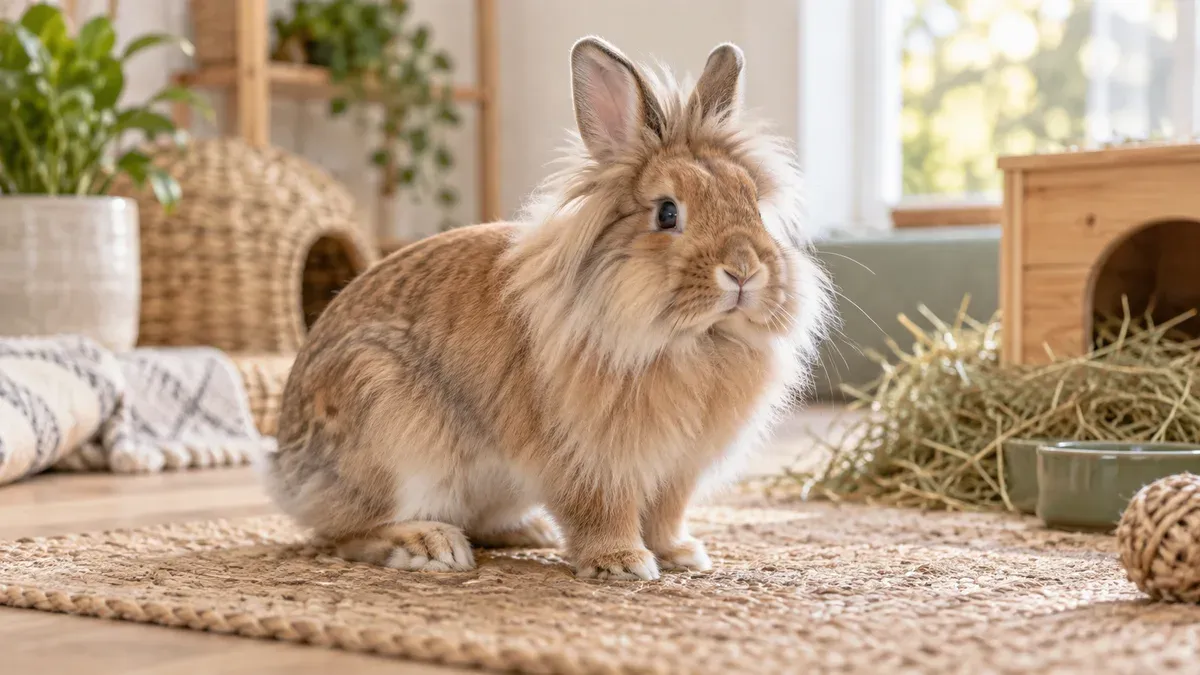
The lionhead is a small rabbit of 1.3 to 1.8 kg as an adult, recognisable by the mane of longer fur framing its head. Its real challenge is neither size nor temperament: two lionheads can need radically different grooming, depending on whether they carry a single or a double mane; without a pedigree or observations from birth, a young rabbit’s appearance may not establish its genotype.
This page covers this breed and its coat. The general picture of sizes and coat types stays in the main domestic rabbit breeds.
Single or double mane: the difference that changes everything
The mane depends on how many copies of the responsible gene the rabbit carries. In practice this creates two very different care profiles.
| Single mane | Double mane | |
|---|---|---|
| Appearance | Light collar around the head | Dense collar, plus a “skirt” on flanks and rear |
| Change with age | Often thins after the first year | Persists for life |
| Care | Adapt to density and any tangles | Often more intensive on the mane, flanks and rear |
| During a moult | Inspect the coat more often | Check long areas daily and brush as the coat requires |
| Matting risk | Low to moderate | High on flanks and rear |
Characteristic markings at birth can help a breeder distinguish single from double mane, and a pedigree adds context. With a young rabbit of unknown history, however, do not promise a future coat from a label: inspect the current coat and plan for the more demanding profile.
The three areas to check before adopting
A lionhead’s back tells you almost nothing — it is often short whatever the type. What actually informs you:
- The mane, around the neck and behind the ears — a dense, deep collar points towards a double mane.
- The flanks, just in front of the thighs — a skirt of longer fur here is the best single indicator.
- The rear and the area around the anus — the critical zone, both for matting and for hygiene.
That last point matters most for health: long, soiled fur around the anus traps caecotrophs and urine, irritates the skin, and — outdoors or in warm weather — exposes the rabbit to flystrike. Check for a clean, dry rear every week, with no scissors involved.
The real health stake: swallowed fur
Rabbits groom constantly and cannot vomit. In a long-coated rabbit, the volume of fur ingested during a moult is substantially higher, and that fur has to move through with the gut contents.
This is not a cat-style hairball: the problem is almost never the fur itself, but a gut that slows down and lets the fur clump together. Which gives one simple, non-negotiable rule for this breed: unlimited hay is not a comfort recommendation, it is the main preventive measure.
Signs to watch during a moult:
- droppings that are smaller, sparser, or strung together by strands of fur;
- appetite dropping, particularly for hay;
- a hunched, unresponsive rabbit that stops eating its caecotrophs;
- no droppings at all for several hours — an emergency, see rabbit GI stasis and rabbit emergency warning signs.
The full mechanism is set out in rabbit swallowing fur, and what a normal moult looks like in rabbit moulting: normal or not.
How to brush, and what never to do
- Work in short sections, with the rabbit on the floor or a non-slip surface, never at height and never on its back.
- Hold a mat at its base, against the skin, so you are not pulling on the skin while you work the tip.
- Never use scissors. Rabbit skin is very thin and lifts with the mat: the cut goes unnoticed at the time and is discovered afterwards. A mat that will not yield is clipped with a short-blade clipper, or handed to a rabbit-savvy vet.
- Stop before the rabbit tenses up. Three short sessions beat one long endured session, which only makes the next one harder.
The choice of tool matters less than regularity: a soft brush and a wide-toothed comb cover most situations. For core equipment, see what accessories are truly essential for a rabbit.
Temperament and the shortened face
Lionheads are often described as lively and sociable, but that reputation does not predict an individual’s temperament. Health, previous experience, socialisation, reproductive status and environment can all affect behaviour (how to tame a fearful rabbit).
One point does deserve conformation-specific attention: some lines have a shortened muzzle, which carries a higher dental risk. The useful check is the same as for lops — watch the rabbit eat long-strand hay, and take notice of sorting, one-sided chewing or watery eyes (rabbit dental malocclusion, my rabbit has watery eyes).
Where to go next
A concrete next step: before saying yes to a lionhead, run your hand over the animal’s flanks and rear and make an honest estimate of the time you will give to brushing during a moult. If the answer is “when I get a chance”, choose a short coat instead — that is a comfort decision, not a compromise.
To compare with the other breed common in pet shops, see dwarf lop rabbit: temperament, size and care, and to place coat types side by side, the main domestic rabbit breeds. Our other guides are gathered in the rabbit breeds section and on the rabbit species page.
Veterinary sources
- Merck Veterinary Manual — Skin disorders of rabbits
- VCA Hospitals — Gastrointestinal stasis in rabbits
- RSPCA — Rabbit health and welfare
Frequently asked questions
Why is my lionhead losing its mane?
A mane that thins with age is common, particularly in single-maned lines: the collar present in a young rabbit often thins out after the first year. That is different from hair loss that is patchy, symmetrical, or comes with redness, crusting or scratching — which calls for a consultation rather than a genetic explanation.
Should a lionhead rabbit be clipped?
Not as a routine. Clipping is justified when tight mats are already established and can no longer be teased out without pain, and it is done with a short-blade clipper, never with scissors: rabbit skin is extremely thin and cuts with alarming ease. For extensive matting, have it done by a rabbit-savvy vet or a groomer trained in small pets.
Is a lionhead suitable for a beginner?
Yes, provided you accept variable coat care and assess the actual coat. Brushing frequency depends on length, density, tangles and moulting; it cannot be inferred from the name “Lionhead” alone. If your available time is uncertain, a standard short-coated rabbit is the safer choice.
What is the difference between a single and a double mane?
It comes down to how many copies of the mane gene the rabbit carries. A double mane produces a dense, lasting collar, usually with a skirt of longer fur on the flanks and rear. A single mane gives a lighter collar that fades with age. Birth markings and a pedigree can inform the genotype, but the appearance of a young rabbit sold without that history may not be conclusive; assess its current coat above all.