Dwarf lop rabbit: temperament, size and what care really involves
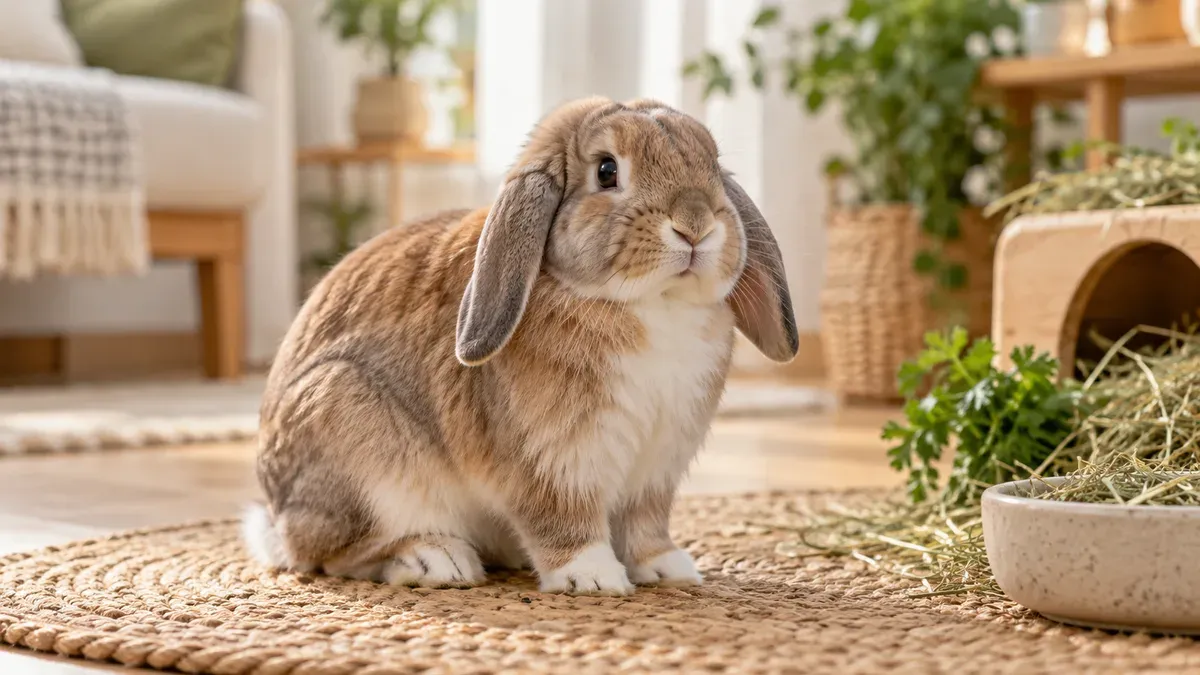
Veterinary note — This page describes conformation predispositions, not a diagnosis. Dirty, smelly or painful ears, a head tilt, or a drop in appetite need a vet experienced with rabbits without delay.
An adult dwarf lop commonly weighs 1.5 to 2.5 kg depending on the line and the national standard — often more than a Netherland Dwarf, despite the “dwarf” label. Its defining feature is neither its size nor its temperament: it is the lop-ear conformation, which can make wax and inflammation harder to spot. A brief weekly visual check is a practical routine, not a clinically proven interval.
This page covers this breed specifically. The general picture of sizes and coat types stays in the main domestic rabbit breeds, and the confusion around the word “dwarf” in dwarf rabbits: adult size and real needs.
Size: what “dwarf” actually means here
| Reference point | Indicative value |
|---|---|
| Adult weight | 1.5 to 2.5 kg depending on line and standard |
“Dwarf” here describes selection for size within the lop group, not a miniature rabbit. An adult dwarf lop is therefore a small-to-medium rabbit, and its space, hay and exercise needs are those of any rabbit — see what size enclosure for a rabbit and how many hours of exercise does a rabbit need.
A budget consequence that is rarely anticipated: vet fees, hay consumption and litter tray size follow actual body size, not the breed name. Figures are in how much does a rabbit cost per month.
Why lop ears change the care routine
In an upright-eared rabbit the pinna stands up and the ear canal is broadly open: it ventilates itself and can be inspected at a glance. In a lop, the pinna falls and partly folds over the canal entrance. Three practical consequences:
- Wax clears less easily and can build up without being visible from outside.
- The canal stays warmer and more humid, a setting more favourable to infection.
- You will not notice a problem by accident — you have to lift the ear and look, deliberately.
A 2019 study of 30 rescue rabbits found more ear-canal stenosis, wax, redness and several dental abnormalities in the 15 lop-eared rabbits than in the 15 erect-eared rabbits. The sample was small and does not predict what will happen to an individual rabbit, but it supports closer observation of lop ears and eating behaviour.
The weekly check, in thirty seconds
- Gently lift one ear, then the other, in a well-lit room.
- Look at the canal entrance: it should be clean, pale pink, with no brown debris or crusting.
- Bring your nose close: a strong or sour smell is abnormal, even with nothing visible.
- Watch the reaction: a rabbit that pulls away sharply, shakes its head or scratches the ear straight afterwards is telling you something.
What should prompt a consultation: brown or dark debris, crusting, smell, pain on handling, repeated head shaking (my rabbit is shaking its head) or a head held to one side (my rabbit has a head tilt). Ear mites, common and intensely uncomfortable, are covered in ear mites in rabbits.
What not to do: clean as a routine, and above all not with a cotton bud. It packs wax deeper and can mask — or worsen — an early infection. Ear cleaning is done on prescription, with a suitable product.
The ear-tooth link, usually left out
This is the angle most breed profiles skip: in rabbits, the skull, the tooth roots and the ear canals are close neighbours. Conformations selected for a round head and a short muzzle come with more crowding, and the veterinary literature links lop-eared rabbits to a higher frequency of dental problems as well as ear problems.
Hence a second weekly check, as quick as the first: watch the rabbit eat long-strand hay. A rabbit that sorts the strands, drops a mouthful, chews on one side only, drools slightly, or abandons hay in favour of pellets should be examined — see rabbit dental malocclusion and my rabbit is drooling.
Unlimited hay is not only a gut question: it is the main source of steady tooth wear. Quantity guidance is in how much hay does a rabbit need.
Temperament: what the breed explains, and what it does not
Dwarf lops carry a reputation for being gentle and sociable. Part of that is an observation bias: lop ears remove a rabbit’s most visible alarm signal. An upright-eared rabbit points its ears at whatever worries it; a lop cannot. Its stress becomes harder to read, and a tense animal can pass for a placid one.
Two concrete consequences:
- Read the rest of the body — hunched posture, fast nose, frozen stance — rather than the ears. The detail is in how to read rabbit body language.
- Approach from the front and announce yourself, because a lop cannot aim its ears toward a sound in the same visible way. Give every rabbit time to notice you before touching it.
Beyond that, a breed label cannot reliably predict an individual’s temperament. Health, previous experience, socialisation, reproductive status and the current environment can all affect behaviour (should you spay a female rabbit, should you neuter a male rabbit).
Coat care
The dwarf lop is short-coated in its standard form: weekly brushing is enough outside moults, stepped up to several times a week during them — see rabbit moulting: normal or not. Watch out for crosses with long-coated breeds, which are common in pet shops: check the real coat length on the belly and rear, not on the back.
Where to go next
A concrete next step: if you are bringing home a dwarf lop, set a two-minute weekly appointment from the first week — ears lifted and looked at, then a minute watching the rabbit eat hay. This cannot prevent or diagnose disease, but it gives you a consistent baseline from which to notice a change promptly.
To compare with the other breed most often sold in pet shops, see lionhead rabbit: coat, temperament and real needs, and to place the dwarf lop among the size groups, the main domestic rabbit breeds. Our other guides are gathered in the rabbit breeds section and on the rabbit species page.
Veterinary sources
- Johnson & Burn, Veterinary Record (2019) — rescue-population study of aural and dental pathology in lop-eared rabbits
- MSD Veterinary Manual — Eye and ear disorders of rabbits
- VCA Hospitals — Dental disease in rabbits
- RSPCA — Rabbit health and welfare
Frequently asked questions
Are dwarf lops calmer than other rabbits?
That is the breed's reputation, not a reliable prediction for an individual. Assess the rabbit in a calm setting and read its whole posture: lop ears make ear-position signals less visible, but they do not prove that the rabbit is calm or cuddly.
At what age do a dwarf lop's ears drop?
Not always straight away. Many lop kits are born with upright or helicopter ears, and carriage can change while they grow. Asymmetry alone is not a diagnosis, but discharge, smell, scratching, pain or a head tilt warrants veterinary advice.
Should I clean a dwarf lop's ears?
No — not as a routine, and never with a cotton bud, which packs wax deeper into the canal. The useful habit is a weekly visual check. Cleaning is done only on veterinary advice with a prescribed product: a blocked canal can hide an infection or mites, and blind cleaning delays treatment rather than providing it.
Does a dwarf lop need less space because it is a dwarf?
No. An adult dwarf lop commonly outweighs a Netherland Dwarf, and its movement needs are those of any rabbit: several hours out of the pen every day, and enough room for three consecutive hops. The word dwarf describes a selection line, not a reduced space requirement.