First days with a new rabbit: what is normal and what is not
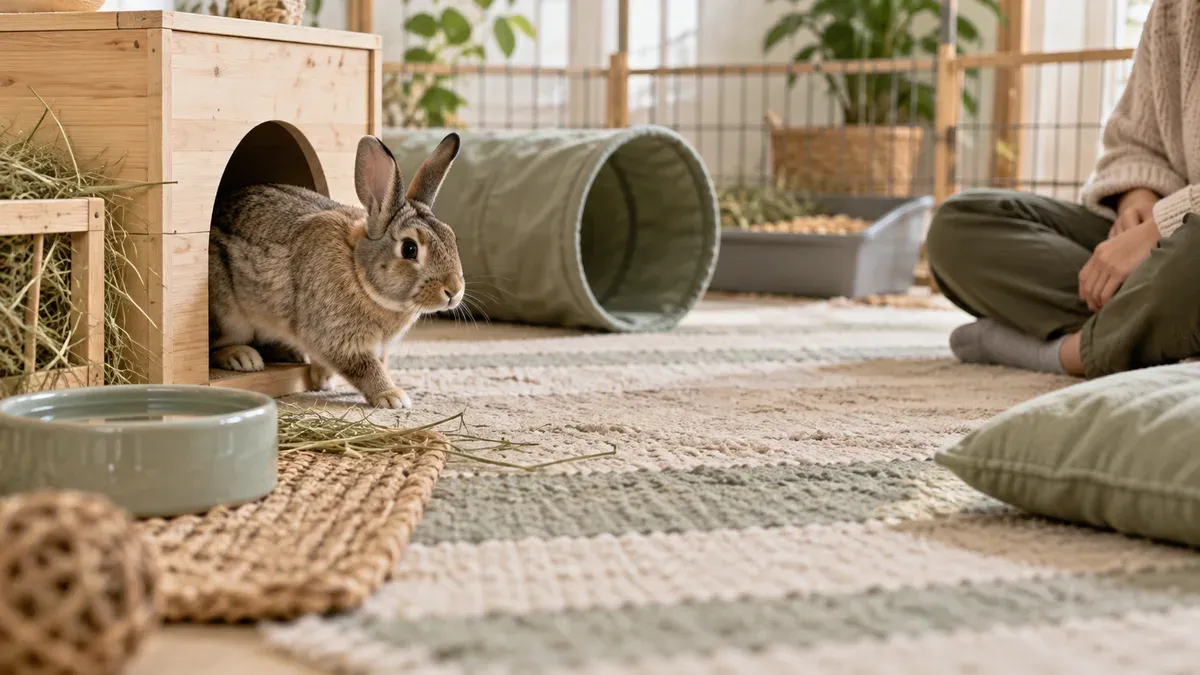
Veterinary warning — This article describes a normal settling-in period and the signs that should lead you to consult. It replaces no clinical examination. In rabbits, a stop in eating or in droppings is not something to watch: it is reported to an exotic vet without delay.
The first three days with a new rabbit are spent doing almost nothing: the setup is ready before he arrives, the food stays exactly what it was, and nobody picks him up. Everything else — run-around time, litter training, the bond — is built afterwards, in that order.
Meanwhile, check hay eaten, the amount and appearance of droppings, and the water level every day. These objective clues are more useful than time spent outside the hide.
The first hour
- Put the open carrier inside the pen, door facing in, and wait for him to come out by himself. You never lift a rabbit out of a carrier by hand: his first contact with you would be a restraint.
- No audience. One person present, seated, silent. Introductions to the rest of the household wait several days.
- Unlimited hay straight away, reachable without crossing the pen, plus a bowl of clean water and a hide with two exits.
- Leave the carrier in the pen for the first days: it is the only object that smells of him, and it often becomes his first hiding place.
- Do not clean the whole tray on your first passes: a few droppings left in place tell him where the toilet is.
If the journey was long or difficult, the way to limit car stress is covered in how to transport a rabbit by car.
Days 1 to 3: what is normal, what is not
| What you see | Normal? | What to do |
|---|---|---|
| Hides all day, comes out at night | Yes, often for one to two weeks | Force nothing, check the tray each morning |
| Freezes when you enter the room | Yes | Slow down, sit on the floor, speak quietly |
| Grunts, thumps, turns on your hand | Yes, in the first days | Withdraw the hand, never punish (why does my rabbit grunt) |
| Urinates outside the tray, marks corners | Yes | Restart litter training gradually |
| Slightly smaller droppings for 24 to 48 h | Yes, if the quantity holds | Monitor, weigh daily |
| Refuses usual food or eats clearly less | No | Call the vet promptly |
| Stops passing droppings and refuses food or seems lethargic | No | Emergency, call without delay |
| Soft or sticky droppings that persist | No | Prompt appointment |
| Repeated sneezing, discharge from nose or eyes | No | Prompt appointment |
| Has not drunk at all since arriving | No | Call the same day |
The rule that prevents mistakes: stress explains a rabbit hiding, never a rabbit stopping eating. A rabbit who stops feeding triggers a slowdown of the gut within hours: what to do about it is in my rabbit is not eating.
Three indicators to check every day
- Hay. Compare the volume you put in each morning with what is left at night, rather than judging that “he eats a bit”. The quantity benchmarks are in how much hay a rabbit needs.
- Droppings. Look at the tray when you get up: their number, size and regularity tell you in one glance how settling in is going. A soft or clumped appearance is triaged in soft droppings in rabbits.
- Water. Fill the bowl to a marked level and note any clear change, taking fresh greens into account. To interpret this indicator, see how much water a rabbit drinks.
Add a fourth marker once a week: weight, written down with the date. That is the figure that will earn its keep six months later, and the method is in how to weigh a rabbit at home.
What you do not change in the first week
- The food. Exactly the same pellets and the same hay as before, even if they are poor quality. The switch comes later, over three to four weeks, following the method in how to transition a rabbit’s diet.
- Where the pen stands. You choose that before arrival and then leave it alone: the criteria are in where to put a rabbit enclosure.
- The accessories. No new tray, no new hay rack, no new bowl until the rabbit has his bearings.
- Cleaning. Soiled patches get cleaned, everything else does not get disinfected: wiping out every scent restarts the marking.
One change is worth making immediately: swapping a bottle for a bowl, because a sipper’s flow rate limits how much a rabbit drinks exactly when it matters most. The full comparison is in water bottle or bowl for a rabbit.
Days 4 to 7: widen the space before the contact
Once the rabbit is eating normally and using his tray, the space grows — the contact does not.
- First run-around in a rabbit-proofed room, late in the day, when rabbits are naturally active. The room is prepared beforehand, following how to rabbit-proof a room.
- Sit on the floor and take no initiative. The rabbit approaches, sniffs a shoe, leaves again: that is exactly what you want. The full progression is in how to tame a fearful rabbit.
- Leave the pen door open during the session: a rabbit who can go home explores faster.
- Never grab the rabbit to put him back. Guide him, or wait for him to return on his own by putting his evening ration inside.
What a rabbit does not understand at this stage is being carried. Most never really accept it, and there is nothing to fix there: the subject is covered in my rabbit doesn’t like being picked up.
Week two: routine, litter training, vet
- The routine settles. Same feeding and exercise times: that is what makes a rabbit predictable, and a predictable rabbit relaxes.
- Litter training really starts now that the rabbit has picked his corner — the method is in how to litter train a rabbit.
- The first veterinary appointment falls in this window, even for an animal in obvious good health. What it should cover depends partly on where the rabbit came from: the detail is in buying a rabbit from a pet shop and in adopting a rabbit from a rescue.
- Get the sex confirmed at the same time, before any plan for a second rabbit: mis-sexing is common and its consequences are set out in male or female rabbit.
Six mistakes of the first days
- Trying to build the bond immediately. Stroking, lifting, taking the rabbit out to show him: every early attempt costs several days of trust.
- Parading family and visitors past the pen in the first week.
- Introducing the dog or the cat on arrival. Cohabitation is prepared later, gradually, and not every household is suited to it.
- Changing the ration “because the shop food is bad”, at the worst possible moment to do it.
- Bathing the rabbit because he looks dirty on arrival: pointless and risky, as can you bathe a rabbit explains.
- Reading silence as contentment. A motionless rabbit who is not eating is not a well-behaved rabbit.
If you already have a rabbit
The newcomer does not meet the resident in the first days. Two reasons, entirely unrelated to each other:
- Health: a separate observation period lets any respiratory, digestive or skin signs show up. How long it lasts is decided with your vet.
- Behaviour: an improvised meeting on the resident’s territory often ends in a fight that makes lasting friendship much harder.
The introduction method, to start once this period is over, is in how to introduce two rabbits.
The rules to set with children
Three rules, stated before the rabbit arrives: nobody picks the rabbit up, nobody wakes him, you go to him at floor level, never the other way round. A rabbit free to walk away becomes a good companion for a child; a rabbit who is chased becomes a rabbit who bites. The full framework is in are rabbits good pets for children.
When to call the vet
- Emergency, call immediately: no droppings together with refusal to eat or lethargy, a tense belly, laboured breathing — the full list is in rabbit emergency warning signs.
- Call promptly: refusal of usual food, no drinking, or clearly fewer droppings.
- Prompt appointment: persistent soft droppings, repeated sneezing, discharge from the eyes or nose, insistent ear scratching, limping.
The three-level triage, outside the context of a new arrival, is detailed in when to see an exotic vet.
Where to go next
The next step is one habit: every morning this first week, write on a sheet taped near the pen how much hay went, how many droppings there are and where the water level sits. Three lines, ten seconds, and you will know before anyone else if something is going wrong. After that come the exercise routine and the question of a second rabbit, covered in should you adopt one or two rabbits. Our other guides are gathered in the rabbit adoption section and on the rabbit species page.
Frequently asked questions
My rabbit arrived yesterday and hides all day — should I worry?
No, on one condition: that he is eating and passing droppings. Hiding by day and coming out at night is exactly what a rabbit does after a change of home, sometimes for one to two weeks. What counts is not how visible he is but what the tray and the hay rack show: hay eaten and normal droppings mean a rabbit who is settling, even an invisible one.
Should a new rabbit stay in the pen for the first days, or be allowed to explore?
Pen first, exploring later. The first two or three days are for building landmarks in a small area: the rabbit learns where his tray, his hay and his hide are. Opening the whole home straight away produces a rabbit who takes refuge under furniture, marks everywhere and becomes impossible to retrieve without picking him up.
How long before a rabbit settles into a new home?
Expect one to two weeks before he moves around without freezing, and often one to two months before he comes to you of his own accord. An already socialised adult goes faster than a just-weaned baby or a rabbit who was rarely handled. The timeline cannot be forced: what shortens it is the number of quiet moments you spend down at his level.
Can I change a rabbit's diet as soon as he arrives?
No, even if the previous food is poor. A change of home plus a change of ration is one of the classic causes of digestive trouble in the first days. Keep exactly the same pellets and the same hay for at least a week, then make the switch gradually over three to four weeks.