Where should you put a rabbit's enclosure in the house?
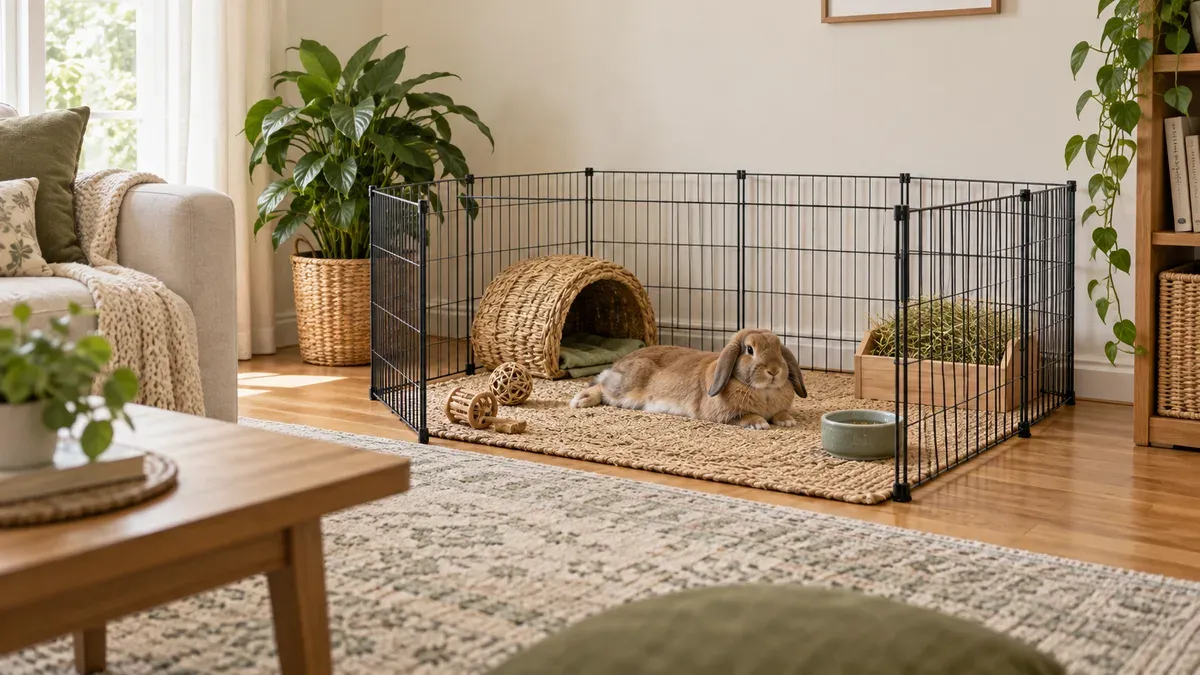
A rabbit’s enclosure goes in the room you actually live in, at floor level, with one or two sides against a wall, away from any heat source, direct sun and through traffic. No garage, no conservatory, no bathroom, no cupboard top.
The question usually comes after the one about size, yet it settles just as much: a correctly sized pen in the wrong place produces a rabbit who sleeps badly, hides, soils outside the tray and never really settles with people.
Why placement counts as much as floor area
Three things stack up, and no accessory fixes any of them.
- Perceived safety. Rabbits are prey animals: a space exposed on every side keeps them alert, which means light sleep only. What looks like a calm rabbit is often a rabbit who does not dare move.
- Socialisation. A rabbit set up in a room nobody enters stays fearful however patient you are afterwards: he never gets the chance to grow used to ordinary noise and movement. It is the first reason a fearful rabbit stays that way.
- The real temperature at floor level. What a wall thermostat reads is not what an animal lying on tiles, next to patio doors or under a radiator actually experiences.
Which room to choose
| Room | Verdict | What decides it |
|---|---|---|
| Living room | Best choice in most homes | Regular traffic, stable temperature, floor space available |
| Home office or a room used in the day | Good choice | Real human presence, relative quiet; watch the cables |
| Adult bedroom | Workable | Fine if you accept dawn and dusk activity: digging, hay, bowls pushed around |
| Child’s bedroom | Avoid | Unsupervised handling, rabbit disturbed during his rest phases |
| Hallway, entrance | Avoid | Draughts, constant passing, nowhere to retreat |
| Kitchen | Avoid | Slippery floor, cleaning products, oven heat, crumbs and forbidden foods |
| Conservatory, garage, utility room, cellar | No | Temperature swings, damp, stored chemicals, social isolation |
The simple rule: the rabbit goes where the household lives, not where he is least in the way. If the living room space looks too tight, it is the floor area that needs rethinking before the animal is moved to an empty room — the figures are in what size enclosure for a rabbit.
Where exactly within the room
- One or two sides against a wall, never all four sides open. That is what lets a rabbit drop his guard and genuinely sleep.
- Not wedged into a fully closed corner either: he needs to see what is coming. One side open to the room is enough.
- Set back from a doorway. A pen on the kitchen-to-sofa route exposes a rabbit to dozens of startles a day.
- Well clear of a radiator, stove or fireplace, and out of direct afternoon sun. Glass amplifies heat at floor level far beyond the room temperature.
- Away from a speaker, a television or any vibrating appliance. Rabbits hear much higher frequencies than we do, and bass travels through the floor.
- At floor level, always. A cage on top of furniture turns every exit into a one-metre drop, and broken legs and backs follow.
If two spots seem equally good, take the one that leaves clear space in front of the pen: that is where your rabbit will spend his run-around hours, the amount of which is set out in how many hours of exercise does a rabbit need.
Three checks before the pen goes down
- A thermometer at floor level, left for 24 hours where you plan to put the pen. A rabbit’s comfort zone is 15–22 °C (59–72 °F), and heat stroke risk starts at 28 °C (82 °F): the full band-by-band detail is in what temperature can rabbits tolerate.
- The afternoon sun. Walk back into the room around 4 pm: a spot that was cool in the morning can be in full sun hours later. The measures that actually work are listed in how to keep a rabbit cool in summer.
- Draughts, at rabbit height. Crouch down and run your hand along the floor near doors and windows. A lying rabbit takes cold air you never feel standing up — which matters in winter too, as how to keep a rabbit warm in winter explains.
The floor under the pen
Placement also decides the surface, and that is not a comfort detail: a rabbit who slips splays his legs, braces himself and ends up moving less. Suitable surfaces and the ones to correct are covered in the best floor surface for rabbits.
In practice two points settle it: a washable rug or non-slip tiles under the whole living area, and protection for wooden flooring if the rabbit has access to it, because urine soaks between the boards within minutes.
What placement changes day to day
- Litter habits. A rabbit naturally picks a toilet corner away from where he eats. Put the tray in the most enclosed corner of the pen and the food at the opposite end: that is half the work described in how to litter train a rabbit.
- Smell. It does not come from the rabbit but from ammonia sitting at floor level in a poorly ventilated corner. A spot with air movement, without being in a draught, cuts the problem before any product does — see how to reduce rabbit litter odour.
- Night noise. Rabbits are active at dawn and dusk: bowls shoved around, digging, hay pulled from the rack. That is the real criterion for deciding whether a bedroom works.
- Cleaning. A pen you can reach from two sides gets cleaned in minutes; a pen jammed behind a sofa gets cleaned less often, and the tray shows it.
Six places to rule out straight away
- The garage: temperature swings, engine fumes, stored chemicals, and a rabbit who sees nobody.
- The conservatory: a greenhouse at the first ray of sun, then cold at night. It heats up faster than anyone in the house notices.
- The utility room: machine noise and vibration, damp, detergents and cleaning products within chewing reach.
- The bathroom: permanent humidity, slippery floor, and the same products to hand.
- A balcony full time: it is supervised access, not housing, and its safety conditions are set out in how to make a balcony safe for a rabbit.
- The top of a cupboard or table: a raised cage invites the rabbit to jump into thin air the moment he can.
Living outdoors is a different choice, which needs housing designed for it rather than a utility space: the real conditions are described in keeping a rabbit outdoors.
Should you move a pen that is already set up?
Yes, if the current spot is on the list above, or if your rabbit hides constantly when nothing else has changed — that behaviour is triaged in why does my rabbit hide all the time.
The method comes down to three points:
- Move the whole thing without rearranging the inside. Same tray in the same corner, same hide, same bowls: one change at a time.
- Transfer a handful of used litter into the tray at the new spot. That scent marking is what prevents the accidents described in why is my rabbit peeing outside the litter box.
- Allow a week to settle, without changing diet or exercise routine during that time.
A move within the same home stays a small event for a rabbit; a house move is a big one, with its own method in moving house with a rabbit.
Checklist before the pen goes down
- The room is occupied several hours a day.
- One or two sides are against a wall, one side stays open to the room.
- No radiator, stove or sun-facing window overheats the area.
- No draught runs along the floor.
- The floor is non-slip and washable, or protected.
- Everything sits at floor level, with clear run-around space in front of the pen.
Where to go next
The next step is concrete: put a thermometer where you plan to set up, leave it 24 hours, and come back to the room late in the afternoon to check the sun. If the spot passes both checks, set the pen down and then deal with the inside, covered in how to set up an indoor pen for a rabbit and, for choosing the enclosure itself, in rabbit cage or pen. Our other guides are gathered in the rabbit housing section and on the rabbit species page.
Frequently asked questions
Can a rabbit's pen go in a bedroom?
Yes, if you accept the noise. Rabbits are active at dawn and dusk: yours will dig, shove his bowl around and pull hay while you sleep. A bedroom suits an adult rabbit in a quiet household perfectly well, but it is rarely the right call in a child's room, where the rabbit disturbs as much as he is disturbed.
Should the pen go against a wall or in the middle of the room?
Against a wall, on one or two sides. A pen exposed on all four sides keeps the rabbit on watch, and he rests less in it. One or two closed sides, plus a hide with two exits, give the security of a burrow without cutting him off from the life of the room.
Can a rabbit live in a garage or a conservatory?
No — those are two of the worst places. A conservatory heats up extremely fast in sunshine and becomes dangerous long before the room feels hot to you. A garage combines temperature swings, exhaust fumes, stored chemicals and social isolation. If a rabbit is to live outdoors, that is organised properly, not in a utility space.
Can the pen be moved once it is set up?
Yes, as long as the landmarks travel with it. Move the whole thing without rearranging the inside, and transfer a handful of used litter into the tray at the new spot: that scent marking is what prevents accidents over the following days. Allow a week to settle, and avoid changing diet or routine at the same time.