Should you adopt one or two rabbits? Deciding before you commit
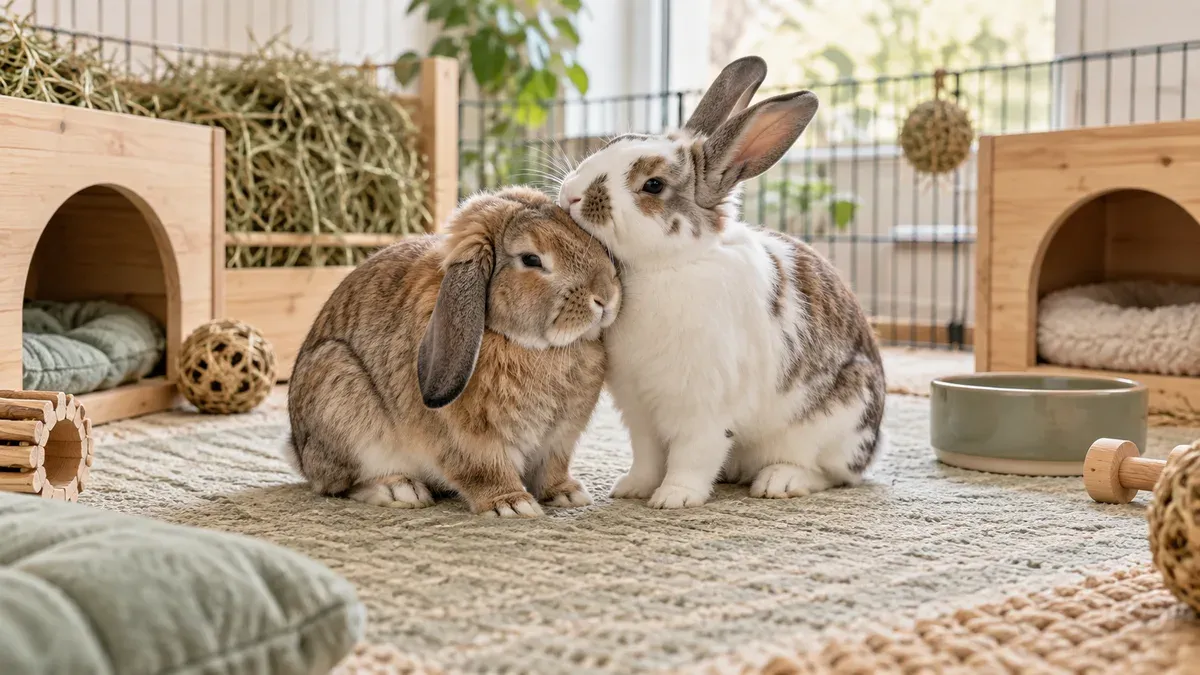
For the rabbit, the answer is two. This is a social species that lives in groups in the wild, and a companion delivers behaviours no owner can reproduce: mutual grooming, resting side by side, spontaneous play.
For you, the answer rests on three things you can check tonight: your vet budget, the floor space you can actually free up, and how you plan to acquire the animals. This page covers the decision before adoption. If you already have a rabbit and are wondering whether it is lonely, that is a different question, handled in can a rabbit live alone.
What genuinely doubles, and what does not
This is the most badly estimated part of the decision. Not everything scales the same way.
| Item | Effect of going from one to two |
|---|---|
| Veterinary costs | × 2, including two neutering operations and two annual vaccinations |
| Hay, pellets, greens | × 2, with no real economy of scale beyond bulk packs |
| Bedding | × 1.5 to × 2: two rabbits soil more, but often share one tray or two adjacent ones |
| Space | No doubling: you need a larger pen and doubled resources, not two homes |
| Initial equipment | + 30 to 50%: second tray, second water point, hideouts with two exits |
| Daily care time | Almost identical: a few extra minutes |
| Free-run hours | Identical: the same slot, shared |
In practice, on the UK market, a well-cared-for rabbit costs around £55–£85 per month excluding surprises, as how much a rabbit costs per month sets out. For two, budget £85–£150 per month — and above all twice the emergency reserve: that is the line that actually puts households in difficulty, not the bag of hay.
Three routes to two rabbits, and they are not equal
1. Adopt an already bonded pair (the safest route)
Rescues regularly take in established pairs and rehome them together. You inherit a working relationship: no introduction phase, no fight to manage, and often two animals already neutered and vaccinated. It is by far the simplest path for a first household, and the practical steps are covered in adopting a rabbit from a rescue.
Ask explicitly how long the pair has lived together and whether they have ever been separated — two rabbits that have shared a pen for months are not in the same position as two placed side by side last week.
2. Adopt two rabbits that do not know each other
This works, but the introduction is on you. It is run on neutral ground, in progressive sessions, using the method set out in how to introduce two rabbits. Expect several weeks, a separate retreat for each rabbit throughout, and the possibility that they never bond.
The thing to settle before you sign: where does each rabbit live if the bonding fails? Without an answer, a double adoption is a gamble.
3. Two littermates (the classic trap)
Two siblings bought together get on perfectly — until puberty. Hormonal behaviour appears around 3 to 5 months and often turns the pair into open conflict, sometimes overnight.
Two consequences to accept at the point of purchase:
- Neutering both is not optional. It is generally done from 3 to 4 months in males (should you neuter a male rabbit) and between 4 and 6 months in females (should you spay a female rabbit). Budget it in the first year rather than putting it off.
- An unneutered male-female pair will produce a litter, and probably several. A doe can conceive very early and again almost immediately after giving birth.
A seller who claims two babies “will always get along” without mentioning neutering does not know the species: it is one of the warning signs described in buying a rabbit from a pet shop.
Which sex combination?
A neutered male with a spayed female is the least conflict-prone combination, and the one rescues most often offer. Two males or two females can get on perfectly well, but territorial tension is more frequent, which makes neutering both all the more decisive.
The question of sex for a single rabbit is a separate one, with its own criteria: see male or female rabbit.
What a pair does not excuse you from
This is the most common misreading: assuming a second rabbit replaces everything else.
- Free-run time is unchanged. Two rabbits need the same 3 to 4 hours of daily freedom as a single one.
- Health monitoring doubles. Two rabbits eating from the same bowl make it harder to see which one is eating less — a genuine blind spot, given that a drop in appetite is the first warning sign in this species.
- Enrichment is still needed. A bored pair is bored together. The occupation needs are identical, and set out in how to keep a bored rabbit busy.
- Your presence still counts. Two rabbits bonded to each other often ask for less human contact, which is neither a problem nor a licence to stop.
When one rabbit is still the right call
A single rabbit, properly integrated into the household, lives well. The choice holds up in four cases:
- The vet budget is tight. One rabbit whose care is covered beats two whose bills become a judgement call in an emergency.
- Free floor space is limited. A pair needs doubled resources and two retreat zones: what a flat imposes on the choice is detailed in which rabbit suits apartment living.
- You are home most of the day and can sustain real daily interaction, not just presence in the room.
- It is your first rabbit and you want to learn the species before managing group dynamics. Nothing stops you adding a companion later: the method is in keeping two rabbits together without fighting.
In that case, compensating is not optional. It is described in detail in can a rabbit live alone.
Your situation, and what fits it
| Your situation | What fits best |
|---|---|
| First rabbit, comfortable budget, rescue adoption possible | A bonded pair, the simplest route |
| First rabbit, tight budget | One rabbit, with real daily contact |
| Long absences during the day, adequate budget | Two rabbits, without cutting free-run hours |
| Studio flat or very limited free space | One rabbit, with a pair considered after a move |
| Set on a baby rabbit from a shop or breeder | One, or two with neutering planned before 5 months |
| A rabbit already at home | Different question: see can a rabbit live alone |
Checklist before saying yes to two
- Two neutering operations budgeted within the first twelve months.
- A doubled emergency reserve, not one reserve split in half.
- A pen and free-run area designed for two: two water points, two hay stations, hideouts with two exits.
- A clear answer to “what do we do if they don’t bond?”.
- Holiday cover that will take two animals together.
Going further
The next step is concrete: before you contact a rescue or a breeder, measure the floor space you can genuinely give over to a pen, and write down the amount you could commit to an unexpected vet bill. Those two figures settle the question faster than any argument of principle. If the choice of individual is still open, how to choose your first rabbit covers the criteria that weigh on the first six months, and the comparison of acquisition routes is in should you adopt or buy a rabbit. If it is your absence rather than boredom that worries you, how long can you leave a rabbit alone sets out the durations that are genuinely acceptable. And if you were thinking of a guinea pig as your rabbit’s companion, can rabbits and guinea pigs live together? explains why the sources advise against it. Our other guides are gathered in the rabbit adoption section and in the rabbit species profile.
Frequently asked questions
Do two rabbits take twice as much time?
No, and that is the one line where a pair costs you nothing extra. Feeding, changing a tray and checking on two rabbits living in the same place takes a few extra minutes, not double. Free-run hours do not double either: it is the same slot, shared. What genuinely rises is money and space, not your diary.
Can I adopt two rabbits that have never met and house them together straight away?
No. Two strangers put together on day one often fight, and a rabbit fight leaves deep wounds. The meeting is prepared on neutral ground, in short progressive sessions. Avoiding that stage is precisely why adopting an already bonded pair is the safest route.
Should it be a male and a female, or two of the same sex?
A neutered male with a spayed female is the combination that causes the fewest problems. Two rabbits of the same sex can get on perfectly well, provided both are neutered and properly introduced, but territorial conflict is statistically more common. Either way, neutering both is a condition, not an option.
Does a second rabbit replace my presence if I work all day?
It offsets social isolation, not the missing exercise time or supervision. Two rabbits shut in a pen for ten hours are still two bored rabbits, and a health problem goes unnoticed just as easily. A pair improves daily life; it does not shrink the basic needs.