How Long Can You Leave a Rabbit Alone?
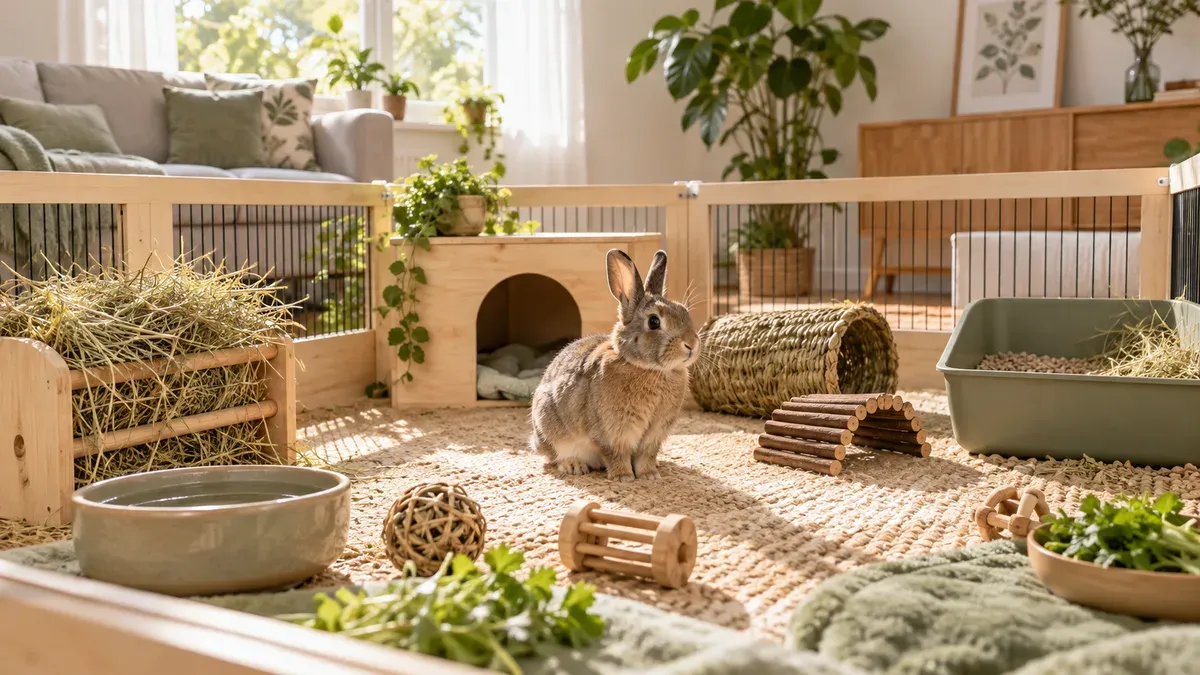
A working day — 8 to 10 hours — is no problem at all for a rabbit with a settled routine, a suitable pen and unlimited hay. Twenty-four hours is the absolute maximum, and only as an exception. Beyond that, somebody has to call in every day.
What sets that limit is not boredom, contrary to what is often written. It is the detection delay. Stopping eating is among the most recorded causes of death in rabbits, and it is treated in hours. A rabbit that stops eating on Saturday morning and is found on Sunday evening has gone more than thirty hours without care — that arithmetic is what governs, not the animal’s mood.
The thresholds, and what each requires
| Length of absence | Acceptable? | What to put in place |
|---|---|---|
| Up to 10 h (a working day) | Yes, routinely | Unlimited hay, water, safe pen, exercise before and after |
| 10 to 24 h | Exceptionally | Doubled resources, pen checked, return next day |
| 24 to 48 h | Not without a visit | A daily call-in at minimum, checking hay and droppings |
| Beyond 48 h | No | Home boarding, or a boarding facility that takes rabbits |
The step between 24 and 48 hours is the only one that really matters. Below it, you get home before a problem has had time to develop. Above it, you no longer can.
Why the detection delay is the real factor
Three situations explain the threshold:
Stopping eating. In rabbits, a gut that stops moving deteriorates quickly. Twelve hours without food already warrants a consultation; the signs to recognise are in GI stasis in rabbits.
Flystrike, in warm weather. Flies lay on a soiled rear end and larvae establish within hours. This is why checking the rear end twice a day is advised in summer — which makes any absence longer than a day incompatible with the warm season unless someone calls in daily.
Equipment accidents. A foot caught in a bar, a jammed bottle, an upturned bowl. None of these is serious if spotted within the hour, and all of them can become so within twenty-four.
On top of this sits a trait of the species: rabbits mask their symptoms. They do not complain, they go quiet — which means the gap between “fine” and “emergency” is short and silent. The signals to know are gathered in rabbit emergency warning signs.
Preparing for a day-long absence
This is the common case, and it asks little:
- Unlimited hay, in two separate places rather than one — an emptied or tipped rack should not leave the animal without.
- Two water sources, covering a failed bottle or an upturned bowl.
- A clean tray when you leave, so the animal is not sitting on soiled bedding for ten hours.
- A checked pen: nothing to catch a limb, nothing dangerous within chewing reach.
- Exercise before and after. That is the trade-off, and it is not negotiable: movement needs are unchanged, as set out in how many hours of exercise a rabbit needs.
A rabbit that copes well with days alone is a rabbit whose mornings and evenings are regular. Consistency matters more than the hour count.
Preparing for a 24-hour absence
Everything above, plus:
- Doubled resources: two water points, two hay areas, possibly two trays.
- A pen rather than free roaming, unless the room has been proofed for a long time and proven (how to rabbit-proof a room).
- A stable temperature, especially in summer: this is the factor that turns an ordinary absence into a real risk (what temperature can a rabbit tolerate).
- A contactable person who holds a key.
And one simple rule: do not test a first 24-hour absence on a newly arrived rabbit, nor on an animal in recovery, nor on an elderly one.
Beyond that: what actually works
Past 24 hours, the options narrow to three, in order of preference:
- Someone calling in daily, briefed on what to look at: has the hay gone down, are there droppings, is the animal moving normally. A visit that consists of topping up a bowl is of no use.
- Home boarding, which spares the animal a journey.
- A boarding facility that takes rabbits, rarer and worth visiting beforehand.
These options, and the choice between taking the animal with you or leaving it behind, are covered in travelling with a rabbit.
What to give whoever calls in: your vet’s name and number, the details of an out-of-hours service that accepts exotics, and explicit authorisation to seek treatment without reaching you first.
Loneliness and absence are two different questions
This page is about length of absence. Whether a rabbit suffers from living without a companion is a separate question, handled in can a rabbit live alone. Likewise, the boredom of an under-stimulated rabbit belongs in how to keep a bored rabbit busy.
A pair genuinely reduces boredom while you are out — one of the arguments weighed in should you adopt one or two rabbits. But it does not move the safety limit, and it makes monitoring marginally harder: with two sharing a pen, it becomes difficult to tell which one ate.
When to see a vet
On returning from an absence, seek help immediately if you find: no droppings in the tray, untouched hay, a hunched or unresponsive rabbit, open-mouth breathing, or maggots or wounds around the rear end.
Do not wait on the grounds that the animal “has just been alone and must be tired”. In this species, any unusual reduction in appetite or droppings warrants a prompt call; complete food refusal is an emergency, whatever the assumed reason.
Veterinary sources
- Recognising emergencies, Rabbit Welfare Association & Fund — situations requiring immediate treatment, including not eating.
- Rabbits — advice and welfare, RSPCA — core needs, companionship and environment.
Where to go next
If your absences are regular and long, the real question becomes how the day is organised: how many hours of exercise a rabbit needs gives the benchmark and suggests arrangements for constrained schedules. For trips of several days, travelling with a rabbit compares boarding against taking the animal along. And if you have not adopted yet, this constraint belongs among the criteria weighed in how to choose your first rabbit. The rest of our guidance sits in the rabbit adoption section and the rabbit species profile.
Frequently asked questions
Does an automatic feeder let you stay away longer?
No, and it is a false comfort. A feeder handles the ration, not the monitoring: it cannot see that the rabbit has eaten nothing, cannot notice the absence of droppings, and cannot detect a trapped foot. It can also jam. It makes a day-long absence more comfortable; it does not extend the maximum.
Does a camera replace someone calling in?
It helps without being enough. A camera lets you see that a rabbit is hunched or has not touched its hay, which is genuinely valuable. But it cannot inspect droppings closely, cannot palpate, and cannot act. It shortens the detection delay; it does not replace the person who can get the animal to a vet.
Can two rabbits be left alone for longer than one?
They get less bored, but the safety limit is identical. It is arguably slightly harder to monitor: when two rabbits share a bowl and a tray, it becomes difficult to know which one ate and which one produced droppings. A pair solves loneliness, not detection.
Can a rabbit be left loose in the flat while you are out?
Only if the room has been rabbit-proofed and proven over several weeks while you were there. A long absence is not the moment to test free roaming: cables, plants and furniture need to have already passed the test. If in doubt, the pen is safer for a long absence.