Can rabbits and guinea pigs live together?
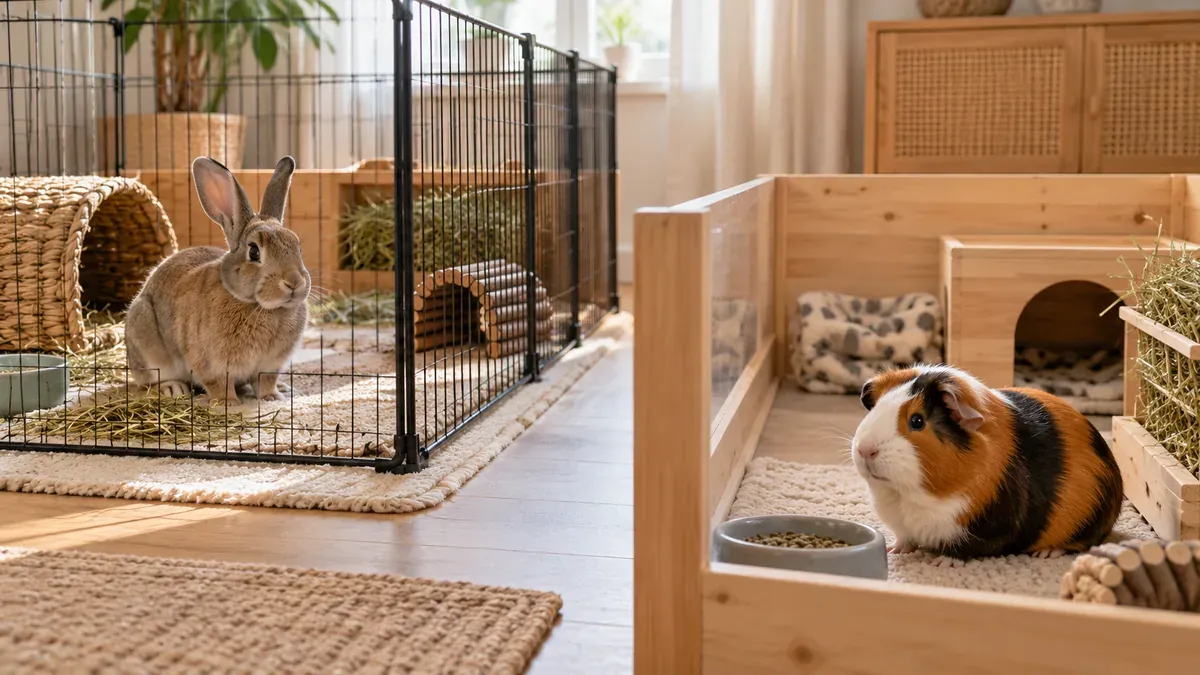
A rabbit and a guinea pig should not be paired up: the RSPCA, the PDSA and the Merck Veterinary Manual all advise against it. The two species do not understand each other, do not eat the same food, and a rabbit can injure a guinea pig or pass on a respiratory bacterium. If yours already live together and get on well, however, the RSPCA advises not separating them automatically, with certain precautions.
Your situation decides what to do:
| Situation | What to do |
|---|---|
| You are thinking of putting them together | Don’t: each species needs a companion of its own kind. |
| They already live together and get on well | Do not separate them automatically; follow the RSPCA’s precautions and ask your vet. |
| There is conflict, injury or a sign of illness | Make the guinea pig safe and see your vet. |
Why the sources advise against this pairing
They do not understand each other
Rabbits and guinea pigs behave and communicate in very different ways (RSPCA). They do not understand each other’s signals, which can lead to conflict and even fights (PDSA). They are not well-suited companions, even if they tolerate each other.
They do not eat the same food
Guinea pigs cannot synthesise vitamin C and must get it from their diet; rabbits can (RSPCA). Their pellets are therefore not interchangeable: rabbit pellets do not provide enough vitamin C for a guinea pig (Merck). The amounts differ too (PDSA). From a shared bowl, it is hard to know who is eating what.
A rabbit can injure a guinea pig
Rabbits are generally much bigger. They can injure guinea pigs, intentionally or not: a kick from their powerful back legs, or attempts to mate that can injure the guinea pig’s back (RSPCA). They can also bully them, which stresses the guinea pig if it cannot get away (RSPCA, PDSA).
An infection risk
The bacterium Bordetella bronchiseptica can cause respiratory disease in guinea pigs. Rabbits, as well as cats and dogs, can carry it and pass it on (RSPCA). According to the PDSA, it usually does not affect rabbits but can make guinea pigs very ill. Merck advises against housing the two species in the same cage, as some diseases can spread between them.
A habit from another era
Rabbits and guinea pigs were long kept together, including in pet shops (PDSA), at a time when neutering rabbits was considered unsafe (RSPCA). The RSPCA explains that neutering is now routine, making companionship within each species easier to arrange. Any operation has individual benefits and risks to discuss with a vet.
They already live together and get on well
The RSPCA’s view is that if a rabbit and a guinea pig already live together and get on well, it is best not to separate them, as this could upset them. It sets three conditions:
- Hiding places just for the guinea pig, available at all times, with an entrance large enough for the guinea pig but too small for the rabbit.
- Separate feeding if needed, so that each gets the right diet.
- A neutered rabbit, otherwise it may stress or injure the guinea pig through mounting or bullying.
The RSPCA refers owners to their vet for tailored advice. The PDSA page advises against cohabitation but does not address this particular case: its silence does not establish a disagreement about that situation. So have your situation assessed by your vet, taking into account the age and health of both animals.
Stay alert over time. If their relationship deteriorates or a sign of illness appears, the situation moves into the next category.
There is conflict, injury or a sign of illness
The RSPCA’s nuance only applies to animals that get on well. It does not apply to a guinea pig that is injured, ill or being bullied.
- Make the guinea pig safe if it is being chased, mounted or injured.
- Have any injury checked.
- Watch for respiratory signs in the guinea pig: sneezing, discharge from the nose or eyes, difficulty breathing. Difficulty breathing is an emergency (PDSA).
- Ask your vet how to organise things for both animals from here.
What next?
For a new group, choose rabbits with rabbits and guinea pigs with guinea pigs (RSPCA, PDSA). For an existing association, plan the next steps with your vet: do not automatically add more animals to the set-up.
- For the guinea pig, see can a guinea pig live alone? and how many guinea pigs should you get.
- For the rabbit, see can a rabbit live alone? and should you adopt one or two rabbits.
When one of them dies, do not replace it with an animal of the other species.
Next step
If you do not have an animal yet and are torn between the two species, the comparison is in rabbit or guinea pig: which should you choose? Each species’ needs are summarised in the guinea pig species guide and the rabbit species guide.
Sources
- RSPCA — Keeping rabbits and guinea pigs together: reasons not to pair them, Bordetella bronchiseptica, neutering, animals that already live together and precautions.
- PDSA — Vet Q&A: Can I keep rabbits with guinea pigs?: communication, size, diet, respiratory bacterium, companion of the same species.
- PDSA — Guinea pigs as pets: rabbits and guinea pigs should not be kept together.
- PDSA — Guinea pig health: difficulty breathing is an emergency.
- Merck Veterinary Manual — Providing a home for a guinea pig: do not house rabbits and guinea pigs in the same cage.
- Merck Veterinary Manual — Diet for a guinea pig: rabbit pellets lacking vitamin C.