Rabbit or guinea pig: which suits your household?
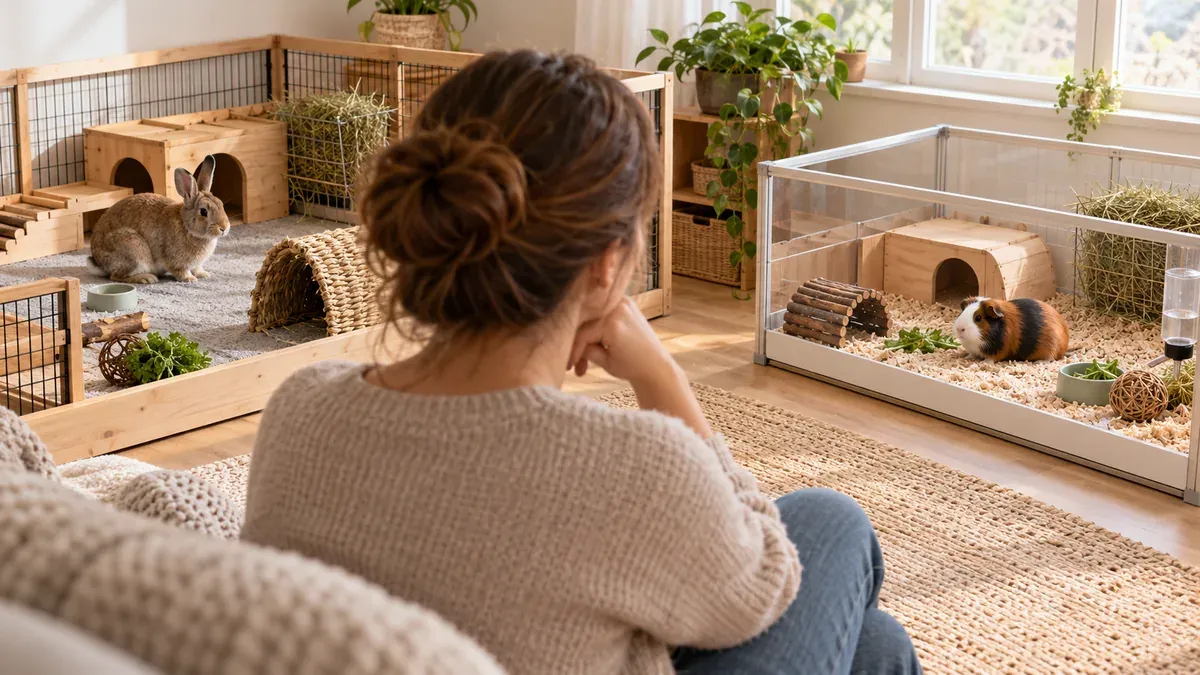
There is no “easier” pet in absolute terms: rabbits and guinea pigs both need a companion, space, unlimited hay and a vet experienced with exotic pets. The rabbit generally has a longer lifespan and needs considerable space; the guinea pig has a particular need for vitamin C every day. Housing and care requirements must be assessed for each group.
This guide compares the two species on the same criteria, each with its own sources, to help you choose based on your household’s real constraints, or to put adoption off if neither suits.
The comparison, criterion by criterion
| Criterion | Rabbit | Guinea pig |
|---|---|---|
| Lifespan | Typically 8 to 12 years, sometimes longer (RSPCA) | 4 to 8 years on average (PDSA) |
| Company | A companion of its own kind; a neutered male and neutered female is a common pairing (RSPCA) | At least one compatible companion (RSPCA); two or more according to the PDSA |
| Living space for two | At least 3 × 2 m and 1 m high, including shelter and exercise area (RSPCA) | About 9 to 11 sq ft (0.84 to 1.02 m²) of cage with daily time out (Merck), or a 1.5 × 1 m hutch linked to a 2 × 1 m run accessible at all times (PDSA) |
| Neutering | Strongly encouraged for all rabbits (RSPCA) | Essential for a male living with females; less common in females (RSPCA) |
| Vaccinations | Recommended against the relevant diseases, with a schedule agreed with the vet (RSPCA) | No routine vaccinations (Merck) |
| Diet | Unlimited hay; makes its own vitamin C (RSPCA) | Unlimited hay; vitamin C needed in the diet every day (Merck) |
| Ideal temperature | 10 to 20°C (RSPCA) | 17 to 20°C (RSPCA); 18 to 24°C according to Merck |
| Relationship with people | Handled gently from a young age, it can learn that people are friends; handled roughly, it may become fearful (RSPCA) | Generally does not enjoy being picked up; prefers being watched, stroked or fed at ground level (PDSA) |
The two columns do not rely on the same pages: each value comes from a source dealing with that species.
What this table changes in practice
Space, the first deal-breaker
This is often the clearest difference. The RSPCA asks for a living space of at least 3 × 2 m, 1 m high, including shelter and exercise area, for two medium-sized rabbits. For two guinea pigs, the sources’ guides are more modest, but Merck considers many commercial cages too small. A minimum cage with daily time out should not be compared with a total area accessible at all times without this distinction. If you cannot give that much floor space to rabbits, the guinea pig is not a fallback for all that: first check you can provide the space described in what size cage or enclosure for two guinea pigs.
For rabbits, see what size enclosure for a rabbit.
How long the commitment lasts
A group of rabbits commits you for longer than a group of guinea pigs. In both cases, the animals are not all the same age: a survivor will need a new companion, which extends the commitment. See how long do guinea pigs live and how long do rabbits live.
Veterinary care
Both species need a vet experienced with exotic pets. Their care differs:
- rabbits must be vaccinated (RSPCA), and the RSPCA strongly encourages neutering all rabbits;
- guinea pigs do not need vaccinations (Merck); neutering is necessary in particular for males that are to live with females (RSPCA), without ruling out other medical indications. Merck recommends a vet check at least once a year.
For rabbits, see should you vaccinate your rabbit?
The relationship you expect
Neither is a pet to carry around at will. Both are prey species. The PDSA says guinea pigs generally do not enjoy being picked up and prefer strokes and treats given at ground level. For rabbits, the RSPCA stresses gentle handling from a young age. If what you want above all is an animal to cuddle, neither species guarantees that relationship.
Guinea pigs are often vocal (PDSA). They are mostly active during the day according to Merck, and at dawn and dusk according to the PDSA.
Budget
We do not give a side-by-side figure: we do not have sourced, dated figures for guinea pigs. The cost items, however, differ clearly:
- set-up: a 3 × 2 m space for two rabbits, against a smaller set-up for two guinea pigs;
- preventive care: vaccinations and neutering for rabbits; no vaccinations for guinea pigs, but a yearly check-up;
- running costs: hay, species-appropriate pellets and vegetables, for the whole group;
- the unexpected: in both cases, visits to an exotics vet.
For rabbits, a costed budget, dated and based on UK prices, is available in how much does a rabbit cost per month.
Which choice for your situation?
| Your situation | What it means |
|---|---|
| You can give at least 3 × 2 m to animals | Both species are possible, on this criterion. |
| Your space is more limited | Rabbits are not suitable; check that a set-up for two guinea pigs is feasible. |
| Your home is often above 20°C in summer | Both species are sensitive to heat: plan how to protect them. |
| You cannot commit for more than a few years | Bear in mind that both species need a group, so the commitment extends. |
| You have no exotics vet within reach | Find one before adopting, whatever the species. |
| None of these conditions is met | Putting adoption off is a good choice too. |
When forming a new group, choose companions of the same species. If a rabbit and a guinea pig already live together, have their situation assessed rather than separating them automatically: see can rabbits and guinea pigs live together?
Next step
If you are leaning towards guinea pigs, move on to how many guinea pigs should you get, and which pairings work, then see the guinea pig species guide. If you are leaning towards rabbits, start with should you adopt one or two rabbits and the rabbit species guide.
Sources
Rabbits
- RSPCA — Rabbits: lifespan of 8 to 12 years.
- RSPCA — Rabbit environment: living space of at least 3 × 2 × 1 m for two rabbits, temperature of 10 to 20°C.
- RSPCA — Rabbit health: vaccination, neutering encouraged.
- RSPCA — Rabbit company: neutered male and female pairing, handling.
Guinea pigs
- PDSA — Guinea pigs as pets: lifespan of 4 to 8 years, handling, vocal nature, activity at dawn and dusk.
- PDSA — The ideal home for your guinea pigs: hutch and run.
- RSPCA — Keeping guinea pigs together: company, neutering.
- RSPCA — Creating a good home for guinea pigs: temperature of 17 to 20°C.
- Merck Veterinary Manual — Routine care of guinea pigs: no vaccinations, yearly check-up.
- Merck Veterinary Manual — Providing a home for a guinea pig: minimum cage area, commercial cages too small.
- Merck Veterinary Manual — Unique needs of guinea pigs: temperature, daytime activity.
Both species
- RSPCA — Keeping rabbits and guinea pigs together: rabbits make their own vitamin C, guinea pigs do not.