What size cage or enclosure for two guinea pigs?
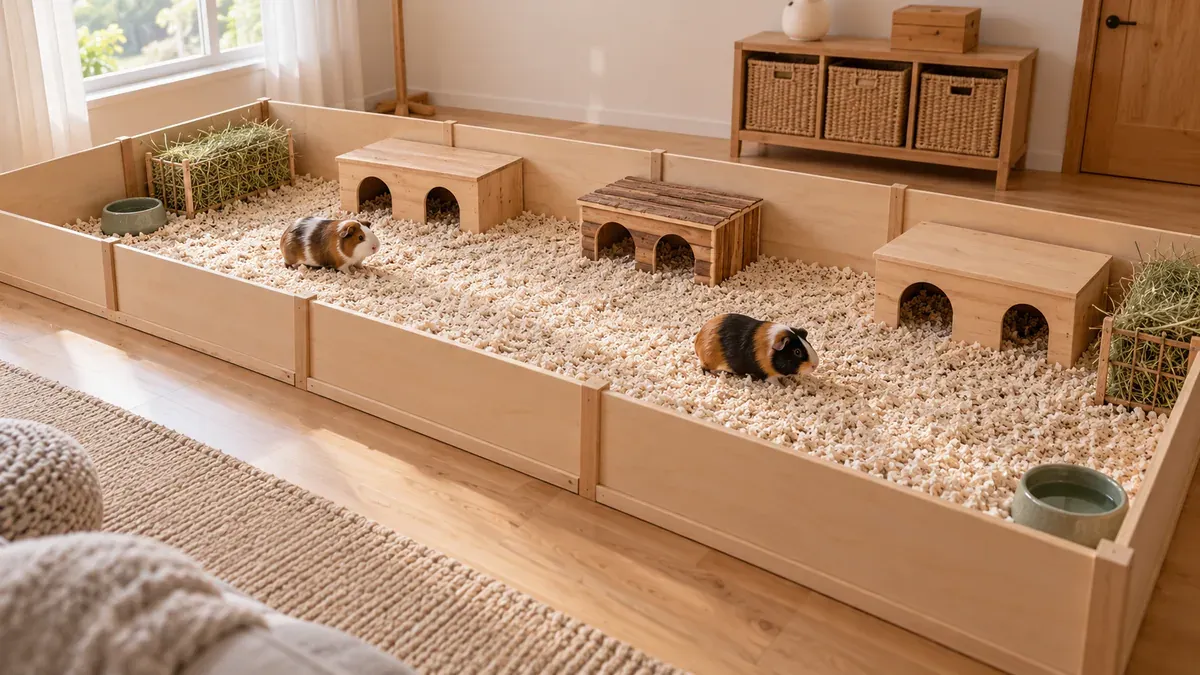
For two guinea pigs, the Merck Veterinary Manual gives a cage of about 9 to 11 square feet (0.84 to 1.02 m²) as a minimum, plus daily exercise outside the cage. The PDSA recommends a larger set-up: a hutch of at least 1.5 × 1 m linked to a run of at least 2 × 1 m, accessible at all times.
These two guides do not measure the same thing: one is a minimum cage combined with time out, the other a complete living space. This guide explains how to read them, shows a dimensioned plan and lists what to check before buying.
Two set-ups, not two competing figures
| Merck Veterinary Manual | PDSA | |
|---|---|---|
| What is measured | The minimum floor area of the cage | A hutch and a run linked together |
| For how many animals | One animal, plus extra space per additional animal | The household’s guinea pigs, number not specified |
| Size | At least 7 sq ft (about 106 × 61 cm, 0.65 m²) for one, then 2 to 4 sq ft (0.19 to 0.37 m²) per additional animal | Hutch of at least 1.5 × 1 m, run of at least 2 × 1 m |
| Exercise | Daily supervised time outside the cage, in a guinea pig-proofed area | Constant access to the run |
| For two animals | About 9 to 11 sq ft (0.84 to 1.02 m²) of cage, plus time out | At least 1.5 m² of hutch and 2 m² of run |
Merck gives its figures in square feet; the square metre values are our conversions.
Why not set them against each other? Merck’s minimum assumes the guinea pigs leave their cage every day. The PDSA describes housing where the run stays open at all times. Putting their areas side by side without that context would be misleading. Keep these points in mind:
- a minimum is still a minimum: the PDSA repeats that bigger is better;
- Merck’s figure for one guinea pig is not enough for two: add the area for the second;
- without a permanent run, daily time out is not optional: it is part of Merck’s recommendation.
A dimensioned example using PDSA sizes
An example in-line layout for two guinea pigs. The PDSA gives these minimum hutch and run sizes without specifying the number of animals or the layout:
                         350 cm in total
 ┌──────────────────────────┬─────────────────────────────────┐
 │ HUTCH  150 × 100 cm      │ RUN  200 × 100 cm               │
 │ (at least 1.5 m²)        │ (at least 2 m²)                 │
 │                          │                                 │ 100 cm
 │ [hide] [hide]            │ [tunnel with two exits]         │
 │ [hay rack] [water]       │ [hide]                          │
 └──────────────────────────┴─────────────────────────────────┘
A passage links the hutch and the run at all times.
Three hides for two animals: the RSPCA recommends one more hiding place than the number of guinea pigs. The hay rack, water and hides take up floor space: the area actually free is smaller than the total area.
What matters as much as floor area
- Height. Guinea pigs must be able to stand fully on their back legs, and youngsters need around 30 cm of height for their “popcorning” jumps (RSPCA). They rarely jump: a lid is not always necessary, unless other pets or young children are around (Merck).
- Floor. No wire floors: they hurt their delicate feet (Merck, RSPCA). Provide a smooth base and a good depth of bedding. Choosing bedding is covered in best bedding for guinea pigs.
- Resources for everyone. Food, water, shelters and hiding places must be enough for all the animals at once, and each must be able to get away from the others (RSPCA). A cramped space can lead to fighting (PDSA).
- Shelters with two exits. So that no guinea pig gets cornered, the PDSA recommends tunnels and shelters with two openings, and removing single-entrance houses when the animals move in together. Pipes used as tunnels should be at least 13 cm (5 inches) in diameter (Merck).
- Ventilation. If the sides are solid, use a wire mesh top (Merck).
- Location. Merck recommends 18 to 24°C, the RSPCA 17 to 20°C, away from direct sunlight, radiators and draughts.
- No wheel. Merck advises against exercise wheels, which can injure guinea pigs. A second level reached by a solid ramp, on the other hand, can encourage movement (Merck).
Checklist before buying
- Measure the inside, not the advertised outside dimensions. Merck considers many commercial cages too small, especially for more than one animal.
- Calculate for the actual number: two animals, not the figure for one.
- Subtract the equipment in your head: hides, hay rack, bowls, water bottle.
- Check the base: solid, smooth, no grid.
- Plan for exercise: a run accessible at all times, or a safe area for supervised time out every day, free of cables and toxic plants (Merck).
- Plan the height so they can stand up.
If no shop-bought cage reaches these sizes, a modular enclosure whose area you choose is an alternative.
Next step
Once the size is set, choose what goes on the floor with best bedding for guinea pigs. If you have not chosen the group yet, the number of animals changes the floor area: see how many guinea pigs should you get. For the species’ overall needs, see the guinea pig species guide.
Sources
- Merck Veterinary Manual — Providing a home for a guinea pig: minimum area per animal, commercial cages too small, floor, ventilation, lid, temperature, tunnels, wheel, daily time out.
- Merck Veterinary Manual — Unique needs of guinea pigs: safety during time out of the cage.
- PDSA — The ideal home for your guinea pigs: hutch of at least 1.5 × 1 m, run of at least 2 × 1 m with constant access, bigger if possible.
- PDSA — Introducing guinea pigs: shelters with two exits, cramped space and fighting.
- RSPCA — Creating a good home for guinea pigs: height, extra hiding places, no grid floors, temperature.
- RSPCA — Keeping guinea pigs together: enough resources for everyone and room to get away.