How many guinea pigs should you get? Choosing a group
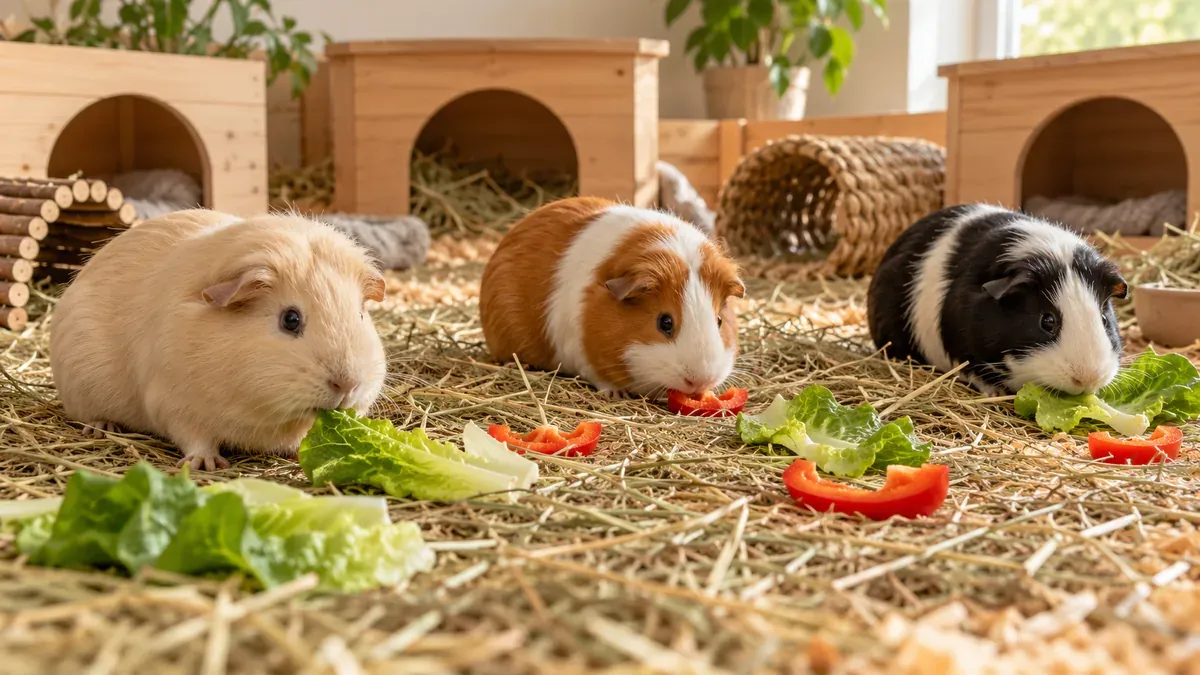
Adopt at least two guinea pigs, and if possible animals that are already friends: a same-sex pair or a mixed group with verified reproductive status. The PDSA recommends choosing animals that already get on. The most commonly cited pairings are two females, two males raised together, or a neutered male with one or more females. None guarantees that they will get on: that depends mainly on the animals’ personalities.
This guide helps you choose the make-up of the group, then check the points that prevent nasty surprises: sex, neutering, space and arrival.
Two or three?
The sources agree on the need: a guinea pig must live with at least one compatible companion. They vary on numbers:
- the RSPCA recommends at least one other friendly guinea pig;
- the PDSA recommends “two or more” on its introductions page, and groups of three or more on its general page.
A well-matched pair already meets the social need. A trio can work if you have the space, the budget and compatible animals. The choice depends on your situation more than on a single rule. For the space needed, see what size cage or enclosure for two guinea pigs.
Start with animals that are already bonded
This is the simplest option when it is available. The PDSA advises, wherever possible, adopting guinea pigs that are already friends, whether from the same litter or an existing pair. Rescue centres often have guinea pigs that already live together, and some help put together a compatible group.
An established group avoids introductions, which take time and can fail. It does not remove the need to check each animal’s sex and reproductive status.
Possible pairings
| Configuration | What the sources say | What to check |
|---|---|---|
| Two females | Pairing cited by the RSPCA and the PDSA | Sex confirmed for both; compatible personalities |
| Two males | Brothers raised together: pairing cited by the RSPCA. Male pairs are common (PDSA). Unrelated males can be introduced, but it can be tricky and take a few attempts (RSPCA) | Neutering does not resolve fighting between males (RSPCA); enough space and resources |
| A neutered male and one or more females | Pairing cited by the RSPCA. A mixed group sometimes gets on better than a single-sex group (PDSA) | Neutering done before they live together; the vet’s instructions on when the male can join the females |
| Parent and offspring (father and son, mother and daughter) | Often live well together (PDSA) | Sex of both; the same neutering rule if the sexes differ |
| Group of three or more | The PDSA often recommends only one male, as in wild groups | Resources and hides for everyone; space scaled to the group |
These configurations are possibilities, not guarantees. The RSPCA and the PDSA both stress that a successful pairing depends more on the animals’ personalities than on their sex. Brothers do not automatically get on, and unrelated males can become compatible.
Taking character into account helps: the PDSA suggests pairing an active guinea pig with a playful companion, and a dominant one with a less opinionated friend.
Sex first: the point that allows no mistakes
A female can become pregnant from 3 weeks of age (PDSA). A single sexing error is enough to cause an unexpected litter, and the RSPCA points out that pregnancy and birth carry many risks for the female.
- Have each animal’s sex confirmed by the seller or rescue, then by the vet at the first check-up.
- Ask about reproductive status: neutered or not, and since when.
- For a female from a mixed group, tell the vet that she could be pregnant.
Neutering
- Essential for a male that is to live with females (RSPCA). According to the RSPCA, male guinea pigs are now routinely and safely neutered; the PDSA notes that the operation also carries risks, to discuss with your vet.
- Not necessary solely to house two males together, according to the RSPCA, which says it does not resolve their fighting. This does not rule out an individual medical indication determined by a vet.
- Spaying females is possible but less common, as the operation is more complicated (RSPCA, PDSA).
Before putting a neutered male with females, ask your vet how long to wait, and follow their instructions. Also discuss the benefits and risks of the operation with them (PDSA).
Welcoming the group
- A health check before mixing a newcomer with the group: the PDSA advises keeping it apart for a few days until you are sure it is healthy.
- Gradual introductions if the guinea pigs do not know each other. The steps are summarised in can a guinea pig live alone?
- Resources for everyone: food, water, shelters, and one more hiding place than the number of animals (RSPCA). Prefer shelters with two exits (PDSA).
- The group goes to the vet together, even if only one is ill, unless told otherwise (PDSA).
Next step
Once the group is chosen, size its housing with what size cage or enclosure for two guinea pigs. To measure the long-term commitment, see how long do guinea pigs live, and for the species’ needs, the guinea pig species guide.
Sources
- RSPCA — Keeping guinea pigs together: recommended pairings, unrelated males, neutering with no effect on behaviour, spaying females, risks of pregnancy.
- RSPCA — Keeping rabbits and guinea pigs together: male guinea pigs routinely and safely neutered.
- PDSA — Introducing guinea pigs: two or more, already-bonded animals, pairings, one male per group, personality, introductions.
- PDSA — Guinea pigs as pets: groups of three or more, pregnancy possible from 3 weeks, neutered males in mixed groups.
- PDSA — Guinea pig health: neutering, spaying females possible, benefits and risks to discuss with the vet.