Can a guinea pig live alone? What to do if yours is on its own
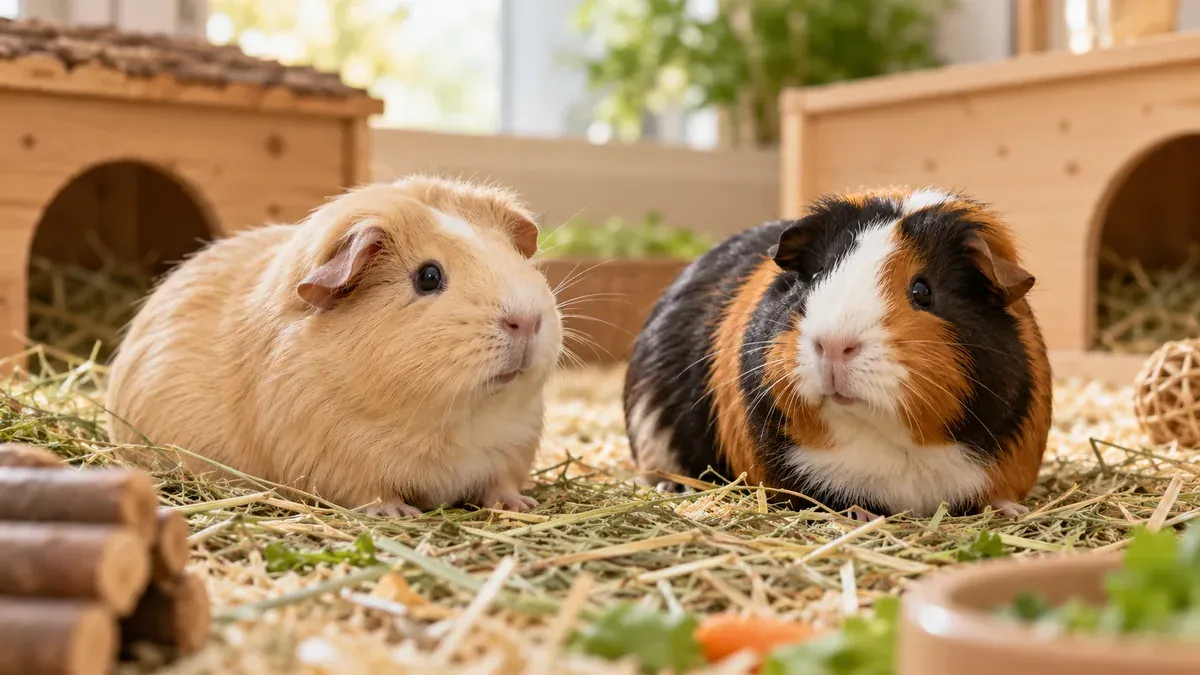
No, a guinea pig should not live alone: it needs the company of at least one other compatible guinea pig. The RSPCA recommends keeping a guinea pig with at least one friendly companion, unless a vet or clinical animal behaviourist advises otherwise, because guinea pigs left alone for long periods can develop abnormal behaviour.
If yours lives alone today, there is no need for guilt: the situation can be fixed, just not in a rush. This guide starts from your situation, whether it has been alone since it arrived, its companion has just died, it needs to be separated for a while or the two do not get on.
What the sources say
All the sources consulted agree on the essentials: guinea pigs are social animals that need their own kind. They differ only on numbers.
- RSPCA: at least one other friendly guinea pig, unless a vet or clinical animal behaviourist advises otherwise.
- PDSA: “two or more guinea pigs” on its introductions page, “pairs or small groups” on its health page, and groups of three or more on its general page.
In practice, a well-matched pair already meets the social need. Choosing between two and three depends mostly on the animals, the space and your means: see how many guinea pigs should you get, and which pairings work.
Why your company is not enough
A guinea pig that is very attached to its owner is not fulfilled for all that. The PDSA puts it plainly: our company is not enough. We cannot be there all the time, and it needs an animal of its own species that understands its signals and communicates with it. On its own, a guinea pig is often stressed, depressed and bored (PDSA). Boredom and stress can also lead it to overeat and gain weight (PDSA).
Your attention still matters, but it comes on top of a companion, not instead of one.
Depending on your situation
It has lived alone since it arrived
The aim is to find it a compatible companion, without rushing.
- Choose a companion that suits its personality. The PDSA suggests taking character into account: an active guinea pig will get on better with a playful friend, a calm one with a quieter companion. Some rescue centres offer a bonding service: they help choose and introduce the animals, even if the newcomer does not come from them (PDSA).
- Check sex and reproductive status before any meeting: a female can become pregnant from 3 weeks old (PDSA). Possible pairings and their conditions are covered in how many guinea pigs should you get.
- Keep the newcomer apart for a few days. The PDSA advises waiting until you are sure it is healthy, as the stress of moving can bring on illnesses it could pass on. At the slightest symptom, have it checked before starting introductions. A few symptom-free days do not guarantee freedom from infection: ask your vet about the appropriate separation period and arrangements before contact or equipment sharing.
- Introduce them gradually. The steps suggested by the PDSA:
- two separate set-ups in the same room, so they can see each other without touching, swapping bedding and toys to mix their scents;
- after a few days, the enclosures side by side, separated by a barrier;
- then a meeting on neutral ground, short and supervised at first (10 to 15 minutes), with tunnels and shelters that have two exits so neither gets cornered;
- finally living together, in a large enough space, with no single-entrance houses.
- Plan space for two. See what size cage or enclosure for two guinea pigs.
Its companion has just died
The PDSA notes that a guinea pig that has lost its companion often struggles on its own, and recommends finding it a new friend, or two. The same approach applies: choose a compatible companion, check its health, introduce it gradually.
In the meantime, watch its appetite closely. A guinea pig that eats less needs to see a vet quickly, whatever the apparent cause: see my guinea pig is not eating. If the remaining guinea pig is old or ill, ask your vet how best to organise a companion’s arrival.
They need to be separated for a while
Once bonded, guinea pigs should stay together at all times, unless the vet advises otherwise (PDSA). For a vet visit, the PDSA advises taking the whole group, even if only one is unwell, unless the vet says otherwise: separation is stressful. If one needs to be hospitalised, ask the vet whether its companion can stay with it.
They do not get on
Falling out can happen during introductions, or after years of getting on well, sometimes because of illness, sexual maturity or separation (PDSA).
- Separate them temporarily if they fight: they can seriously injure each other. Never step in with bare hands: slide a clean board or dustpan between them, or throw a towel over them as a distraction (PDSA).
- Have any injury checked: bites and scratches can become infected or form an abscess (PDSA).
- Have the change investigated, including possible illness or pain. The PDSA also suggests discussing neutering, whereas the RSPCA says it does not resolve fighting between males: do not treat it as an automatic solution.
- Start introductions again from the beginning, separate housing included: it often goes faster the second time (PDSA).
Complete incompatibility is rare. If it is confirmed despite a gradual approach, the PDSA suggests reconsidering the pairing, not giving up on a companion altogether.
The vet advises against a companion
This is the exception the RSPCA allows for. In that case, the RSPCA stresses the importance of interacting with your guinea pig every day. Ask the vet or behaviourist how best to make up for it, and whether the situation might change.
What about a rabbit for company?
That is not a solution. The two species communicate differently, have different dietary needs, and a rabbit can injure a guinea pig or pass on a respiratory bacterium (RSPCA, PDSA). If a rabbit and a guinea pig already live together, see can rabbits and guinea pigs live together?
Next step
To choose the right companion and group make-up, read how many guinea pigs should you get, and which pairings work, then check the set-up keeps up with the cage or enclosure size for two. The species’ needs are summarised in the guinea pig species guide.
Sources
- RSPCA — Keeping guinea pigs together: at least one friendly companion unless advised otherwise, abnormal behaviour when alone, daily interaction if a guinea pig must live alone, neutering and fighting.
- RSPCA — Creating a good home for guinea pigs: guinea pigs are social animals that should not live by themselves.
- PDSA — Introducing guinea pigs: two or more guinea pigs, our company is not enough, choosing a companion, introduction steps, falling out.
- PDSA — Guinea pigs as pets: groups of three or more, a companion after a death, pregnancy possible from 3 weeks.
- PDSA — Guinea pig health: stress, depression and boredom when alone, vet visits together.