My guinea pig is not eating: what to do right now
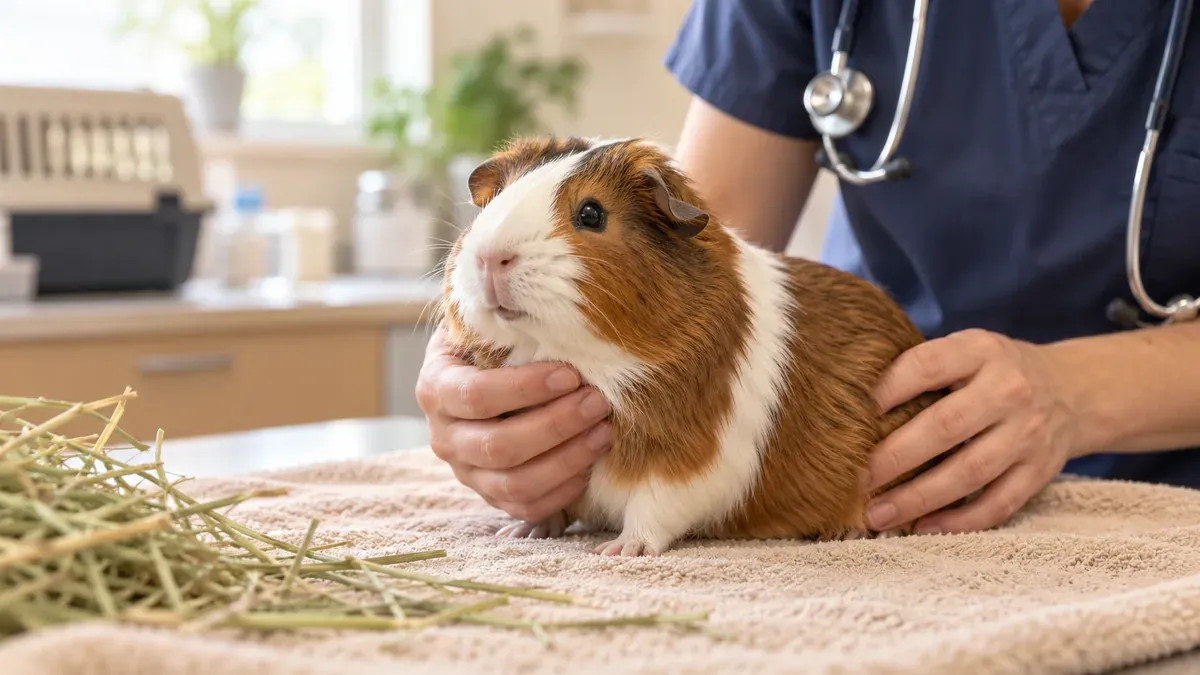
If your guinea pig is eating less or has stopped eating, call your vet now, ideally one experienced with exotic pets, or the out-of-hours service if the practice is closed. According to the PDSA, a guinea pig that stops eating is at risk of gut stasis, which can be life-threatening: do not wait to see if it passes.
Do this now
- Call the vet as soon as you notice, even if the drop in appetite seems slight.
- Note the observations in the next section: they help the vet judge how urgent it is.
- Follow their instructions, including for transport and feeding until the appointment.
What to tell the vet
These observations are there to prepare the call. They do not allow you to diagnose, nor to decide to wait.
- Complete stop or reduced appetite? And since when: the last time you saw it eat.
- What it still eats: hay, pellets, vegetables, and what it refuses.
- Its droppings: present or not, fewer, smaller, softer. The RSPCA advises contacting a vet immediately if they stop, become less frequent or softer.
- Is it drinking?
- Its behaviour: dull, unresponsive, hunched, hiding in a corner (Merck).
- Other signs: drooling or a wet chin, difficulty breathing, discharge from the nose or eyes, sneezing, diarrhoea, head tilt, blood in the urine or straining to urinate (Merck, VCA).
- Whether it seems unusually cold. Mention it without delaying the call to measure its temperature: touch alone cannot confirm a low body temperature.
- Its weight, if you weigh it regularly, and any recent change (PDSA).
- What has changed recently: new food, old pellets, a companion arriving or leaving, a move, a possible pregnancy.
- Any recent medication: some antibiotics can cause loss of appetite or diarrhoea in guinea pigs (Merck).
If several guinea pigs live together, say which one is not eating: with a shared bowl, one guinea pig’s loss of appetite can go unnoticed.
What not to do
- Wait. No length of time can be considered safe. Guinea pigs hide symptoms until they are very sick and can decline quickly (Merck).
- Give medication without a prescription. Many common antibiotics are dangerous for guinea pigs (Merck), and those sold in pet shops should never be given to them (VCA).
- Start with a vitamin C supplement in the hope that it will be enough. Deficiency is one possible cause, but not the only one, and trying it delays the visit.
- Force-feed with a syringe without veterinary instructions. The vet may prescribe assisted feeding; what to give, how much and how is for them to decide (Merck).
- Suddenly change its food to tempt it: a sudden change can itself cause a guinea pig to refuse food (VCA).
Until the appointment
- Leave available its hay, water and usual food.
- Keep its companion with it and take them to the vet together, unless told otherwise: the PDSA advises this, as separation is stressful.
- For the journey, the RSPCA suggests putting familiar-smelling items in the carrier and moving it with its companion(s).
- Avoid temperature extremes: no direct sunlight or draughts, and take care when travelling in very hot or very cold weather (Merck).
Why it is urgent in guinea pigs
Guinea pigs depend on a high-fibre diet to keep their gut working. When they stop eating, the gut can slow down and then stop: this is gut stasis, which the PDSA describes as life-threatening. VCA states that signs such as not eating, depression, dehydration or diarrhoea need immediate veterinary attention. Merck notes that some guinea pigs with digestive problems decline rapidly and die suddenly.
Like many prey animals, guinea pigs hide symptoms for a long time (Merck, PDSA). By the time loss of appetite is visible, the problem is often already established.
Causes the vet will look for
Loss of appetite is a sign, not a disease. There are many possible causes, and they can combine. The table below helps you understand the vet’s questions. It is not for diagnosing at home, and it is not exhaustive.
| Possibility | Signs that may go with it | Source |
|---|---|---|
| Dental problem | Drooling, weight loss, difficulty eating. The back molars are often involved even when the front teeth look normal | Merck |
| Digestive problem | Gas, swollen belly, pain, small droppings, diarrhoea | Merck, VCA |
| Vitamin C deficiency | Rough coat, reluctance to move, swollen joints, bleeding gums | Merck, VCA |
| Respiratory infection | Discharge from the nose or eyes, sneezing, difficulty breathing | Merck, VCA |
| Ear infection | Pain when chewing, head tilt, loss of balance | Merck |
| Urinary problem | Blood in the urine, straining or crying out when urinating, hunched posture | VCA |
| Ovarian cysts (female over one year) | Hair loss, reduced appetite, low energy | Merck |
| Pregnancy toxaemia (pregnant female) | Loss of appetite at first, then muscle twitching | VCA |
| Sudden change of diet, stress | Refusing a new food, recent upheaval | VCA, PDSA |
Several of these look alike: only an examination can tell them apart. Vitamin C deficiency is covered in vitamin C deficiency in guinea pigs.
What the vet will do
Merck explains that the vet looks for the cause, including dental disease, dietary imbalance or another illness, using x-rays and blood tests. Depending on the examination, they may prescribe rehydration and assisted feeding until gut function returns. These treatments are not automatic: they depend on the cause and the guinea pig’s condition. Assessing the teeth may require skull imaging, x-rays or a CT scan, and dental treatment is done under anaesthesia (VCA, Merck).
After the episode: prevent and spot it earlier
- Unlimited hay: too little hay or too many pellets encourage digestive problems (Merck). See what do guinea pigs eat.
- Vitamin C every day, from fresh pellets and vegetables. See how much vitamin C does a guinea pig need?
- Daily checks of appetite, drinking and droppings (RSPCA).
- Regular weighing: weight loss can be the first sign of illness (PDSA).
- A vet check at least once a year with a vet experienced with guinea pigs (Merck).
Next step
Once the emergency is over, review the diet with what do guinea pigs eat and check vitamin C intake. Find the health guides in the guinea pig health section and the species’ needs in the guinea pig species guide.
Sources
- PDSA — Your guinea pig’s diet: a guinea pig that stops eating risks life-threatening gut stasis, regular weighing, contacting the vet.
- PDSA — Guinea pig health: hidden symptoms, contacting the vet quickly, taking the group together.
- Merck Veterinary Manual — Nutritional problems of guinea pigs: causes investigated, x-rays, blood tests, fluids and syringe-feeding by the vet.
- Merck Veterinary Manual — Common health problems of guinea pigs: teeth, digestive problems, ears, breathing, ovarian cysts, antibiotics.
- Merck Veterinary Manual — Unique needs of guinea pigs: draughts, direct sunlight, transport in extreme weather.
- Merck Veterinary Manual — Routine care of guinea pigs: signs to watch for, rapid decline, yearly check-up.
- VCA Animal Hospitals — Health problems in guinea pigs: gut stasis and immediate care, low body temperature, urinary problems, pregnancy toxaemia, antibiotics.
- RSPCA — What to feed a guinea pig: contact a vet immediately if droppings or appetite change.