What do guinea pigs eat? The daily diet explained
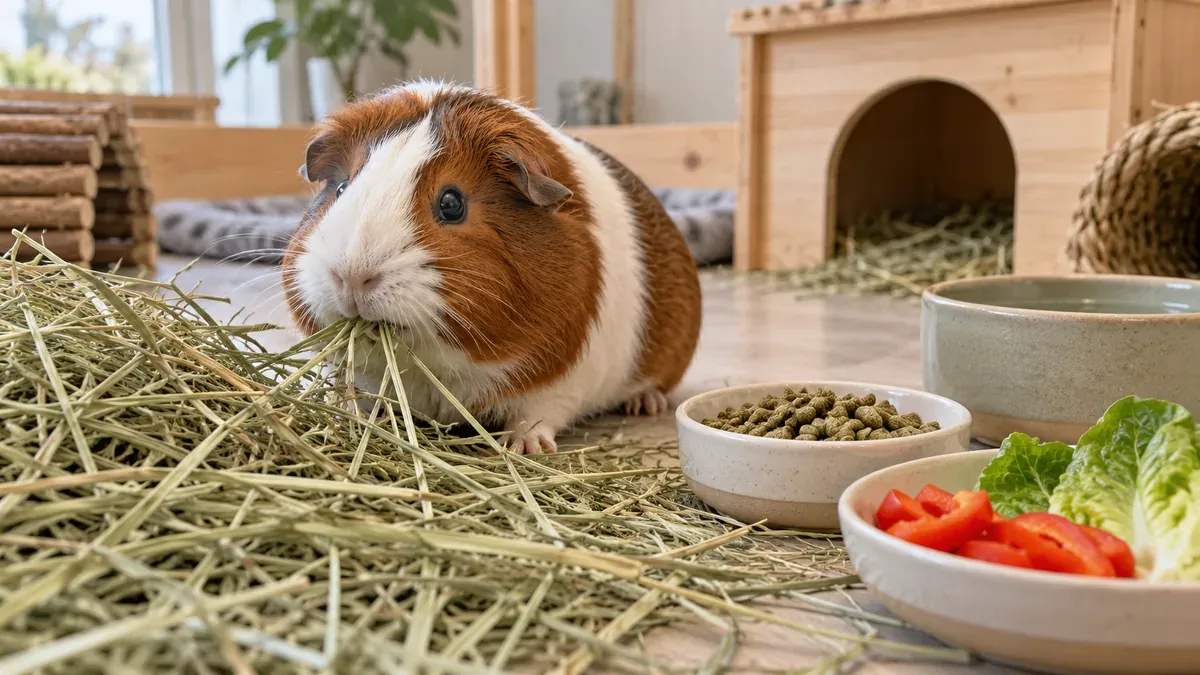
A guinea pig eats mainly unlimited hay, topped up every day with fresh vegetables, a small portion of guinea pig pellets and constant access to fresh water. Its diet must also supply vitamin C every day, because its body cannot make it.
This guide organises the daily diet: what is given freely, what is measured and what stays occasional. Vitamin C needs, choosing vegetables and foods to avoid each have their own page.
The diet at a glance
| Food | Guide | What the sources say |
|---|---|---|
| Hay (and fresh grass) | Unlimited, day and night | The PDSA puts it at 80 to 90% of the diet, and 85 to 90% on its dedicated diet page. The RSPCA asks for fresh grass as often as possible, ideally every day. |
| Vegetables and greens | About one cup per guinea pig per day | The PDSA recommends at least five to six different types a day, including some high in vitamin C. |
| Guinea pig pellets | Small measured portion, renewed daily | One tablespoon per adult per day for the PDSA, about two tablespoons a day for the Merck Veterinary Manual. |
| Water | Always available | The RSPCA advises checking it twice a day and making sure it does not freeze in winter. |
| Fruit | Occasional, in small amounts | High in sugar (Merck, VCA). The PDSA limits treats to once every week or two. |
These figures are guides, not a recipe to weigh. The hay percentages describe hay’s place in the diet, and the source gives no basis of calculation: they do not convert into grams. A “cup” is a volume: its weight changes depending on whether it holds lettuce leaves or chunks of pepper.
Hay, the foundation of the diet
Hay is not a side dish: it is the main food. Guinea pig teeth grow continuously, and chewing fibre wears them down. The same fibre feeds the gut bacteria that digestion depends on. According to the PDSA, a lack of fibre can lead to the gut slowing down or stopping, which can be life-threatening.
Which hay? The Merck Veterinary Manual recommends good-quality grass hay, such as timothy or orchard grass. VCA recommends timothy or another low-calcium hay. A hay rack keeps it clean and dry (Merck). The PDSA also suggests scattering large piles of hay around the living space to encourage foraging.
Fresh grass is a good addition. For indoor guinea pigs, the RSPCA suggests pots of growing grass. One rule has no exceptions: never lawnmower clippings. They ferment quickly (PDSA) and make guinea pigs ill (RSPCA).
Pellets: a small, well-chosen portion
Pellets complement hay. They provide vitamin C in particular, but must not replace hay.
- Choose guinea pig pellets, grass-based and high in fibre (PDSA, VCA, Merck). Rabbit pellets do not contain enough vitamin C for a guinea pig (Merck).
- Choose pellets of uniform shape and colour. With a muesli-style mix, the guinea pig picks out only what it likes best: the PDSA advises against it.
- Match the type to the life stage. Merck notes that alfalfa-based pellets, which are higher in calcium, suit young growing guinea pigs and pregnant females, and that timothy-based pellets with less calcium are preferable for adults.
- Give a fresh portion every day, rather than topping up yesterday’s bowl (RSPCA). The vitamin C in pellets breaks down over time and with air, heat and light. The PDSA advises using them within three months of purchase.
One tablespoon or two? Both guides exist: one tablespoon per adult for the PDSA, about two for Merck. They do not merge into a universal dose. The RSPCA points out that the amount depends on age, lifestyle and health: a growing youngster, a pregnant or nursing female, or an underweight guinea pig may need a larger portion. If in doubt, ask your vet and keep track of your guinea pig’s weight.
Vegetables, and a little fruit
Vegetables provide vitamin C and variety. The PDSA recommends about one cup per guinea pig per day, with five to six different types, and avoiding too much of any one: cabbage or broccoli, for example, can cause gas in large amounts. Remove uneaten fresh food after a few hours so it does not spoil (Merck).
Choosing vegetables, their vitamin C and calcium content, and how to rotate them are covered in what vegetables can guinea pigs eat. Some plants must be avoided, such as iceberg lettuce or potato: the full list, with what the sources say about each food, is in foods guinea pigs should not eat.
Fruit is sugary and stays occasional (Merck, VCA). The colourful treats sold in pet shops are very high in sugar: the PDSA suggests replacing them with vegetables, greens or a small piece of fruit.
Vitamin C, the guinea pig’s particular need
This is the big difference from rabbits. Guinea pigs cannot synthesise vitamin C: without enough of it, they develop a deficiency called scurvy (Merck, PDSA). A balanced diet with fresh pellets and vitamin C-rich vegetables is the basis of prevention. Requirements, pellet storage and the question of supplements are covered in how much vitamin C does a guinea pig need?
Water: constant access and clean containers
- Constant access to clean, fresh water (RSPCA, VCA, Merck).
- Bottle or heavy bowl. VCA accepts either, as long as the bowl cannot tip over. Merck notes that a bottle fixed at the right height keeps water cleaner.
- Daily cleaning of the container, and fresh water at least once a day, even if some is left (VCA). Check the sipper tube is not blocked.
- Nothing in the water. Merck advises against adding supplements. It also advises avoiding distilled water and water very high in minerals or calcium.
Changing the diet without upsetting it
Guinea pigs form their food habits early and do not adapt easily to change (VCA, Merck). A sudden change can lead them to refuse food, which is serious in this species.
The PDSA advises spreading any change over two to four weeks: mix a small amount of the new food with the old, increase gradually, and slow down at the first sign of a tummy upset. New vegetables are introduced the same way, one at a time.
Common situations
- You have just adopted it. Start with the food it already knows, then change the diet gradually (Merck). Ask the breeder, rescue or pet shop what it was eating.
- It picks through its food. Check whether it is getting a muesli-style mix: the PDSA advises against these because guinea pigs can select individual ingredients. If so, switch gradually to uniform pellets. If it is also leaving familiar foods, contact your vet.
- It is gaining or losing weight. The PDSA advises weighing regularly: weight gain can come from too many pellets or too much fresh food, weight loss can signal illness. Talk to your vet if there is a clear change.
- It eats its droppings. That is normal. Guinea pigs produce soft droppings called caecotrophs, which they eat straight from the bottom as part of digestion (RSPCA, PDSA).
- It is eating less, or not at all. This is not a diet problem to fix by changing the menu: contact your vet without delay. See my guinea pig is not eating.
What to watch every day
Keep an eye on what it eats and drinks, and on its droppings. The RSPCA advises contacting a vet immediately if droppings stop, become less frequent, softer or stuck to the rear end, or if eating, drinking or toilet habits change.
Next step
Once the diet is organised, check that it covers vitamin C: this is what diets “copied” from rabbits tend to miss. Start with a guinea pig’s vitamin C needs, then build the vegetable portion with our vegetable table. For the species’ overall needs, see the guinea pig species guide.
Sources
- PDSA — Your guinea pig’s diet: share of hay, one tablespoon of pellets and one cup of vegetables per adult, pellet storage, two-to-four-week transition, treats.
- PDSA — Guinea pigs as pets: share of hay and grass in the diet.
- Merck Veterinary Manual — Diet for a guinea pig: choosing hay, two tablespoons of pellets, alfalfa or timothy by life stage, water, rabbit pellets lacking vitamin C.
- RSPCA — What to feed a guinea pig: fresh grass, lawnmower clippings, daily fresh pellet portion, water, monitoring droppings.
- VCA Animal Hospitals — Feeding guinea pigs: low-calcium hay, timothy-based pellets, gradual changes, cleaning the water bottle.