How much vitamin C does a guinea pig need?
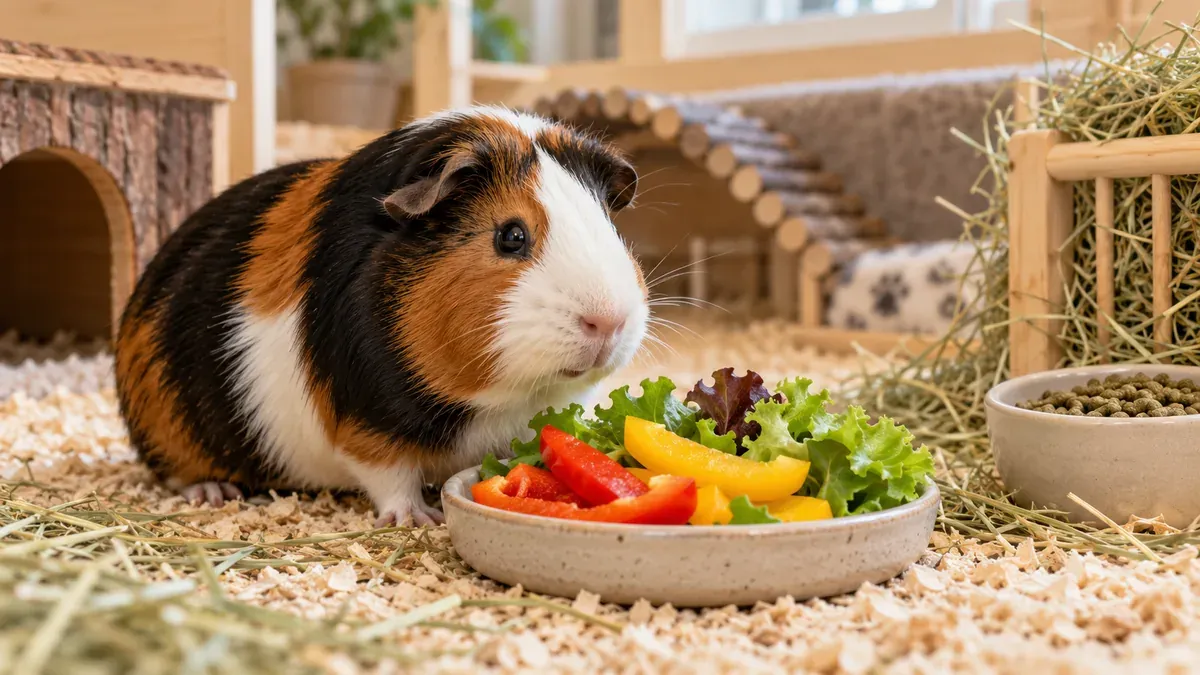
A guinea pig needs vitamin C every day, because its body cannot make it. The Merck Veterinary Manual puts this need at at least 10 mg per kilo of body weight per day (30 mg/kg for a pregnant female). In a healthy guinea pig, fresh guinea pig pellets and vitamin C-rich vegetables usually cover it.
This guide explains where that vitamin C comes from, why it disappears from pellets, when a supplement is worth discussing and why it should never go in the water. The deficiency itself, its signs and its treatment are covered in vitamin C deficiency in guinea pigs.
Why guinea pigs depend on their diet
Like humans and a few other mammals, guinea pigs cannot produce vitamin C (Merck). They rely entirely on what they eat. This vitamin is essential for skin, joints, blood vessels and gums, and it plays a part in wound healing and immune defences (Merck, VCA). Too little leads to scurvy, and also makes guinea pigs more prone to other illnesses, including infections (VCA).
This is the main difference from rabbits, which do synthesise their own vitamin C (RSPCA). It is also why rabbit pellets are not suitable: they do not contain enough vitamin C for a guinea pig (Merck).
How much vitamin C? Two guides not to confuse
| Source | Guide | Who it applies to |
|---|---|---|
| Merck Veterinary Manual | At least 10 mg per kg per day | Adult guinea pig |
| Merck Veterinary Manual | 30 mg per kg per day | Pregnant female |
| VCA Animal Hospitals | 10 to 50 mg per day | Varies with age, health, stress and pregnancy |
The two sources do not express the need the same way: Merck relates it to body weight, VCA gives a daily range and adds that the vet can tell you what each guinea pig requires.
What these figures are not: an amount to add. They describe the total intake the guinea pig needs, from all sources. In a properly fed guinea pig, the diet already supplies a good part of it, or all of it. Nor do they tell you how much to give a deficient guinea pig: treating a deficiency is the vet’s job.
Where the vitamin C in the diet comes from
Guinea pig pellets, as long as they are fresh
Guinea pig pellets are fortified with vitamin C. But it is unstable: it breaks down with heat, light, moisture (Merck) and exposure to air (RSPCA). Merck notes that pellets can lose a substantial amount within a few months.
Hence three habits:
- Stick to a use-by window. The PDSA advises using pellets within three months of purchase. VCA counts 90 days from the date of manufacture. The two windows do not start on the same day: when the manufacturing date is on the bag, it gives the more cautious guide.
- Store them well: dry, cool and dark (PDSA). A small bag used quickly keeps its vitamin C better than a large bag opened for months.
- Give a fresh portion every day, rather than topping up yesterday’s bowl (RSPCA).
Vegetables and herbs rich in vitamin C
The RSPCA describes fresh vegetables and herbs as excellent sources of vitamin C, to be rotated daily. VCA names bell peppers, broccoli and cauliflower florets, and parsley among good sources. The PDSA recommends about one cup of vegetables per guinea pig per day, including some high in vitamin C.
Some of these plants are also high in calcium, such as parsley or kale: they are given in moderation (Merck). The vitamin C and calcium content of the main vegetables, from the ANSES-Ciqual food composition table, is set out in what vegetables can guinea pigs eat.
Fruit, as an extra only
Some fruits are rich in vitamin C, but they are also sugary: they stay occasional and in small amounts (VCA, Merck). They are not a source to rely on day to day.
Does a guinea pig need a vitamin C supplement?
The sources agree on the principle: a well-built diet is usually enough, and a supplement is decided case by case.
- VCA: if the guinea pig gets pellets with stable vitamin C, timothy hay and some leafy greens, a supplement is not necessary.
- PDSA: with a balanced diet and vitamin C-rich greens every day, a supplement should not be needed. But because it is hard to know whether intake is enough, the PDSA suggests, if you are concerned, a daily supplement given in or on the food.
- Merck: talk to your vet about the best vitamin C sources and amounts for your guinea pig. Multivitamins are usually not advised, as some added vitamins can be harmful to guinea pigs.
When to talk to your vet
Veterinary advice is useful if:
- the pellets are old, poorly stored, or your guinea pig does not eat them;
- it refuses most vegetables, or eats very few;
- it is young, old, pregnant, ill or stressed, situations in which VCA says the need varies;
- you notice a sign that could point to a deficiency (see the box below).
Reading a supplement label
Supplements come as chewable tablets or as a liquid given by mouth (VCA). Their strength varies from one product to another: there is no universal number of drops or tablets. Look at the amount of vitamin C per tablet or per millilitre, and follow the manufacturer’s directions and your vet’s. The PDSA considers an overdose very unlikely with a balanced diet and the product’s directions, and Merck notes that vitamin C is safe even at higher doses.
Why vitamin C should never go in the water
It is a common practice, and the sources advise against it for two reasons:
- Vitamin C breaks down quickly in water, and even faster in light (VCA, PDSA). The guinea pig gets far less than intended.
- The taste can put it off drinking (VCA, PDSA). A supplement meant to protect it can end up reducing how much it drinks.
Merck more broadly advises against adding any supplement to drinking water.
Prevention is not treatment
| Situation | What applies | Who decides |
|---|---|---|
| Healthy guinea pig | Complete diet: fresh guinea pig pellets, vitamin C-rich vegetables, hay | You, using the guides above |
| Doubt about whether needs are covered | Possible supplement, in or on the food, as labelled | You, ideally after veterinary advice |
| Signs of deficiency or an unwell guinea pig | Diagnosis, then daily vitamin C by mouth or injection as prescribed (Merck) | The vet |
Signs that need a vet: a rough coat, reluctance to move or signs of pain, swollen feet or joints, bleeding or ulcers on the gums or skin, diarrhoea, loss of appetite (VCA). These signs have other possible causes: only a vet can tell them apart. They are covered in vitamin C deficiency in guinea pigs.
If your guinea pig is eating less or not at all, do not start by giving a supplement: contact your vet without delay. See my guinea pig is not eating.
Next step
Check the purchase or manufacturing date of your pellets, then build the vegetable portion with our table of vitamin C and calcium content. To place vitamin C within the whole diet, see what do guinea pigs eat.
Sources
- Merck Veterinary Manual — Nutritional problems of guinea pigs: need of at least 10 mg/kg/day, 30 mg/kg/day in pregnancy, breakdown of vitamin C, vet-prescribed treatment, multivitamins not advised.
- Merck Veterinary Manual — Diet for a guinea pig: fortified but unstable pellets, rabbit pellets lacking vitamin C, no supplements in water.
- VCA Animal Hospitals — Health problems in guinea pigs: 10 to 50 mg per day depending on the guinea pig’s condition, 90 days from manufacture, tablets and liquid forms, no vitamin C in water.
- VCA Animal Hospitals — Feeding guinea pigs: supplement unnecessary with a complete diet, signs of deficiency.
- PDSA — Your guinea pig’s diet: pellets within three months of purchase, supplement if in doubt, not in water, overdose risk.
- RSPCA — Keeping rabbits and guinea pigs together: unlike guinea pigs, rabbits synthesise their own vitamin C.