Vegetables for guinea pigs: vitamin C and calcium table
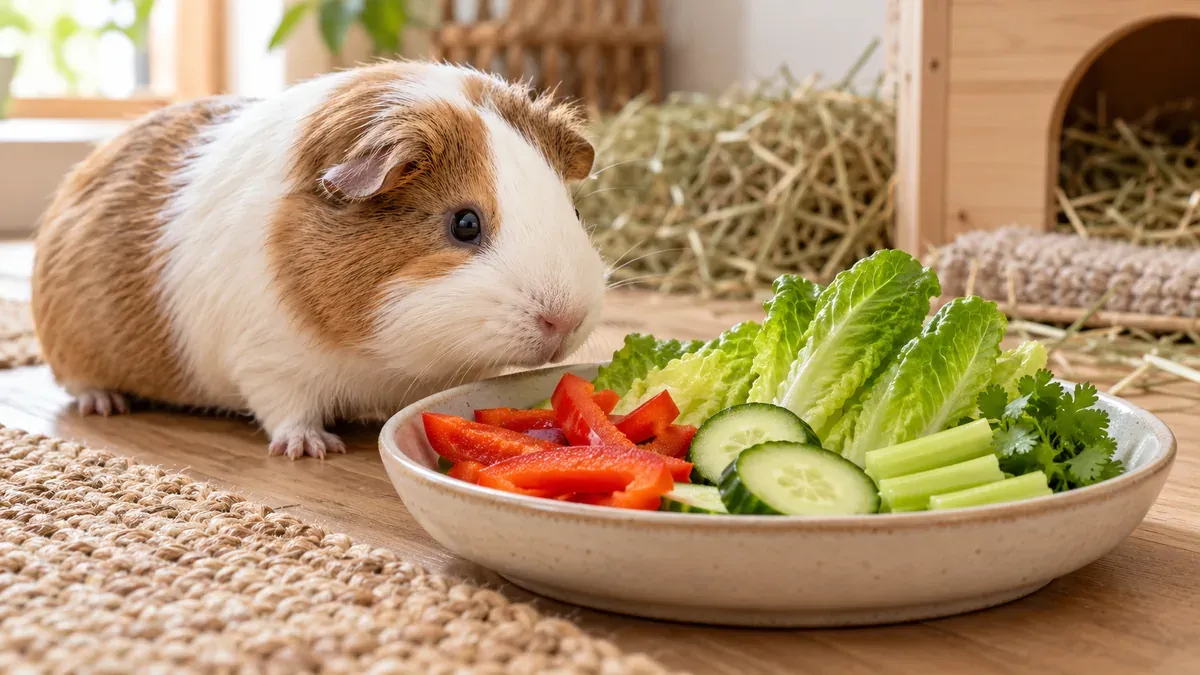
A guinea pig can have vegetables and herbs such as sweet pepper, romaine lettuce, cucumber or celery every day, rotating the selection. Use parsley in moderation, and keep broccoli, kale or a small piece of carrot as occasional additions. The PDSA recommends about one cup of vegetables per guinea pig per day, with at least five to six different types, including some high in vitamin C.
The table below combines what veterinary sources say about each vegetable with composition data published by ANSES, the French food safety agency. It is there to help you vary the plate, not to rank vegetables on vitamin C alone.
Vegetables according to veterinary sources
The RSPCA sorts plants into three groups:
- Can eat often, rotated daily: parsley, celery, bell peppers, cucumber, gem lettuce, romaine lettuce.
- As a treat, in small amounts a few times a week, because of their sugar or calcium content: broccoli, spinach, kale, small pieces of carrot, a quarter of an apple.
- Can’t eat: including iceberg lettuce, potato, garlic, avocado, coconut and citrus fruits.
VCA lists bell pepper, tomato, turnip, collard greens and asparagus as vegetables high in vitamin C, then other useful vegetables: green and red leaf lettuce, romaine, broccoli, cauliflower, endive, carrot tops, beet greens, cilantro, carrot and squash. Iceberg lettuce, which is mostly water, has little nutritional value (VCA, Merck).
Foods to avoid, and what each source says about their risk, are covered in foods guinea pigs should not eat.
Table: vitamin C and calcium in common vegetables
Values from the ANSES-Ciqual 2025 food composition table, in milligrams per 100 g of edible portion, for the raw food. The “use” column reflects veterinary sources: Ciqual measures food composition, and says nothing about a food’s value or safety for guinea pigs.
| Ciqual label (code) | Vitamin C (mg/100 g) | Calcium (mg/100 g) | Use according to sources |
|---|---|---|---|
| Parsley, fresh (11014) | 133 | 138 | Often (RSPCA); high in calcium, not too often (Merck) |
| Sweet pepper, red, raw (20087) | 121 | 4.8 | Often (RSPCA); high in vitamin C (VCA) |
| Sweet pepper, yellow, raw (20168) | 121 | 8.6 | Often (RSPCA); high in vitamin C (VCA) |
| Kale, raw (20346) | 93.4 | 254 | Treat (RSPCA); high in calcium, not daily (Merck, VCA) |
| Broccoli, raw (20057) | 91.2 | 47.5 | Treat (RSPCA); gas in large amounts (PDSA) |
| Cauliflower, raw (20016) | 48.2 | 23 | Florets high in vitamin C (VCA) |
| Green cabbage, raw (20069) | 40.2 | 42.3 | Good source of vitamin C (RSPCA); gas in large amounts (PDSA) |
| Spinach, raw (20059) | 28.1 | 99 | Treat (RSPCA); high in calcium (Merck) |
| Coriander, fresh (11094) | 27 | 67 | Useful vegetable (VCA) |
| Sweet pepper, green, raw (20085) | 26.9 | 6.2 | Often (RSPCA) |
| Tomato, raw (average) (20385) | 20.1 | 6.78 | High in vitamin C (VCA); fruit only, not the vine or leaves (PDSA) |
| Celery stalk, raw (20023) | 5.51 | 46 | Often (RSPCA) |
| Cos or romaine lettuce, raw (20171) | 4 | 33 | Often (RSPCA); useful vegetable (VCA) |
| Carrot, raw (20009) | 3.73 | 36.2 | Small pieces as a treat (RSPCA, Merck) |
| Cucumber, flesh and skin, raw (20019) | 2.8 | 19.2 | Often (RSPCA) |
| Iceberg lettuce, raw (20200) | 2.8 | 18 | Avoid (RSPCA, PDSA, VCA, Merck) |
| Chicory, raw (20026) | 2.12 | 20 | Useful vegetable, as endive (VCA) |
These are averages from the available data, not an analysis of the vegetable in your kitchen: values vary with factors including variety and storage conditions. Keep the exact food code: “Kale, raw” (20346) and “Curly kale, raw” (20218) are distinct Ciqual entries whose values should not be interchanged.
How to read this table
1. Pepper entries differ by colour. In Ciqual 2025, the mean values for red and yellow peppers are about 4.5 times the green pepper value: 121 versus 26.9 mg of vitamin C per 100 g. This compares database entries; it does not guarantee the content of an individual pepper.
2. High in vitamin C does not mean “unlimited”. Parsley and kale are among the richest in vitamin C, but also in calcium. Merck advises not giving high-calcium greens often, and VCA advises against giving them daily or free choice, because too much calcium can contribute to bladder stones. These two properties do not cancel each other out: they are managed within the whole diet, by rotating.
3. Some vegetables are mainly there for variety. Cucumber, romaine lettuce and celery are among the vegetables the RSPCA says can be given often, but they provide very little vitamin C. They round out the plate without covering vitamin C on their own.
4. Calcium is not the enemy. For most healthy guinea pigs, a balanced diet provides the right amount of calcium (PDSA). Do not build an “anti-stone” diet from this table: if your guinea pig has a urinary problem, its diet should be adjusted by the vet (PDSA).
Building the daily plate
- Amount: about one cup per guinea pig per day (PDSA). A cup is a volume: its weight varies with the vegetables that fill it.
- Variety: at least five to six different types a day, including some high in vitamin C (PDSA), rotated (RSPCA). Avoid too much of any one vegetable: cabbage and broccoli can cause gas in large amounts (PDSA).
- Example plate built from the RSPCA’s categories: red pepper, romaine lettuce, cucumber, celery and a little parsley, with a few broccoli florets in place of one of them on one or two days a week.
- Preparation: fresh, well-washed vegetables (VCA). Remove leftovers after a few hours (Merck).
- New vegetables: introduce them slowly, one at a time, to avoid tummy upsets (PDSA).
- Foraging: only plants you can identify, away from areas treated with weed killers or pesticides and from busy areas used by people and dogs (PDSA). Never lawnmower clippings (RSPCA, PDSA).
- Serving: the PDSA suggests scattering vegetables around the living space to encourage foraging.
If your guinea pig refuses vegetables
Guinea pigs form their food preferences early and do not take easily to new foods (Merck, VCA). A refusal is therefore not necessarily a passing whim:
- offer one new vegetable at a time, in a small amount, next to familiar ones;
- keep trying over several days before drawing conclusions;
- keep the vegetables it accepts and widen the list gradually.
A sudden refusal of familiar vegetables or an overall reduction in eating can signal illness: do not assume it is simply a taste preference, and contact your vet. See my guinea pig is not eating.
Next step
Vegetables are only part of the diet: hay remains the foundation and fresh pellets also supply vitamin C. For the overall balance, see what do guinea pigs eat. For vitamin C requirements and the question of supplements, see how much vitamin C does a guinea pig need?
Sources
- ANSES — Ciqual 2025 food composition table: vitamin C and calcium content (mg/100 g), labels and codes of the foods listed, files dated 3 November 2025, dataset published on 19 November 2025. Values checked against the official XML files; data and downloads, methodology.
- RSPCA — What to feed a guinea pig: vegetables to give often, as treats or not at all.
- PDSA — Your guinea pig’s diet: one cup a day, five to six types, gas, gradual introduction, foraging, calcium.
- VCA Animal Hospitals — Feeding guinea pigs: vegetables high in vitamin C, other recommended vegetables, iceberg lettuce.
- VCA Animal Hospitals — Bladder sludge and bladder stones in rabbits and guinea pigs: calcium-rich greens not to be given daily or free choice.
- Merck Veterinary Manual — Diet for a guinea pig: high-calcium greens, carrot as a treat, removing leftovers, food preferences.