How long do guinea pigs live? Lifespan and commitment
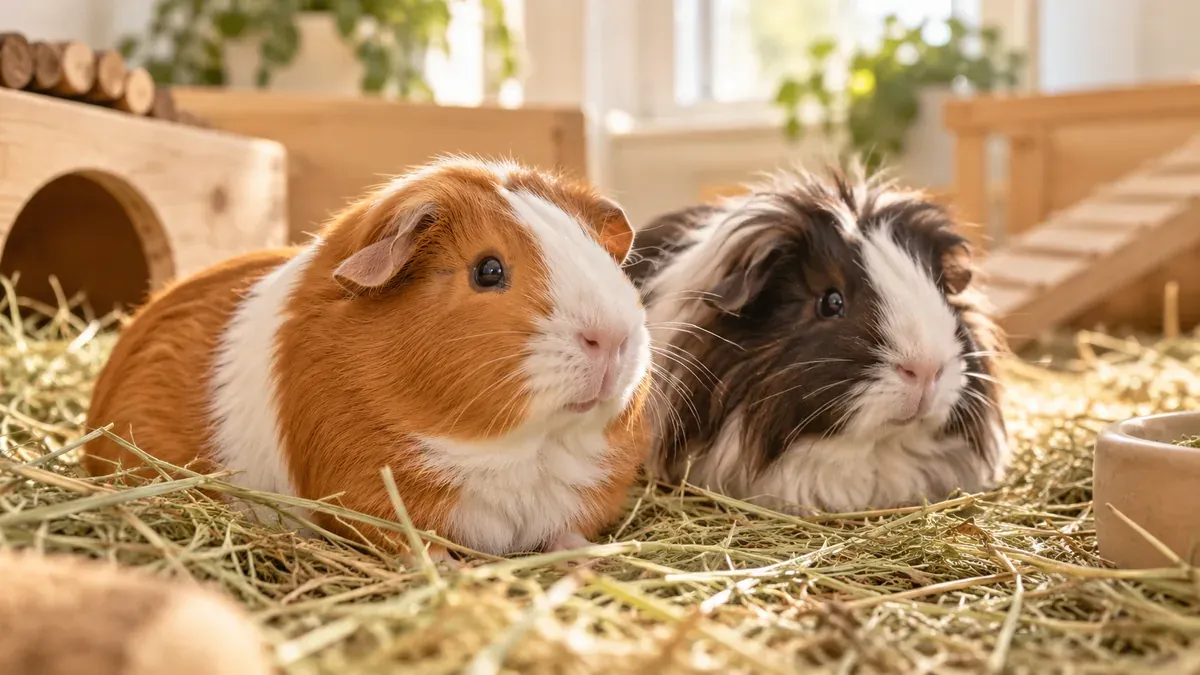
Guinea pigs live 4 to 8 years on average, according to the PDSA. This range does not predict the life of any particular guinea pig: above all, it gives the scale of the commitment. Care involves the whole group, and animals of different ages can extend that responsibility beyond the life of the first guinea pig adopted.
What this range says, and what it does not
Four to eight years is an indicative lifespan range, not a single statistical mean. Some guinea pigs live shorter lives, others longer, and this is not necessarily down to the care they receive: an early illness is not a sign of neglect. We give no “human age” equivalent here, nor lifespans by breed or sex, for lack of verifiable data.
What matters for your decision is the scale: several years of daily care, for at least two animals.
What the lifespan means in practice
Several years of daily and regular care
The Merck Veterinary Manual sums up routine care:
- every day: unlimited hay, fresh leafy greens, fresh water, spot-cleaning the cage;
- every week: a thorough cage clean; brushing frequency depends on coat length;
- every few weeks: trimming the nails.
The PDSA recommends daily brushing for long-haired guinea pigs and once or twice a week for short-haired ones. It also advises a quick daily health check and a fuller check every week. On top of that comes a vet check at least once a year, with a vet experienced with guinea pigs (Merck).
A group, and therefore ages that drift apart
A guinea pig should not live alone. But two guinea pigs adopted together do not die at the same time, and a companion adopted later is often younger. Plan from the start for a survivor needing a new companion: the PDSA notes that a guinea pig that loses its companion often struggles on its own. The approach is described in can a guinea pig live alone?
In practice, the commitment does not necessarily end when the first guinea pigs reach the end of their lives.
Years of absences to organise
Holidays, trips, a hospital stay: for the whole life of the group, someone will need to look after them. The RSPCA advises finding a responsible person to care for your guinea pigs in their familiar home and, if they must be boarded elsewhere, keeping the group together with familiar items.
Monitoring that changes with age
Some problems become more common over the years. Merck notes that tumours are rare in young guinea pigs but more common after age 5, and that ovarian cysts are common in females over one year old. Regular weighing (PDSA) and daily observation help you spot a change early.
What you can influence
No habit guarantees extra years of life. The sources do, however, stress care that prevents common problems:
- a suitable diet every day, with unlimited hay and vitamin C: see what do guinea pigs eat;
- clean water, soft bedding and a frequently cleaned cage (Merck);
- a companion of its own kind and enough space;
- a prompt vet visit at the slightest change, because guinea pigs hide symptoms and can decline quickly (Merck). Loss of appetite is an emergency: see my guinea pig is not eating.
Before adopting: three questions to ask yourself
- Can you provide daily care for several years, for at least two animals?
- Who will look after them while you are away?
- Are you ready to take in a new companion for the last survivor?
If the answer is yes, the next question is the group: how many guinea pigs should you get, and which pairings work. If you are still choosing between two species, see rabbit or guinea pig: which should you choose?
Sources
- PDSA — Guinea pigs as pets: average lifespan of 4 to 8 years, daily and weekly checks, a companion after a death.
- Merck Veterinary Manual — Routine care of guinea pigs: daily and weekly care, nails, yearly vet check, rapid decline.
- Merck Veterinary Manual — Common health problems of guinea pigs: tumours more common after 5, ovarian cysts, prevention.
- PDSA — Guinea pig health: daily health check, observing behaviour.
- PDSA — Your guinea pig’s diet: regular weighing to spot weight loss.
- RSPCA — Creating a good home for guinea pigs: care during absences.