Best bedding for guinea pigs: what to choose
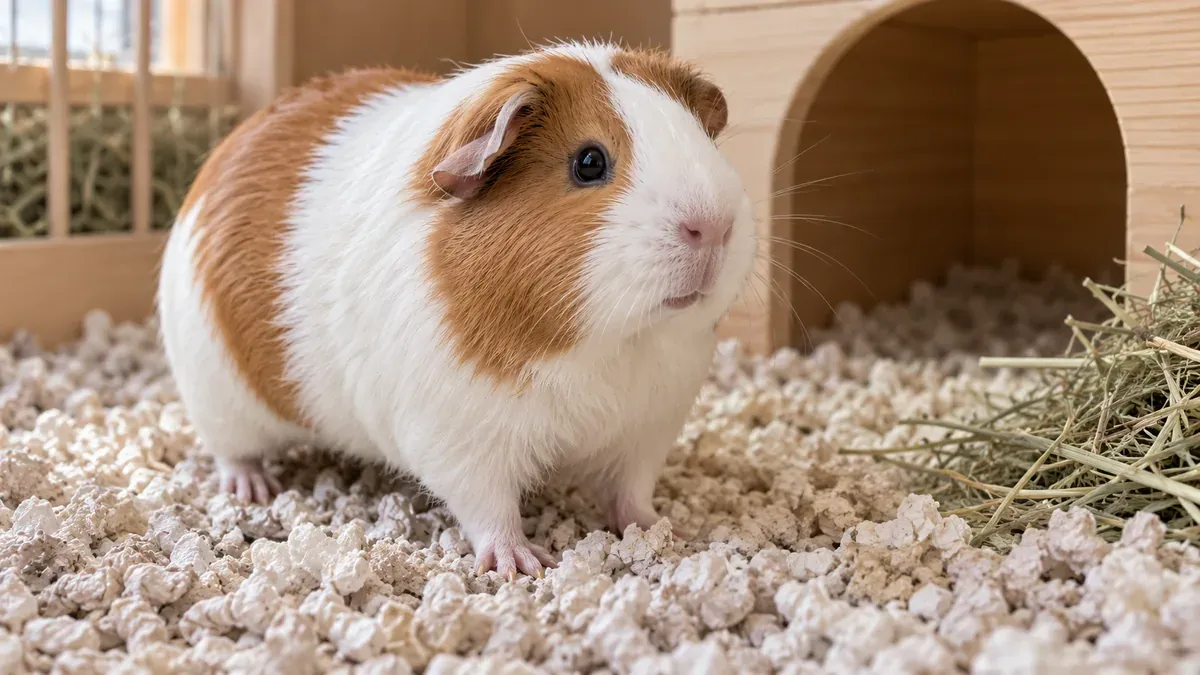
For a guinea pig, choose an absorbent, low-dust substrate for the cage floor, such as paper-based bedding or dust-free wood shavings, and add a good layer of clean hay for it to nest in. Avoid cedar, raw pine, cat litter and cotton-type fibres.
Veterinary sources do not agree on everything, notably on sawdust, pine and straw. This guide compares materials, explains these disagreements and suggests a starting choice, with what to check on the product.
Three layers, three jobs
“Bedding” is often used for everything on the floor. In practice, three things do different jobs:
- The substrate, at the bottom: it absorbs urine and keeps the floor dry. The RSPCA asks for a good depth of litter.
- Nesting material, in hides and resting spots: for snuggling and hiding. The PDSA recommends a deep layer, 10 to 15 cm, of soft, dust-free hay for burrowing and hiding.
- Hay to eat, in a hay rack: it needs to stay clean and dry (Merck). Floor hay, trampled and soiled, is best not relied on as the food supply.
Nesting material may be eaten: the RSPCA asks that it be safe to eat, such as dust-free hay.
Materials compared
| Material | What the sources say | What to check |
|---|---|---|
| Paper-based bedding | Preferred by Merck. Safer than wood shavings if eaten, because it is digestible (Merck). Shredded paper also works as nesting material (PDSA). | Absorbency, low dust, stays dry |
| Dust-free wood shavings | ”The best type” for the RSPCA, if dry, absorbent and dust-free, supplemented with hay. Suitable if clean and dust-free (PDSA). Merck warns that swallowed wood can cause blockages. | Type of wood, “dust-free” label |
| Sawdust | Avoid, respiratory hazard (Merck). Suitable if dust-free (PDSA). | Disputed: see below |
| Kiln-dried pine | Acceptable (Merck). No softwood such as pine (RSPCA). | Disputed: see below |
| Cedar, raw pine | Avoid: their oils can irritate the lungs (Merck). | — |
| Straw | Avoid, risk of eye injuries (RSPCA). Acceptable as bedding (PDSA). | Disputed: see below |
| Hay | Deep nesting layer (PDSA), alongside shavings for tunnelling and hiding (RSPCA). | Clean, dry, dust-free |
| Wood wool | Good for hiding in (RSPCA). | — |
| Cotton wool and “fluffy” bedding | Do not use: guinea pigs can get tangled and it is not safe to eat (RSPCA). | — |
| Cat litter | Do not use: it cannot be digested (Merck). | — |
No material is guaranteed risk-free: product quality and upkeep matter as much as the type of bedding.
What about washable fleece liners? The veterinary sources consulted do not mention them. Without data on how they handle moisture and how they should be maintained, we do not recommend them here.
Sawdust, pine, straw: why the sources disagree
These disagreements concern similar but not identical products, and different uses.
- Sawdust. Merck advises against it because of the respiratory hazard. The PDSA accepts it as a floor lining, provided it is dust-free. Truly dust-free sawdust is therefore the minimum condition; if in doubt, another substrate avoids the problem.
- Pine. Merck distinguishes raw pine, to avoid, from kiln-dried pine, which it accepts. The RSPCA rules out softwoods such as pine without making that distinction. To avoid the debate altogether, choose another wood or paper.
- Straw. The RSPCA counts straw among coarse materials that can injure the eyes. The PDSA lists it among possible bedding. Hay, softer and accepted by both, does the same nesting job.
A starting choice
If you are not sure where to start:
- on the floor: paper-based bedding, absorbent and low-dust, in a good depth;
- in hides and resting spots: a good layer of clean, dust-free hay;
- in the hay rack: hay to eat, unlimited.
This is not the only possible choice, but it is the one the sources disagree on least: Merck prefers paper and the PDSA accepts it for nesting. Dust-free wood shavings can be an alternative, provided you check the wood and its treatment: avoid cedar and raw pine, and account for the disagreement over kiln-dried pine.
Upkeep shapes the choice
Bedding only works if it stays dry: Merck asks for bedding that does not collect moisture. Wet or dirty bedding also harms the feet: VCA lists dirty cages among the causes of pododermatitis, sores on the underside of the feet.
- Every day: remove wet or soiled patches (RSPCA, PDSA).
- At least once a week: a thorough clean of the housing, more often if the space is small or the group large (RSPCA). The PDSA advises only letting the guinea pigs back in once the housing is completely dry.
Check for dust and wet patches every day. If the substrate quickly becomes soaked or seems to irritate your guinea pig, change the product or cleaning routine without waiting; breathing signs or foot sores need veterinary advice.
Particular situations
- It eats its bedding. Merck notes that paper is digestible, whereas swallowed wood can cause a blockage. If your guinea pig nibbles the substrate, paper is the more cautious choice.
- Outdoor housing in winter. The RSPCA asks for enough bedding throughout the enclosure to keep guinea pigs warm, and the PDSA for extra bedding in very cold weather. Below 15°C, the RSPCA advises bringing them indoors.
Next step
Bedding goes into a space of the right size: check the floor area with what size cage or enclosure for two guinea pigs. Feeding hay must remain available at all times: see what do guinea pigs eat. For the species’ overall needs, see the guinea pig species guide.
Sources
- Merck Veterinary Manual — Providing a home for a guinea pig: paper preferred and digestible, kiln-dried pine, cedar and raw pine, sawdust, cat litter, dry bedding.
- RSPCA — Creating a good home for guinea pigs: dry, dust-free shavings with hay, no softwood, no cotton wool, no straw, wood wool, cleaning, winter bedding.
- PDSA — The ideal home for your guinea pigs: dust-free shavings or sawdust, hay, straw or shredded paper as bedding, daily and weekly cleaning.
- PDSA — Guinea pigs as pets: 10 to 15 cm layer of hay, soft flooring.
- VCA Animal Hospitals — Health problems in guinea pigs: dirty cages and pododermatitis.