How Long Do Rabbits Live? Real-World Lifespan
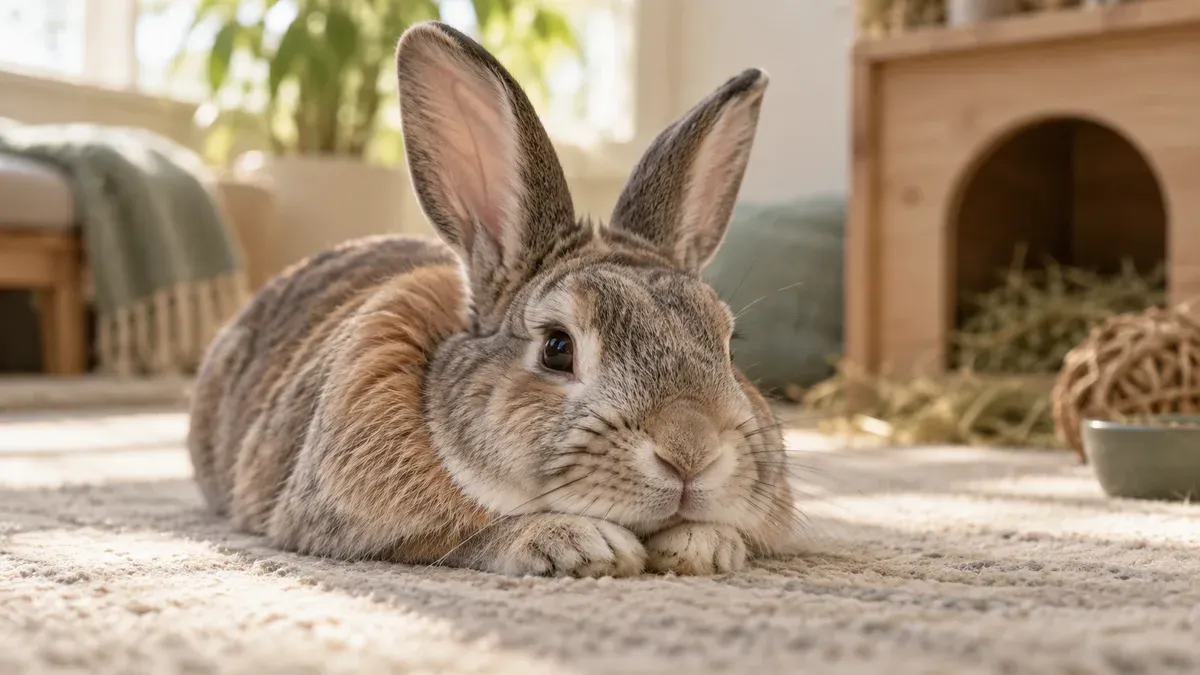
A well-cared-for pet rabbit lives 8 to 12 years, sometimes longer — that is the range the RSPCA gives, assuming a safe environment, a sound diet and decent company.
A Royal Veterinary College study analysed 6,349 records from 107 UK clinics. Among the 370 rabbits that died during the study year, median age at death was 4.3 years. This describes that clinical subgroup at one point in time; it is neither a life expectancy for all pet rabbits nor evidence that most rabbits die before that age.
8 to 12 years as a guide, 4.3 years in a clinical subgroup
| Benchmark | Value | Source |
|---|---|---|
| Typical quoted lifespan | 8 to 12 years, sometimes more | RSPCA |
| Median age at death among 370 deaths observed in 2013 | 4.3 years | RVC VetCompass (6,349 records overall) |
| Longest survival in the study | 14.4 years | RVC VetCompass |
| Average age of rabbits seen in consultation | 3.2 years | RVC VetCompass |
| Switch to senior status | 5 to 8 years | RSPCA |
The two figures measure different things: the first is a general potential-lifespan guide, while the second is median age at death in a primary-care sample. The paper itself cautions that this value may not represent the wider UK rabbit population.
Females and males: what the study cannot establish
Among the deaths studied, median age was 5.2 years for males and 3.7 years for females. This association is noteworthy, but it does not establish a cause.
Uterine disease, including adenocarcinoma, is independently an important medical reason to discuss spaying with a veterinarian. Reported prevalence varies considerably with age, population and study design, so a single percentage should not be presented as every doe’s individual risk.
Most importantly, neuter status was missing from 80.3% of the records. The study therefore cannot show that neutering explains or closes the observed sex difference. The decision should instead be discussed with a veterinarian on its own benefits and risks, covered in should you spay a female rabbit.
The four most common causes of death
From the same dataset, here is what vets most often record as cause of death:
| Cause | Share of deaths with a recorded cause | Prevention or early-detection lever |
|---|---|---|
| Flystrike | 10.9% | A clean rear end, checked twice daily in summer |
| Anorexia (stopping eating) | 4.9% | Caught in hours, not days |
| Collapse | 4.9% | Usually the endpoint of something missed earlier |
| Gut stasis | 4.3% | Hay-first diet, and fast reaction to any stoppage |
Among the 267 deaths with a recorded cause, flystrike led the list. It is an absolute emergency, not a hygiene inconvenience: flies lay on a soiled or damp rear end and larvae can establish quickly. What to do, and why a dirty rear end is a symptom before it is a cleanliness problem, is covered in can you bathe a rabbit.
The other three share a starting point: a rabbit that eats less. It is the single highest-yield signal to watch, which is why it pays to recognise the signs of a life-threatening emergency.
The same data shows what wears rabbits down day to day
The study also records the most frequent reasons for consultation: overgrown nails (16%), overgrown molars (7.6%), dirty rear ends (4.5%), overgrown incisors (4.3%) and gut stasis (4.2%).
That list is revealing, because none of these are rare diseases. They are consequences of husbandry and diet:
- Overgrown nails come down to a task due every four to six weeks (how to trim a rabbit’s nails).
- Overgrown teeth almost always trace back to insufficient hay chewing (dental disease and malocclusion in rabbits).
- A dirty rear end is a signal, not an inevitability of housekeeping.
What actually extends a rabbit’s life, ranked by payoff
Not every piece of good practice carries the same weight. In order:
- Unlimited hay. It governs both digestion and tooth wear — that is, two of the most frequent presenting problems. The reference quantity is in how much hay a rabbit needs per day.
- Neutering, particularly for females, for the reason above.
- Daily appetite and droppings checks. Free to do, and the earliest detector you have.
- Vaccination against myxomatosis and RHD, two often-fatal diseases with no reliable cure (should you vaccinate your rabbit).
- Rear-end checks twice daily in warm weather.
- A safe environment: non-slip flooring, room to move, protection from heat.
What is missing from that list matters less than people assume: pellet brand, toy type and pen sophistication all rank well below those six points.
Does breed change life expectancy?
Partly, and less than lifestyle does. Large breeds statistically live shorter lives than small ones, and certain body shapes carry their own predispositions — flattened faces, lop ears, long coats. What breed genuinely predicts, and what it does not, is set out in the main domestic rabbit breeds and in the comparison small or large rabbit.
Keep the orders of magnitude straight: the spread between breeds runs to one or two years, while the spread between a well-monitored rabbit and a poorly monitored one exceeds five.
What this commitment means before you adopt
A rabbit is not a transitional pet. Over 8 to 12 years you are committing to:
- a recurring vet budget, including as the animal ages and consults more often;
- a boarding solution for every trip away, for a decade;
- housing stability, since floor space is a permanent constraint;
- end-of-life care, with costs that rise in the final years.
If that frame works for you, the age at which you adopt then shapes the first few months: that is the subject of the best age to adopt a rabbit.
When to see a vet
Regardless of age, contact a veterinarian as soon as appetite or droppings decrease abnormally, and seek emergency care if the rabbit stops eating completely, stops producing droppings, is hunched and unresponsive, breathes through an open mouth, or has maggots or wounds around its rear end. Do not wait for an hourly threshold.
In a rabbit over 5, add to that list any progressive weight loss, any difficulty moving and any lasting change in behaviour. The full set of old-age warning signs is gathered in senior rabbit health.
Veterinary sources
- Rabbits — advice and welfare, RSPCA — typical lifespan of 8 to 12 years, senior status between 5 and 8 years.
- Morbidity and mortality of domestic rabbits under primary veterinary care in England, Veterinary Record / VetCompass — 6,349 records; median age at death calculated from the 370 observed deaths and limitations from missing data.
- Management of Rabbits, Merck Veterinary Manual — prevalence of uterine adenocarcinoma and the case for spaying does.
Where to go next
What comes next depends on where you are. If you have not adopted yet, the real work is financial: a decade of care needs planning, and how much a rabbit costs per month gives you the monthly baseline. If your rabbit is already with you and approaching five, switch into monitoring mode with senior rabbit health. And if you are still weighing up adoption itself, our rabbit adoption section and the rabbit species profile bring the rest together.
Frequently asked questions
My rabbit is 6 — is that old?
It is entering the senior bracket, but it is not near the end of its life. The RSPCA places the switch to senior status between 5 and 8 years. In practice that means moving to two vet check-ups a year instead of one, watching weight more closely, and adjusting access to food, water and litter if agility drops. A well-monitored 6-year-old rabbit often has several years ahead of it.
What is the longest a rabbit has lived?
The documented record holder, an Australian rabbit called Flopsy born in 1964, lived to almost 19. In UK veterinary records the longest survival registered is 14.4 years. Treat these as outliers rather than targets: what they show is that the species' biological ceiling sits far above what most pet rabbits actually reach.
Do outdoor rabbits live shorter lives than indoor ones?
Housing matters through the risks it creates and the quality of observation. Outdoors brings more temperature variation and predator exposure. In the cited VetCompass study, flystrike was the most frequently recorded individual cause among the 267 deaths with a recorded cause; that result does not by itself compare indoor and outdoor housing.
Can you estimate the age of a rescue rabbit with no history?
Only roughly, and a vet does it best. Tooth wear, claw condition, joint suppleness and coat quality give a bracket, not a birthday. For a rescue rabbit with no paperwork, ask for the estimate made on intake — it gives your health monitoring a baseline to work from.