How to choose rabbit pellets: reading the label
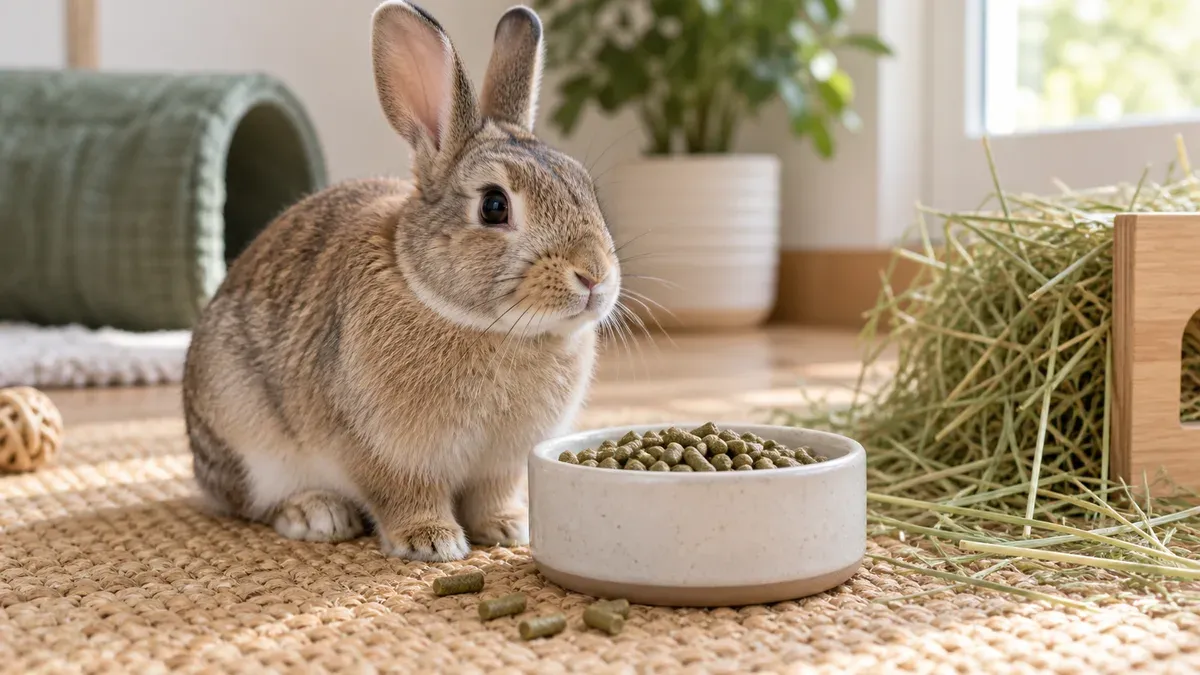
A good rabbit pellet comes down to one sentence: identical nuggets throughout, at least 18% crude fibre, and hay as the first ingredient. Everything else — the brand, the aisle, the colour of the bag — matters far less than those three points, all checkable by turning the pack over.
This page is about choosing the product. How much to serve each day depends on age and weight, and lives in how many pellets to feed a rabbit: they are two separate decisions, and a good composition never excuses skipping the portioning.
The label in 60 seconds: the five lines that decide it
The mandatory analysis sits on the back of the pack, usually in small type under “analytical constituents”. Five values are enough to settle it.
| Line | What to look for | Why |
|---|---|---|
| Crude fibre | ≥ 18%, ideally 20–22% | It drives the gut and tooth wear |
| Crude protein | 12–16%, nearer 12–14% in adults | Above that the extra is useless and loads the kidneys |
| Fat | < 3% | Higher, and the product fattens and puts the rabbit off hay |
| Starch | < 14% | Excess feeds caecal fermentation |
| First ingredient | Timothy or meadow hay | The order of the list reflects the proportions |
Calcium, when declared, sits around 0.5–0.6% for an adult. A junior formula contains more, which is normal during growth and unsuitable afterwards.
The four signals that put the bag back on the shelf: a multicoloured mix with seeds and puffed cereals, molasses, sugar or honey in the top five ingredients, wheat, maize or soy at the head of the list, and crude fibre below 15%. The precise mechanism by which a mix unbalances the ration is set out in why seed mixes are bad for rabbits.
Uniform nuggets or extruded: the form matters too
Three forms sit side by side on the shelf, and they are not worth the same.
- Compressed uniform pellets: identical green cylinders. This is the reference. The rabbit cannot pick through them, and every mouthful has the same composition.
- Extruded nuggets (lighter, often moulded into shapes): nutritionally acceptable if the analysis holds up, but their aerated texture gives less chewing, and some ranges drift into decoration.
- “Muesli” mixes: to be ruled out, whatever the average composition claimed. The rabbit selects, and never eats the product as it was analysed on the label.
Nugget size has no nutritional importance. It does matter for an older rabbit or after dental treatment: smaller or slightly moistened pellets are sometimes better accepted, which the vet will confirm depending on the state of the mouth — see rabbit dental malocclusion.
Junior, adult, senior: which formulas make sense
- Junior / growth: richer in protein and calcium, alfalfa-based. Useful until around 6 months, then replaced — the markers for that period are in what to feed a 2-month-old baby rabbit and alfalfa’s exact place in is alfalfa good for rabbits.
- Adult: the reference formula, grass-hay based. This is the one that should cover most of the rabbit’s life.
- Senior: rarely essential. An older rabbit losing weight despite a good appetite needs a veterinary work-up, not a different bag — see senior rabbit health.
- “Light” formulas: these ranges mostly exist to reassure. In a rabbit putting on weight, it is the amount served and the share of hay that correct the curve, as my rabbit is getting fat explains.
Bag size: the criterion everyone forgets
Pellets lose part of their vitamin content after opening. The practical rule is to finish a bag within 6 to 8 weeks of opening it.
Do the arithmetic before buying in bulk. An adult rabbit eats in the order of 25–50 g of pellets a day depending on weight, so roughly 0.75–1.5 kg a month. A 5 kg bag therefore covers three to six months: the last of it is eaten well past the freshness window, and the saving per kilo is cancelled by the loss of quality.
In practice: a 1–2 kg bag suits a dwarf rabbit, 2–3 kg a large rabbit or a pair. Once opened, decant into an airtight container away from light and damp — a folded-over bag keeps out neither.
Price per kilo, and what you are actually paying for
On the UK market, a decent pellet costs between £6 and £15 per kilo, as how much a rabbit costs per month sets out. At roughly a kilo a month, the gap between an entry-level product and a premium one comes to a few pounds a month — far less than one consultation for a digestive problem.
That is the order of magnitude worth keeping in mind: pellets make up only about 5% of the ration, and saving on that share at the cost of a poor composition is the wrong trade. Where buying in bulk genuinely pays is hay, which makes up the bulk of the volume — see Timothy or meadow hay, which to choose.
Packaging claims that mean nothing
- “Premium”, “natural”, “GM-free”: none of these commits the maker to any fibre content.
- “Dwarf rabbit formula”: the formula is the same, only the amount served changes.
- “Vitamin enriched”: a sound pellet already covers the requirement, and added vitamins degrade after opening like all the others.
- “With fruit and vegetables”: the colourful pieces are sugar. Real portions of greens are served fresh, following what greens to give a rabbit every day.
- Photos of rabbits on the pack: they say nothing about the product. Only the “analytical constituents” line commits the manufacturer.
Switching brands without triggering a gut problem
An abrupt pellet change can cause soft caecotrophs, diarrhoea or a slowdown of the gut. The transition is run over 3 to 4 weeks, in stages, following the method in how to transition a rabbit’s diet.
If your rabbit refuses the new product, three levers before giving up: slow the progression by one stage, serve the ration in the evening rather than the morning, and check that hay is genuinely available at all times. Refusing pellets while still eating hay and greens is not worrying in the short term; a general refusal to eat is the opposite, and calls for a prompt phone call, as my rabbit is not eating describes.
Going further
The next step takes a minute: turn over the bag currently open in your house and read the crude fibre line. If it is below 18%, or if the first ingredient is a cereal, plan a gradual switch now rather than at the end of the bag. For the amount to serve afterwards, everything is in how many pellets to feed a rabbit, and for the overall balance of the ration in what do rabbits eat. Our other equipment guides are gathered in the rabbit accessories section and on the rabbit species profile.
Frequently asked questions
Are supermarket pellets all bad?
No, but the share of colourful mixes and low-fibre products is higher there. The aisle matters less than the label: a uniform nugget at 20% crude fibre, with no cereal at the top of the ingredient list, is a good pellet wherever it is sold. The useful habit is turning the bag over before looking at the brand.
Should I buy pellets labelled for dwarf rabbits?
That is not a nutritional criterion. A 1.5 kg rabbit and a 3 kg rabbit have the same qualitative needs: what changes is the amount served, not the formula. Dwarf ranges differ mainly in nugget size and in price per kilo, which is often higher on small packs.
Are more expensive pellets automatically better?
Not mechanically, but a very low price per kilo is almost always achieved by replacing fibre with cereals. The label settles it better than the price: below 18% crude fibre, or with wheat or maize as the first ingredient, the product is unsuitable whatever its positioning.
Can an adult rabbit eat pellets made for another species?
No. Guinea pig pellets contain added vitamin C that rabbits do not need (guinea pigs, unlike rabbits, cannot make it: see their vitamin C needs), and formulas for seed-eating rodents are far too rich in cereals and fat. Each species has its own fibre, protein and calcium requirements: one day as a stopgap is not a disaster, a habit is.