My rabbit is eating its litter: should I worry?
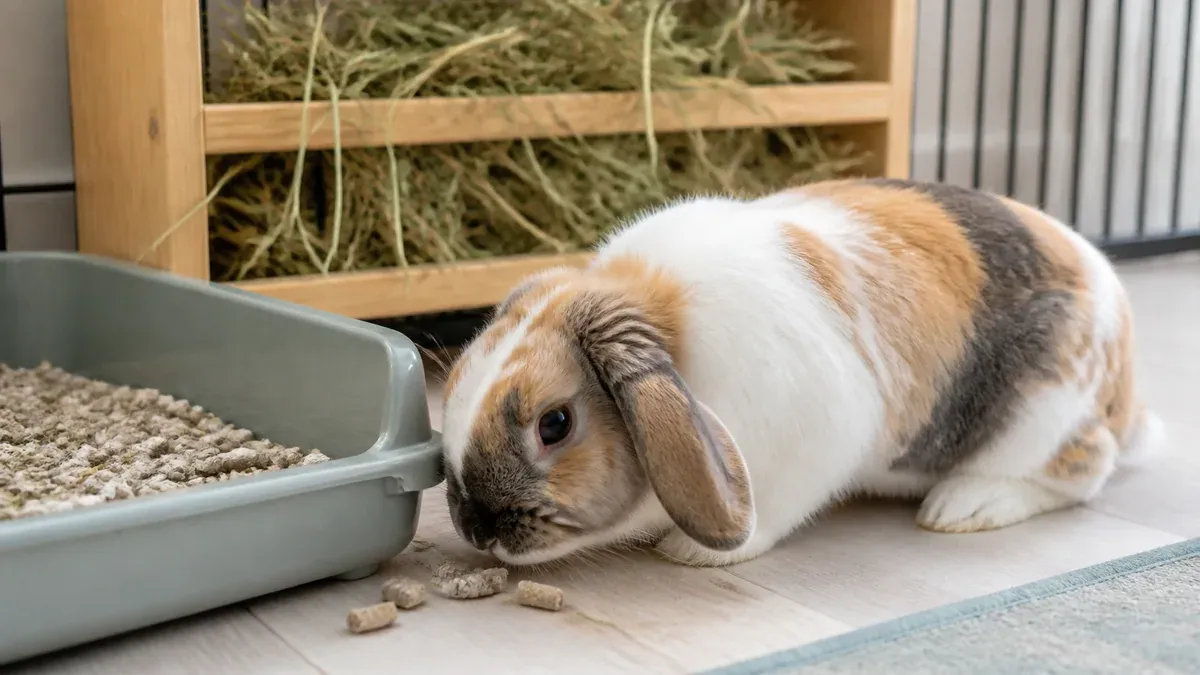
Veterinary warning — This article helps you sort the possible causes and fix the set-up. A rabbit eating bedding instead of hay, losing weight, passing fewer droppings or with a tight abdomen needs to be seen by a rabbit-savvy vet: dental pain and gut risk are not solved by changing the tray.
A rabbit that swallows a few strands of plant-based bedding while digging in its tray is doing something ordinary — provided it eats its hay normally and its droppings are unchanged. Two situations fall outside that: a rabbit that eats bedding instead of hay, and bedding that was never meant to be eaten — clumping mineral litter, silica crystals, scented products. Both need fixing the same day.
The two useful reflexes are always the same: identify what is actually in the tray, and check that hay is genuinely unlimited, not merely present. Everything else follows from that.
First sort: nibbling, or replacing the hay?
Nibbling means a few strands swallowed while digging, with hay eaten normally and droppings unchanged. Replacement means the tray empties while the hay sits untouched. One benchmark separates them: the RSPCA puts the daily hay bundle at at least the rabbit’s own body size. Below that, look at the hay offer before anything else.
| What you see | What it is | What to do |
|---|---|---|
| A few strands swallowed while digging, hay eaten normally, droppings unchanged | Ordinary exploration | Check the material, keep watching |
| The tray is visibly emptying, the hay sits untouched | Bedding is replacing hay | Deal with the hay first |
| Young rabbit tasting its environment | Exploration phase | Safe material plus unlimited hay |
| Ingestion during a moult, with heavy grooming | Fur and bedding swallowed together | Brush, watch the droppings |
| Sudden onset in an adult, hay sorted and left, weight loss | Dental pain or discomfort | Book an appointment |
| Mineral, clumping or crystal litter swallowed | Material unsuited to rabbits | Change now, vet advice if a lot was eaten |
| Smaller or fewer droppings, tight abdomen, appetite dropping | Gut signal | Call without waiting |
The point to hold on to: the worrying part is not the behaviour, it is what it replaces and which material is involved.
Is it the litter, or its caecotrophs?
Caecotrophs are the soft clusters a rabbit takes directly from under its tail; litter is the material you poured into the tray. Tell them apart by look: caecotrophs are glossy and grape-like, bedding is dry and uniform. Never interrupt normal caecotroph eating. Clusters still sitting there two mornings running deserve a vet appointment.
This mix-up is common because the timing invites it: caecotrophs are produced mainly at the quiet end of the night, which is exactly when an owner walks in and sees the rabbit busy with something in its tray. Telling them apart takes one look. Caecotrophs come as a grape-like cluster, darker and glossier than normal droppings, with a strong smell; bedding is dry, uniform and looks like what you poured in.
The distinction matters because the two call for opposite reactions. Caecotrophy supplies microbial protein and B vitamins, so interrupting it — clearing the tray at dawn, pulling the rabbit away, telling it off — takes away part of its nutrition rather than fixing anything.
What is worth acting on is the opposite situation: clusters repeatedly left behind, flattened in the bedding. That is not a litter problem and, without the urgent signs below, not an emergency either. It usually means the rabbit is not motivated to eat them because the ration is too rich — pellets or treats crowding out hay, a balance covered in how much pellets to feed a rabbit — or that it physically cannot reach, which points at excess weight (my rabbit is getting fat), stiff hips or a painful mouth. Book an appointment rather than waiting it out, and read soft droppings in rabbits first.
One thing not to confuse with either: watery droppings that stain the fur and the tray are diarrhoea, not caecotrophs, and that is urgent — see my rabbit has diarrhea.
The material decides the risk
Bedding types are not interchangeable when it comes to ingestion. The full material-by-material comparison is in the best bedding for rabbits; here is the reading that matters for a rabbit emptying its tray.
| Material | When it gets eaten |
|---|---|
| Hay or dust-free straw | RSPCA-listed bedding that is safe to eat; hay still remains the main food |
| Shredded paper or newspaper | RSPCA-listed options for a toilet area |
| Paper-based litter | Choose a non-clumping, non-expanding product |
| Dust-free, non-cedar wood shavings | RSPCA-listed as absorbent material beneath hay |
| Hemp or flax | Plant fibre, not toxic: a few strands are unremarkable if hay is eaten normally |
| Compressed wood pellets | They soften with moisture and look like food nuggets: avoid with a rabbit that empties its tray |
| Corn cob | Rule it out for a rabbit that eats its bedding |
| Clumping or expanding litter | Remove it: it falls outside the RSPCA’s selection criteria |
| Silica crystals, scented products or an unidentified material | Remove it and ask a rabbit-savvy vet about any ingestion |
The rows marked RSPCA-listed come from the RSPCA’s rabbit housing guidance; the others are our own reading for a rabbit that empties its tray. If the tray contains a clumping, expanding or unidentified product, replace it now with one of the listed options. Keep a little clean old bedding at the bottom so the familiar smell still marks the toilet area.
One mistake comes up again and again, and it is visible at a glance: pellet-shaped litter in the tray of a rabbit that is fed pellets. Compressed wood and paper pellets have the size, shape and rattle of food nuggets, and a rabbit that has learned nuggets are food has no particular reason to tell them apart. If your rabbit gets nuggets, pick a bedding that looks nothing like them — loose hemp, flax or shredded paper — rather than another pellet.
If the usual litter is unavailable
Price and availability are real constraints. For a temporary replacement, use an option in the RSPCA list: shredded paper, newspaper, hay, dust-free straw or a paper-based product labelled non-clumping and non-expanding. Do not improvise with fabric or an unidentified cat litter when the rabbit is already chewing what is in the tray.
The same goes for the hay side, where cost is usually what stops “unlimited” from happening. A bale bought from a farm or a feed merchant is what makes daily unlimited hay realistic, and losing less of it to the tray helps: a rack hung just above the bedding keeps hay within reach while it stays clean, a trade-off weighed up in does a rabbit need a hay rack. A tray too small to dig in also pushes a rabbit to scatter and chew its bedding — sizing is covered in choosing a litter tray for a rabbit.
Why it eats bedding: the real causes, in order
1. Hay is short, or unappealing. By far the most common cause. A rabbit needs long fibre to chew; if the rack is repeatedly empty, or the hay is dusty, compacted or stale, it falls back on the nearest fibrous material — its bedding. The benchmark is hay available at all times, roughly a volume equal to the size of the rabbit each day, as set out in how much hay a rabbit needs. If hay is there but ignored, that specific problem is covered in why has my rabbit stopped eating hay.
2. The hay is too far from the tray. Rabbits eat while they toilet: that is physiology, not bad manners. Hay at the far end of the pen leaves bedding as the only material within reach during the long minutes spent in the tray. Put hay at the edge of the tray, or in a rack hung just above it.
3. Boredom and nowhere to forage. A rabbit with nothing to sort, chew or dig will work on whatever is under its feet. The activities that genuinely absorb that need are covered in how to keep a bored rabbit busy.
4. Youth. Young rabbits readily explore with their mouths. This may fade on its own, provided the material is safe and hay is being eaten properly.
5. Moulting. During a heavy moult a rabbit grooms a great deal and swallows fur; bedding swallowed alongside adds to that load. Telling a normal moult from an abnormal one is covered in rabbit moulting: normal or not.
6. Dental pain. This is the one not to miss. Chewing long hay takes a wide sideways grinding movement; short, fine material does not. A rabbit that skips hay but eats bedding, crushed pellets or soft food may be doing so because chewing hurts — see rabbit dental malocclusion.
What to do, in order
- First — Identify what is in the tray. Replace any clumping, expanding or unidentified material immediately.
- Next — Refill hay to unlimited and put it at the edge of the tray. Offer another suitable hay alongside it if the usual one is ignored.
- Then — Check whether droppings remain normal in number and size. Smaller or fewer droppings are a warning, not a detail.
- Secondarily — Add somewhere else to dig and chew: a digging box, cardboard, an untreated branch or hay hidden in kraft paper.
- Reassess — If hay is eaten and the bedding stops disappearing, keep the corrected set-up. If the tray keeps emptying while hay is ignored, book an appointment: dental pain moves up the list.
Do not change everything at once if you want to understand what happened: bedding material and hay access first, enrichment second.
When to call the vet without waiting
- No droppings or clearly fewer, a tight abdomen, a hunched posture: these point to the gut slowing down, described in rabbit GI stasis.
- A large intake of mineral, clumping or crystal litter, even in a rabbit that seems well.
- Hay refusal with weight loss, systematic sorting, or a wet chin.
- Sudden onset of the behaviour in an adult rabbit that was previously normal.
- Watery droppings staining the fur or the tray, which are diarrhoea rather than caecotrophs.
Keep this list apart from what merely needs watching: a few strands swallowed, a young rabbit exploring, or caecotrophs left in the tray are all reasons to look more closely, not by themselves reasons for an emergency call.
Going further
Logical next step: start a simple daily record by weighing or photographing how much hay actually disappears, and look in the tray at the same time each morning. Together those two checks separate the three possible answers — not enough hay on offer, chewing that hurts, or a behaviour that was never about litter in the first place. To go further, browse our rabbit housing guides and the rabbit species page.
Veterinary sources and caution notes
The sources below serve as veterinary or institutional reference points to frame the medical side of the topic cautiously: this article helps you sort causes and fix the set-up, but it does not replace an examination by a rabbit-savvy vet. No treatment or dosage is suggested here.
Sources used to frame the recommendations:
- RSPCA — Rabbit health and welfare
- RSPCA — Creating the ideal home for your rabbits
- RSPCA — What should I feed my rabbits?
- Merck Veterinary Manual — Digestive disorders of rabbits
- VCA Hospitals — Gastrointestinal stasis in rabbits
- VCA Hospitals — Dental disease in rabbits
Frequently asked questions
My rabbit eats his hemp bedding — should I switch products?
Not necessarily. Hemp is not toxic, and a few strands swallowed while digging are unremarkable in a rabbit who otherwise eats his hay normally. The signal to watch here is not the material but the volume: if the tray is visibly emptying while the hay sits untouched, the problem is on the hay side, not the hemp.
Can a rabbit get an intestinal blockage from bedding?
The risk depends mostly on the material. Clumping mineral litters and silica crystals are not designed to be swallowed and have no place with a rabbit. With plant-based bedding, a little ingested fibre is better tolerated, but any large intake followed by fewer droppings, a tight abdomen or a drop in appetite warrants a call to a rabbit-savvy vet.
My baby rabbit eats his bedding — will he grow out of it?
Usually yes. A young rabbit may taste everything it finds, bedding included, and the interest fades once the environment has been explored. Two conditions make it safe to let it run its course: a safe material in the tray and unlimited hay, of which a visible amount should disappear every day.
Should I tell my rabbit off for eating its litter?
No — it achieves nothing and adds stress. A rabbit does not connect a telling-off to something it did moments ago, and eating bedding is not naughtiness: it is either exploration or a shortage of long fibre to chew. You correct the offer — unlimited hay, safe material, things to forage — not the rabbit.
Does eating litter mean my rabbit is short of minerals?
Rarely, and it is not a reason to start a supplement. In a rabbit fed hay, greens and a measured amount of pellets, a mineral shortfall is not the usual explanation: a shortage of long fibre, a tray that is the only thing within reach, or chewing that hurts all come first. If you genuinely suspect an unbalanced ration, have it reviewed by a rabbit-savvy vet rather than adding anything to it yourself.