Intestinal worms and parasites in rabbits: pinworms and coccidiosis
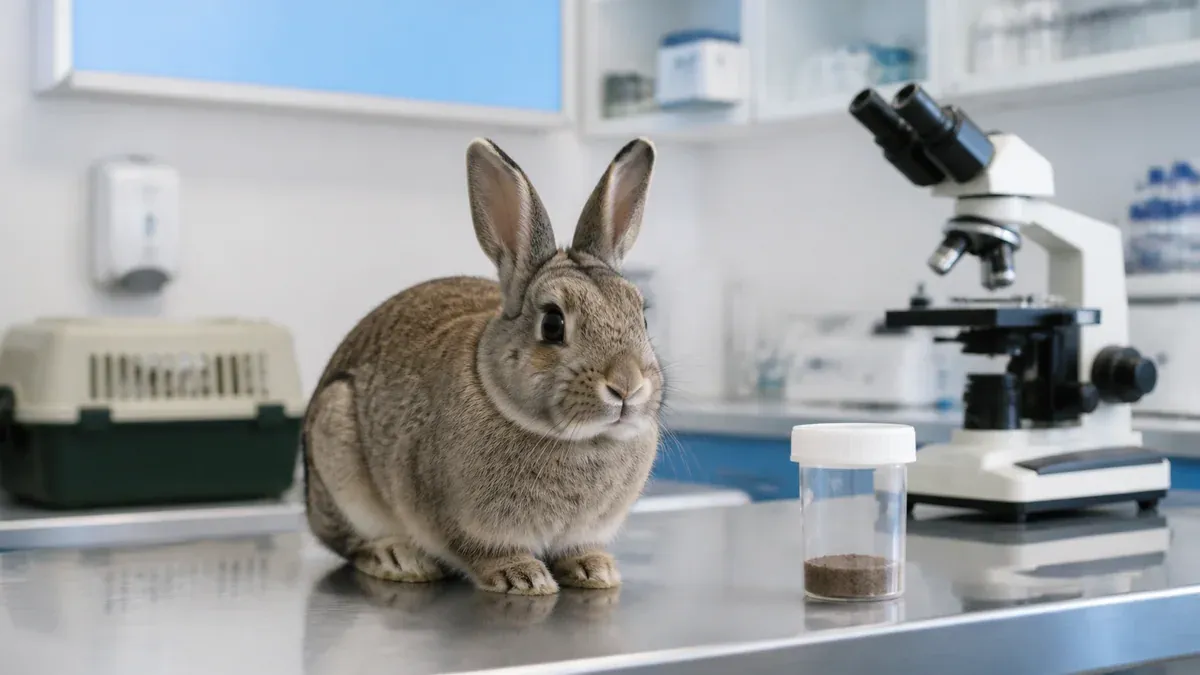
Veterinary warning — Never deworm a rabbit on your own initiative. The choice of molecule, the dose and the duration depend on the parasite involved and the animal’s weight, and belong to a rabbit-savvy vet. A faecal exam is often needed to treat correctly.
Intestinal parasites in rabbits come down to two very different realities: pinworms, common white worms that are usually harmless, and coccidiosis, a far more serious protozoan infection, especially in young rabbits. So seeing tiny worms in the droppings is not necessarily an emergency, but diarrhoea, weight loss or a kit that grows poorly warrant an exam. The golden rule: you don’t deworm a rabbit “at random” like a dog — you treat what is identified, on veterinary advice.
The main intestinal parasites in rabbits
Pinworms (Passalurus ambiguus)
These are the worms most often seen. Thin, white, a few millimetres long, they are sometimes visible in the droppings or around the anus. In a healthy adult rabbit they are generally well tolerated and only mildly pathogenic: many rabbits carry them with no symptoms at all. They are still a reason to see a vet, since only an exam confirms that they really are pinworms and nothing else.
Coccidiosis (Eimeria)
This is the most concerning intestinal parasite in rabbits. These are microscopic protozoa (genus Eimeria) that multiply in the intestine — or, in a specific form, in the liver (hepatic coccidiosis). Coccidiosis mainly strikes:
- young rabbits (weaning, growth), whose immunity is still fragile;
- animals living in a poorly kept environment or in overcrowding.
It can cause diarrhoea, dehydration, weight loss and slowed growth, and can become serious, even fatal, in a kit. It is a treatable disease, but one that requires veterinary diagnosis and follow-up.
Tapeworms (rarer)
Adult tapeworms are rare in pet rabbits. Rabbits can, however, act as intermediate hosts for canine tapeworms after ingesting eggs in food or bedding contaminated by dog faeces. Keep dogs away from the rabbit’s hay, food and bedding.
Don’t confuse it with E. cuniculi
Beware a common trap: E. cuniculi is not an intestinal worm. Encephalitozoon cuniculi is a microscopic parasite that mainly affects the kidneys and nervous system (head tilt, balance problems), not the gut. It has nothing to do with pinworms or coccidiosis and is managed differently: see E. cuniculi in rabbits to avoid mixing the two up.
The signs to watch
| Sign | What it may point to |
|---|---|
| Thin white worms in droppings or near the anus | Pinworms — often harmless, to be confirmed |
| Persistent diarrhoea or soft stools | Coccidiosis or digestive imbalance |
| Weight loss despite appetite, slowed growth | Heavy infestation, especially in the young |
| Dull coat, soiled rump | Poor general condition linked to infection |
| Dullness, dehydration in a kit | Warning sign — see a vet promptly |
Many of these signs are not specific to parasites. Diarrhoea or soft stools may just as easily reflect a dietary imbalance: our guide soft droppings in rabbits helps you tell them apart, and frank diarrhoea belongs to my rabbit has diarrhoea: what to do. Likewise, weight loss has many causes: parasites are only one of them.
Diagnosis: the faecal exam
Contrary to belief, you can’t “see” most parasites with the naked eye. A rabbit-savvy vet makes the diagnosis with a faecal exam (analysing the droppings) that looks for eggs and oocysts. This exam:
- confirms the species involved (pinworms, coccidia, other);
- distinguishes ordinary harmless carriage from an infection that needs treating;
- guides the choice of treatment.
Bringing a fresh faecal sample to the appointment often saves time.
Treatment: never at random
The big difference from dogs and cats: you don’t deworm a rabbit on a fixed schedule. You treat based on a positive exam or clear signs.
- Against worms (pinworms, tapeworms), the vet may prescribe a suitable dewormer — but the molecule, the dose and the duration are the vet’s call.
- Against coccidiosis, they use a specific anticoccidial (for example toltrazuril), always on prescription, sometimes with supportive care (rehydration) if the rabbit is affected.
- A “small-pet” dewormer bought without advice may be unsuitable or wrongly dosed: don’t use it on your own.
No numeric dosage should be improvised at home: the vet sets it according to the animal’s weight and condition.
Prevention: hygiene first
Most intestinal parasites spread by ingesting eggs or oocysts present in droppings and a soiled environment. Prevention therefore rests on hygiene:
- clean the litter tray and enclosure regularly, removing soiled droppings — see how to clean a rabbit litter box;
- stop the rabbit feeding in an area soiled by its own droppings;
- wash greens gathered outdoors thoroughly, as they can be contaminated;
- quarantine any new rabbit and have it examined before cohabitation;
- keep dogs away from hay and bedding to limit exposure to canine tapeworm eggs.
Strict hygiene matters especially for young rabbits, the most vulnerable to coccidiosis.
When to see a vet
Book an appointment if you see worms in the droppings (for confirmation), or sooner in case of diarrhoea, weight loss, a dull coat or slowed growth, especially in a kit. Profuse diarrhoea, or a dull or dehydrated rabbit, is an emergency: don’t delay. To gauge urgency, lean on when to see an exotic vet for your rabbit and how to tell if a rabbit is in pain.
Going further
Browse all our rabbit health guides and the rabbit species page to protect its digestion day to day.
Veterinary sources and caution notes
The sources below are provided as veterinary or institutional reference points to frame the topic cautiously: this article can help you recognise possible signs, but it does not replace an examination by a rabbit-savvy vet. Faced with diarrhoea, weight loss or an affected kit, seek advice without delay.
Sources used to frame the recommendations:
- Merck Veterinary Manual — Parasitic diseases of rabbits
- RSPCA — Rabbit health and welfare
- VCA Hospitals — Infectious diseases in rabbits
Frequently asked questions
I saw tiny white worms in my rabbit's droppings — is that serious?
These are most often pinworms (Passalurus ambiguus), thin white worms a few millimetres long, very common and generally not very harmful in a healthy adult. They still warrant a vet's opinion, because only a faecal exam confirms the species and rules out a more serious infestation, especially in a kit.
Should I deworm a rabbit routinely like a dog?
No. You don't deworm a rabbit 'blind' on a fixed schedule the way you do a dog. Treatment is decided from signs or a positive faecal exam, and both the molecule and the dose belong to the vet. An unsuitable or wrongly dosed dewormer can do more harm than good.
Is rabbit coccidiosis contagious to other rabbits?
Yes. Coccidiosis spreads by ingesting oocysts present in droppings and a soiled environment. It mainly affects young rabbits and poorly kept housing. Good litter hygiene, regular cleaning and quarantining a new rabbit greatly reduce the risk.
Can a rabbit lose weight because of intestinal parasites?
Yes, especially with coccidiosis or a heavy infestation in a young rabbit: diarrhoea, a poor coat, slowed growth and weight loss despite appetite. But weight loss has many other causes (teeth, digestion): it needs a veterinary exam, not a dewormer given at random.